The Mystery Of The Shi’a

This text provides a concise exploration of key aspects of Shi'a Islam, covering the roots (Usul Al-Deen) like Tawhid and Imamah, and branches (Furu Al-Deen) including Salat and Zakat.
It delves into practical aspects such as cleanliness, Wudhu, and Salat rituals, while also discussing significant topics like Jihad and Muslim rights.
The book concludes with insights into the importance of the Qur'an, Ahadith, and the views of Shi'a scholars, emphasizing the significance of the Ahl Al-Bayt (‘A).
Acknowledgements & Dedication
بِسْمِ اللَّهِ الرَّحْمَٰنِ الرَّحِيمِ
In the Name of God, Most Beneficent, Most Merciful
Imam As-as-Sadiq (‘a) said:
“Write and spread your knowledge among your brothers. If the end of your life approaches, leave your books as an inheritance for your sons, since there will come a time of sedition during which the people will only find comfort with their books.”1
***
I would like to thank the following people- Sheikh Mustafa Akhound, Ibrahim Jabbar Karbalai, Hajj Mahdi Gharavi and Sayed Jawad Haider Syedain for all of their help, support, and encouragement. Thank you for motivating me to be productive and encouraging me to always continue moving forward in the path of Allah, no matter how difficult things get.
***
I dedicate the reward of this book to
Amir Al-Mu’minin Imam ‘‘Ali Ibn Abi Talib (peace be upon him)
- 1. Mishkat ul-Anwar by Al-Tabarsi, Hadith n. 736.
About The Author
Joshua Charbonneau is an American Muslim. He was born in 1982 in Sumter, South Carolina. He is of French Canadian and American descent. He was born into a Christian family, and later chose to revert to Shi’a Islam at the age of 17, having studied both faiths. After reverting to Islam, he chose the name Mateen which in Arabic means strong, firm and unshakable. His first language is English and he also learned Qur’anic Arabic. At age 26 he moved to Washington, DC area and has been an active part of the Muslim community. He took part in a documentary by Al-Anwar Husayn TV entitled Journey of the Spirit where he narrated his incredible story on how he became a Shi’a Muslim.
In 2012 and 2015 he had the opportunity to travel with the members of Al-Anwar Husayn TV to visit the Holy shrines of Imam ‘Ali (‘a) and Imam Husayn (‘a) in Iraq for Ziyarat Arbaeen. Since March of 2013 he has been studying Howza (Islamic Seminary) classes under the guidance of Sheikh Mustafa Akhound at the Imam ‘Ali Center of Springfield, VA. Mateen has also compiled and published some very in-depth books entitled The Suffering of the Ahl Al-Bayt and their Followers (Shi’a) throughout History, Christians who defended and died for Prophet Muhammad and his Family, Mystery of the Shi’a and a Study Guide to Logic.
These titles are available at Yasin Publications and Amazon. In 2014 he co-founded a publication company entitled Yasin Publications and also a program to send free books to prisoners entitled 2nd Chance Books.
-
Converted to Shi’a Islam on July 2nd 1999 at the age of 17
-
Learned Qur’anic Arabic in the year 2000
-
Independently studied Islamic books full time from the year 1999-2007
-
Filmed a documentary for al-Anwar Husayn TV entitled The Journey of the Spirit in 2011
-
Made the pilgrimage to Iraq for Ziyarat Arbaeen; Visited Najaf and Karbala in January 2012 and November-December 2015
-
Authored three books in 2012 entitled; The Suffering of the Ahl Al-Bayt and their Followers (Shi’a) throughout History, Christians who defended and died for Prophet Muhammad and his Family and Mystery of the Shi’a
-
Founded an online library on Facebook in 2013 entitled; Shi’a Books for Free Download that now has close to 75,000 members
-
Started studying Howza classes in March 2013 at Imam ‘Ali Center in Springfield, Virginia. His teachers include Sheikh Mustafa Akhound, Sayed Abbas Shamsudin, Sheikh Saed ‘Ali Kulayni and Sheikh Muhammad BagherNejad.
-
2013 & 2014 filmed several short videos about Imam Husayn (‘a) for Stand with Dignity in New Jersey
-
Co-founded Yasin Publications in January of 2014
-
Co-founded a program to send free books to prisoners in March 2014 entitled; 2nd Chance Books
-
Filmed a documentary for Ahlulbayt TV entitled Faith Behind Bars
-
Lectured in various centers in Virginia, New Jersey, Maryland, North Carolina and universities such as George Washington University and Rutgers University
-
Achieved a certificate from Harvard University in Islamic Studies
-
Received his turban from the hand of Sheikh Ahmad al-Haeri on the martyrdom of Muslim Ibn Aqil (ra) / Day of Arafat in 2016
-
2017 started teaching for Imam Mahdi Howza founded by Sheikh Muhammad BagherNejad
Introduction
بِسْمِ اللَّهِ الرَّحْمَٰنِ الرَّحِيمِ
In the Name of God, Most Beneficent, Most Merciful
May Allah shower His blessings on our beloved Prophet Muhammad and his Purified Household. May Allah open our eyes and bestow on us the baseera (insight) to see the truth and an open heart to accept it. May Allah hasten the reappearance of our awaited savior, Imam Mahdi and allow us to be among his humble devoted followers. May we see the time when he will make apparent to everyone the true teachings of Islam as they were taught by his grandfather the Prophet of Allah (S) and not the Islam that was changed by the corrupt rulers and dictators to fit their desires. May Allah continue to bless Muhammad and the family of Muhammad and may He remove His Mercy from those who bear enmity towards them.
Then I Was Guided author, Muhammad al-Tijani al-Samawi, writes of his discovery to the true path of Islam that of adhering to the teachings of the Ahl Al-Bayt (‘a). In his book he describes what the scholar As-Sayyid As-Sadr relates to him:
As-Sayyid As-Sadr said: “It is inevitable that we pass through difficult times because the path of Ahl al-Bayt (‘a) is a difficult one. A man once came to see the Prophet (S) and said to him, ‘O Messenger of Allah, I love you.’ He replied, ‘Then expect many tribulations.’ The man said, ‘I love your cousin ‘Ali.’ He replied, ‘Then expect many enemies.’ The man said, ‘I love al-Hasan and al-Husayn.’
He replied, ‘Then get ready for poverty and much affliction.’ What have we paid for the cause of justice for which Aba Abdillah al-Husayn (‘a) paid his life and the lives of his family’s members and companions; and for which the Shi’a along the path of history have paid and are still paying up to the present day as a price for their allegiance to Ahl al-Bayt (‘a)? My Brother, it is inevitable that we go through difficulties and give sacrifices for the cause of justice, and if Allah helped you in guiding one man to the right path, it is worth the whole world and what is within it.”
Al-Tijani continues, “As-Sayyid as-Sadr also advised me against isolating ourselves and ordered me to get even closer to my Sunni brothers whenever they wanted to keep away from me, and to consider them innocent victims of distorted history and bad propaganda, because people are the enemy of what they do not know.”
This does not mean agree with their teachings, but rather not to shun them when they come to us. If we reject them when they come to us, make fun of them or are rude with them then how will they ever come towards Ahl Al-Bayt (‘a)?
ادْعُ إِلَىٰ سَبِيلِ رَبِّكَ بِالْحِكْمَةِ وَالْمَوْعِظَةِ الْحَسَنَةِ وَجَادِلْهُمْ بِالَّتِي هِيَ أَحْسَنُ إِنَّ رَبَّكَ هُوَ أَعْلَمُ بِمَنْ ضَلَّ عَنْ سَبِيلِهِ وَهُوَ أَعْلَمُ بِالْمُهْتَدِينَ
“Invite to the way of thy Lord with wisdom and beautiful preaching; and argue with them in ways that are best and most gracious: for your Lord knows, best who have strayed from His Path, and who receive guidance.” (Qur’an, 16:125).
Many Muslims have never even heard of the events that took place against the Ahl Al-Bayt (‘a). They were taught all their lives one-way, that is all they have seen and the only path that they know. We cannot hold them accountable until we know that they are aware and then, having known, choose to reject Ahl Al-Bayt (‘a).
The idea that prompted me to write this book was due to the fact that so many new converts to Shi’a Islam would always ask me why we did things differently than other sects. They would be exposed to different things upon going to various mosques. They would ask me why people pray with their hands by their sides while others would fold their arms, why was the call to prayer different, what is that “stone” we prostrate on, etc.? I used to find myself explaining these things on a daily basis, so I decided to write these questions and answers down and share them with people who came to me. That was the first phase of this project.
Later on, I decided to add the Usul al-Deen (roots of religion) and Furu al-Deen (branches of religion) being that these differ from other schools of thought as well. After I looked at what I had put together I thought that this would be a very beneficial piece of information for new converts to Islam. This was designed to help them not only to learn why Shi’a believe and practice the way we do, but also to learn with clear proofs from the sources. I then proceeded to add a few other chapters to help give a good basic foundation for one to start in their quest for knowledge.
In total this work deals with a variety of topics including:
-
Usul al-Deen
-
Furu al-Deen
-
The Word Shi’a and its Meaning
-
The 30 rights of a Muslim
-
Forbidden acts of a Muslim
-
Some Important Dates and Things to Know
-
Cleanliness in Islam
-
Wudhu
-
Salat
-
Ahadith showing the importance of knowing the Ahl Al-Bayt (‘a)
-
Why we say bismillah aloud in salat
-
Why we say hayya ala khayril amal in adhan
-
Why we don’t fold our hands in salat
-
Why we takbir 3 times after salat
-
Why we don’t say as-salatu khayrum min nawm in our fajr adhan
-
Why we prostrate on turbah
-
Why we say aliyan waliyallah in our adhan and iqamah
Note: The use of (S) after the Prophet’s name is an Arabic abbreviation for peace be upon him and his family. The use of (‘a) after the names of Fatimah (‘a) and the 12 Imams (‘a) is an abbreviation for peace be upon him/her/them in Arabic; ‘Alayhi as-Salam. The use of (aj) after the name of Imam Mahdi (aj) is an abbreviation for may Allah hasten his reappearance. The use of (ra) is an abbreviation for May Allah be pleased with him/ her in Arabic; Radi Allahu Anhu.
The Word Shi’a And Its Meaning
The term Shi’a literally means follower. It is a term that Allah used in the Qur’an to refer to the followers of his Prophets. An example was Prophet Abraham (‘a) who was mentioned in the Qur’an specifically as the shi’a of Noah (‘a):
وَإِنَّ مِنْ شِيعَتِهِ لَإِبْرَاهِيمَ
“And most surely Abraham was among the Shi’a of him (Noah)” (Qur’an, 37:83).
Imam ‘Ali (‘a) said “Allah has favored the word Shi’a by using it in the Holy Qur’an. Then verily He says ‘And verily Ibrahim was one of the shi’a of Noah.’ And you are amongst the shi’a of Muhammad (S). This name is neither restricted to a particular group nor is it a newly adopted religion.” 1
In another verse, the Qur’an talks about the Shi’a of Moses:
وَدَخَلَ الْمَدِينَةَ عَلَىٰ حِينِ غَفْلَةٍ مِنْ أَهْلِهَا فَوَجَدَ فِيهَا رَجُلَيْنِ يَقْتَتِلَانِ هَٰذَا مِنْ شِيعَتِهِ وَهَٰذَا مِنْ عَدُوِّهِ فَاسْتَغَاثَهُ الَّذِي مِنْ شِيعَتِهِ عَلَى الَّذِي مِنْ عَدُوِّهِ فَوَكَزَهُ مُوسَىٰ فَقَضَىٰ عَلَيْهِ قَالَ هَٰذَا مِنْ عَمَلِ الشَّيْطَانِ إِنَّهُ عَدُوٌّ …
“And he (Moses) went into the city at a time when people (of the city) were not watching, so he found therein two men fighting, one being of his shi’a and the other being his enemy, and the one who was of his shi’a cried out to him for help against the one who was of his enemy…” (Qur’an, 28:15).
Thus, Shi’a is an official word used by Allah in His Qur’an for His high ranking prophets as well as their followers. This is also a term that our beloved Prophet Muhammad (S) used for those who had love for ‘Ali (‘a) and followed him as the successor after the Prophet (S).
The Messenger of Allah said to ‘Ali: “Glad tidings O ‘Ali! Verily you, your companions and your Shi’a (followers) will be in Paradise.”
Sunni references:
-
Fadha’il al-Sahaba, by Ahmad Ibn Hanbal, v. 2, p. 655
-
Hilyatul Awliyaa, by Abu Nu’aym, v. 4, p. 329
-
Tarikh, by al-Khateeb al-Baghdadi, v. 12, p. 289
-
al-Awsat, by al-Tabarani
-
Majma’ al-Zawa’id, by al-Haytami, v. 10, pp. 21-22
-
al-Darqunti, who said this tradition has been transmitted via numerous authorities.
-
al-Sawa’iq al-Muhriqah, by Ibn Hajar Haytami, Ch. 11, section 1, p. 247
Therefore, we see the Messenger of Allah (S) used to say the phrase “Shi’a of ‘Ali.”
The Messenger of Allah (S) said: “The Shi’a of ‘Ali are the real victorious on the day of resurrection”
Sunni references:
-
al-Manaqib Ahmad, as mentioned in:
-
Yanabi al-Mawaddah, by al-Qundoozi al-Hanafi, p. 62
The Messenger of Allah said: “O ‘Ali! (On the day of Judgment) you and your Shi’a will come toward Allah well pleased and well-pleasing, and there will come to Him your enemies angry and stiff-necked (i.e., their head forced up).
Sunni references:
-
al-Tabarani, on the authority of Imam ‘Ali
-
al-Sawa’iq al-Muhriqah, by Ibn Hajar al-Haythami, Ch. 11, section 1, p. 236
A more complete version of the tradition, which has also been reported by Sunni narrators, is as follows:
Ibn Abbas narrated: When the verse “Those who believe and do righteous deeds are the best of the creation” (Qur’an, 98:7), was revealed, the Messenger of Allah (S) said to ‘Ali: “They are you and your Shi’a.” He continued: “O ‘Ali! (On the day of Judgment) you and your Shi’a will come toward Allah well pleased and well pleasing, and your enemies will come angry with their heads forced up.” ‘Ali (‘a) said: “Who are my enemies?” The Prophet (S) replied: “He who disassociates himself from you and curses you. And glad tiding to those who reach first under the shadow of al-’Arsh on the day of resurrection.” ‘Ali asked: “Who are they, O the Messenger of Allah?” He replied: “Your Shi’a, O ‘Ali, and those who love you.”
Sunni references:
-
al-Hafidh Jamaluddin al-Dharandi, on the authority of Ibn Abbas
-
al-Sawa’iq al-Muhriqah, by Ibn Hajar, Ch. 11, section 1, pp. 246-247
- 1. “Shi’a Origin and Faith” by Ayatollah Kashif al-Ghita.
Usul Al-Deen (Roots Of Religion)
Usul al-deen means the roots of religion. Just as a tree’s roots are its foundation, the religion of Allah has its foundation. These roots are the following set of 5 beliefs:
-
Tawhid- Oneness of Allah
-
‘Adalah- Justice of Allah
-
Nubuwwah- Prophet hood
-
Imamah- Vicegerency/Leadership
-
Mi’ad- Resurrection
These beliefs are very in depth and would take volumes to cover fully, but here we will just touch upon them briefly to get an overview of them.
Tawhid
This is the belief in the oneness of Allah. He is without any partners. It is the belief in Him being the sole creator of the universe and all that it contains. There is nothing like Allah; nothing that can compare. We cannot give Allah human attributes; because He is above the things He has created. Allah has no image, so we cannot be created in His image as some other religions assume. He is far exalted over His creation.
We cannot see Allah and never will be able to do so. When Prophet Musa (‘a) asked to see Allah, He replied by saying that Musa would never be able to see Him,
وَلَمَّا جَاءَ مُوسَىٰ لِمِيقَاتِنَا وَكَلَّمَهُ رَبُّهُ قَالَ رَبِّ أَرِنِي أَنْظُرْ إِلَيْكَ قَالَ لَنْ تَرَانِي وَلَٰكِنِ انْظُرْ إِلَى الْجَبَلِ فَإِنِ اسْتَقَرَّ مَكَانَهُ فَسَوْفَ تَرَانِي فَلَمَّا تَجَلَّىٰ رَبُّهُ لِلْجَبَلِ جَعَلَهُ دَكًّا وَخَرَّ مُوسَىٰ صَعِقًا فَلَمَّا أَفَاقَ قَالَ سُبْحَانَكَ تُبْتُ إِلَيْكَ وَأَنَا أَوَّلُ الْمُؤْمِنِينَ
“And when Musa came to Our determined appointment and his Lord spoke to him, he said: ‘My lord! Show me yourself so that I may gaze upon you.’ Allah said: ‘You will never see Me, but gaze upon the mountain! If it stands still in its place, then you will see Me. And when his lord revealed his glory to the mountain, he sent it crashing down. And Musa fell down senseless and when he woke up, he said: ‘Glory to you! I turn unto you repentant and I am the first of the believers.” (Qur’an, 7:143).
Our intellect cannot perceive Allah.
لَا تُدْرِكُهُ الْأَبْصَارُ وَهُوَ يُدْرِكُ الْأَبْصَارَ
“Vision comprehends Him not but He comprehends all vision.” (Qur’an, 6:103).
He is infinite and boundless, while we are finite and limited. Allah is not like His creation. He does not have a mate, nor does he have offspring. He is above all that the unbelievers attribute to Him.
قُلْ هُوَ اللَّهُ أَحَدٌ
“Say: He, Allah, is One” (112:1).
اللَّهُ الصَّمَدُ
“Allah is He on Whom all depend” (112:2).
لَمْ يَلِدْ وَلَمْ يُولَدْ
“He begets not, nor is He begotten” (112:3).
وَلَمْ يَكُنْ لَهُ كُفُوًا أَحَدٌ
“And none is comparable with Him” (112:4).
Also, some people believe that Allah is a spirit, but this is not the case as the spirits and souls are created beings of Allah as well.
وَيَسْأَلُونَكَ عَنِ الرُّوحِ قُلِ الرُّوحُ مِنْ أَمْرِ رَبِّي وَمَا أُوتِيتُمْ مِنَ الْعِلْمِ إِلَّا قَلِيلًا
“And they ask you about the spirit. Say ‘the spirit is from the command of my Lord and you are not given of the knowledge except a little” (Qur’an, 17:85).
‘Adalah
This is the belief in the ultimate justice and justness of Allah and that he does no injustice to anyone. He deals justly with all his creation. He will reward or punish us according to how we lived out our lives here. Did we abide and act accordingly to Allah’s laws or did we discard the Qur’an, toss it behind our backs and live how we wanted according to our own desires?
وَنَضَعُ الْمَوَازِينَ الْقِسْطَ لِيَوْمِ الْقِيَامَةِ فَلَا تُظْلَمُ نَفْسٌ شَيْئًا وَإِنْ كَانَ مِثْقَالَ حَبَّةٍ مِنْ خَرْدَلٍ أَتَيْنَا بِهَا وَكَفَىٰ بِنَا حَاسِبِينَ
“And we shall set up the balances of justice on the Day of Judgment so no soul will be dealt with unjustly in the least. And even if there be the weight of a grain of a mustard seed even that we will bring it into account. And sufficient are we as reckoners” (Qur’an, 21:47).
قُلْ يَجْمَعُ بَيْنَنَا رَبُّنَا ثُمَّ يَفْتَحُ بَيْنَنَا بِالْحَقِّ وَهُوَ الْفَتَّاحُ الْعَلِيمُ
“Say: Our lord will gather us together then He will judge between us with justice. And He is the Greatest Judge, the All-knowing.” (Qur’an, 34:26).
Nubuwwah
This is the belief in the prophet hood of all the prophets sent by Allah. When Allah wants to communicate to the people, he sends messengers to teach the masses about him and his message. The way he does this is through inspiration/revelation to his chosen righteous servant of the time, so that he may be Allah’s messenger and the role model for the people to follow.
These messengers are called prophets, are the infallible guides of humanity. They are the way for the people to receive Allah’s messages. We mold our lives according to their teachings and their character. These messengers are inspired through revelations brought by the angel Gabriel who is sent by the command of Allah. Also, some were spoken to directly by Allah such as prophet Musa (‘a).
There are 24 prophets spoken of in the Qur’an, but it is reported that there were as many as 124,000 prophets, Adam (‘a) being the first and Muhammad (S) being the last final messenger of Allah. There are five Major Prophets who were sent as universal prophets to all of mankind, while the other prophets were sent to particular groups or nations and sent to limited areas or specific territories. These five Major Prophets were Nuh (Noah), Ibrahim (Abraham), Musa (Moses), ‘Isa (Jesus) and the seal of the prophets Muhammad, peace be upon them all.
Imamah
This is the belief in the successor ship of the 12 Imam’s after the prophet hood. Since there are NO prophets after Prophet Muhammad (S), we have Imam’s to carry on the message and to lead humanity in its course towards Allah. The Imam’s have been appointed by the order of Allah for us to follow, through revelation to his last messenger Muhammad (S). These are the Ulil ‘Amr (those given the authority) that Allah speaks of in Qur’an, 4:59.
The Shi’a believe that the prophet appointed by the order of Allah 12 successors from his progeny to be the Imams for his community. The Prophet (S) said “After me there will be Imams from my progeny their number will be equal to the number of Bani Isra’il’s heralds. That is 12 of whom nine will be Husayn’s (‘a) descendants. Allah has bestowed upon all of them my knowledge and wisdom, so don’t teach them because surely, they know better than you. Follow them since they are definitely with the truth and the truth is with them.”1 We also believe that just as the prophets are infallible, so are the 12 imams. Allah says:
إِنَّمَا يُرِيدُ اللَّهُ لِيُذْهِبَ عَنْكُمُ الرِّجْسَ أَهْلَ الْبَيْتِ وَيُطَهِّرَكُمْ تَطْهِيرًا
“Allah’s wish is to remove all impurity from you O’ people of the house (Ahl Al-Bayt) and purify you with a thorough purification!” (Qur’an, 33:33).
How could Allah and his messenger appoint us guides and allow them to be sinful and corrupt? This would indeed be against Allah’s justice commanding us to follow someone in sin, God forbid!
These 12 Imams are as follows:
-
Imam ‘Ali Ibn Abu Talib
-
Imam al-Hasan Ibn ‘Ali
-
Imam al-Husayn Ibn ‘Ali
-
Imam ‘Ali Zayn Al-’Abideen (Sajjad)
-
Imam Muhammad al-Baqir
-
Imam Ja’far as-Sadiq
-
Imam Musa al-Kadhim
-
Imam ‘Ali ar-Ridha’
-
Imam Muhammad at-Taqi, al-Jawad
-
Imam ‘Ali an-Naqi, al-Hadi
-
Imam Hasan al-’Askari
-
Imam al-Mahdi (May Allah hasten his reappearance)
May Allah bless them all!
Mi’ad
Mi’ad means “return.” This refers to the belief in the resurrection, which takes place after the life of this world and all that is contained within it has come to an end. Allah will resurrect His creation, so that we may return before Him for judgment, before taking our place in the afterlife.
On this Day of Judgment, if the person was a believer and a doer of good his place will be in Jannah (paradise) and if he was a disbeliever and/or a mischief maker then his place will be in the hell-fire. Allah is the best of judges and He will judge us justly and according to our intentions. May He have mercy on us all!
When we die, our souls will reside in barzakh, which is an intermediary phase between death and the resurrection, also called the life in the grave. If we were a doer of good, our grave will be a similitude to paradise and if we were evildoers, then it will be a place of punishment. When each person dies, he or she will be questioned by the two angels about his or her beliefs. They will ask us all three major questions that we must know the answer to if we want to be granted Allah’s favor:
1) Who is your Lord?
– Allah
2) Who is your prophet?
– Muhammad Al-Mustafa (S)
3) Who is your imam?
– Imam al-Mahdi (aj), who is the current Imam of our time.
May Allah allow us to all answer these questions with conviction and the certainty of strong faith!
- 1. Peshawar Nights by Sultanul Waizin Shirazi page 472. Online at:
https://www.al-islam.org/peshawar-nights-sayyid-muhammad-al-musawi-al-sh...
Furu Al-Deen (Branches Of Religion)
Furu al-deen means the branches of religion. The usul al-deen are the beliefs of a Muslim and the furu al-deen are the practices. These branches are the obligations that Allah has commanded us to follow. These are the actions that when applied to the beliefs make us a mu’min (believer). If you believe without following the laws and doing the actions you will just be considered a Muslim (one who submits) and not a mu’min.
قَالَتِ الْأَعْرَابُ آمَنَّا قُلْ لَمْ تُؤْمِنُوا وَلَٰكِنْ قُولُوا أَسْلَمْنَا وَلَمَّا يَدْخُلِ الْإِيمَانُ فِي قُلُوبِكُمْ وَإِنْ تُطِيعُوا اللَّهَ وَرَسُولَهُ لَا يَلِتْكُمْ مِنْ أَعْمَالِكُمْ شَيْئًا إِنَّ اللَّهَ غَفُورٌ رَحِيمٌ
“The wandering Arabs say: ‘We believe.’ Say: ‘You believe not but rather say you submit for faith has not yet entered into your hearts. Yet if you obey Allah and his messenger, he will not withhold from you anything of your deeds. Verily Allah is the Oft-forgiving, the most Merciful.’ (Qur’an, 49:14).
إِنَّمَا الْمُؤْمِنُونَ الَّذِينَ آمَنُوا بِاللَّهِ وَرَسُولِهِ ثُمَّ لَمْ يَرْتَابُوا وَجَاهَدُوا بِأَمْوَالِهِمْ وَأَنْفُسِهِمْ فِي سَبِيلِ اللَّهِ أُولَٰئِكَ هُمُ الصَّادِقُونَ
“The true believers are those who say believe in Allah and his messenger and afterward doubt not, but strive with their wealth and their lives for the cause of Allah. Such are the sincere ones.”” (Qur’an, 49:15).
Iman (faith) must be accompanied with actions. These branches of religion are ten, which are:
1) Salat - Prayer
2) Sawm - Fasting
3) Hajj- Pilgrimage
4) Zakat- consists of the payment of a portion of certain assets for the cause of Allah.
5) Khums- consists of 20% of one’s surplus savings that is given for the cause of Allah.
6) Jihad- Striving/Fighting in the cause of Allah with your wealth, property, and selves
7) Amr bil ma’ruf- Enjoining what is right
8) Nahi ‘an il-munkar- Forbidding what is wrong
9) Tawalla- Love for Allah, the Prophet (S), the Prophet’s Family (‘a), and their friends
10) Tabarra- Disassociation from the enemies of Allah, those who hate the Prophet (S), hate the Prophet’s Family (‘a) and hate their friends.
Salat
These are the five daily prayers that all Muslims are obligated to make. This is our direct line of communication to Allah. By staying in the remembrance of Allah we will refrain from shameful deeds.
اتْلُ مَا أُوحِيَ إِلَيْكَ مِنَ الْكِتَابِ وَأَقِمِ الصَّلَاةَ إِنَّ الصَّلَاةَ تَنْهَىٰ عَنِ الْفَحْشَاءِ وَالْمُنْكَرِ وَلَذِكْرُ اللَّهِ أَكْبَرُ وَاللَّهُ يَعْلَمُ مَا تَصْنَعُونَ
“Recite that which has been revealed to you of the Book and keep up prayer; surely prayer keeps (one) away from indecency and evil, and certainly the remembrance of Allah is the greatest, and Allah knows what you do.” (Qur’an, 29:45).
These 5 prayers are as follows:
1) Fajr - the dawn prayer
2) Zuhr - the noon prayer
3) ‘Asr - the afternoon prayer
4) Maghrib - the after-sunset prayer
5) Isha’ - the evening prayer
The Prophet (S) said that on the Day of Judgment the first thing that we are going to be asked about by Allah is the salat. If the prayers are accepted then all other deeds will be accepted but if the prayers weren’t accepted then all the other deeds will be rejected.
So dear brothers and sisters lets please guard our salat and be punctual in performing them.
Sawm
This is the fasting in the month of Ramadan, the 9th month of the Islamic calendar. This is the month that the Qur’an was revealed to our beloved Prophet (S). Also, all the other books of Allah were revealed in this month as well to their respected prophets (‘a). Fasting is made for us to obtain piety (taqwa). It is reported that fasting is a shield against the hell-fire. We also give up the luxuries of life and thus see how it is for the people who do without. This will make us more compassionate towards mankind, especially those who are less fortunate. We abstain from eating, drinking, sexual intercourse, vain talk, etc. from dawn till after sunset. This is a good time to work on ourselves and give up our bad habits and start fresh, inshaAllah (God-willing). Blessings are also increased during this blessed month for the good deeds. Traditions state that if you complete the month of fasting successfully all of your sins will be forgiven. May Allah grant us all this great mercy!
Hajj
This is the pilgrimage to the holy city of Makkah (Mecca) to visit and fulfill the rituals at the Holy Ka’bah. The Ka’bah is the house of worship that prophet Ibrahim (‘a) and his son Isma’il (‘a) built. This trip to Makkah (Mecca) is obligatory upon the Muslim only once in his life if you have the means to do so, otherwise it is not held against you. We should all have the niyyat (intention) in our heart to make Hajj, so that even if we die not being able to do so then may Allah reward us for our intentions, Insha Allah (God willing).
فِيهِ آيَاتٌ بَيِّنَاتٌ مَقَامُ إِبْرَاهِيمَ وَمَنْ دَخَلَهُ كَانَ آمِنًا وَلِلَّهِ عَلَى النَّاسِ حِجُّ الْبَيْتِ مَنِ اسْتَطَاعَ إِلَيْهِ سَبِيلًا وَمَنْ كَفَرَ فَإِنَّ اللَّهَ غَنِيٌّ عَنِ الْعَالَمِينَ
“In it are clear signs, the standing place of Ibrahim, and whoever enters it shall be secure, and pilgrimage to the House is incumbent upon men for the sake of Allah, (upon) every one who is able to undertake the journey to it; and whoever disbelieves, then surely Allah is Self-sufficient, above any need of the worlds.” (Qur’an, 3:97).
Zakat
The Arabic word zakat means to purify. This charity is a way to purify our wealth. Zakat consists of the payment of a portion of certain assets for the cause of Allah.
From What Things Should Zakat Be Paid?
1. The three groups of grazing livestock: cows, sheep and goats and camels.
2. The four types of grains: dates, raisins, wheat and barley.
3. Two types of coinage: gold and silver.
Thus, zakat has to be paid obligatorily from nine things. It is recommended that zakat should also be paid from other things like properties and business assets.
To Whom Should Zakat Be Given?
Zakat should be expended in eight categories:
1. The poor.
2. The penurious: one whose condition is more severe than that of a poor person.
3. Officials who are appointed to collect the zakat.
4. Matters that may be considered to be for the cause of God, that is anything that is for the benefit of the Muslims, be it related to his religious or worldly affairs.
5. Debtors who are unable to pay their debts.
6. Wayfarers who cannot travel any further and cannot afford to return to their own homeland.
7. Those who receive from the zakat in order either to strengthen the faith already present in their hearts or to discourage them from harming the Muslims.
8. Slaves: bond persons who live under difficult conditions should be purchased with zakat money or freed.
Khums
This is the 20% of one’s surplus savings that is given for the cause of Allah.
وَاعْلَمُوا أَنَّمَا غَنِمْتُمْ مِنْ شَيْءٍ فَأَنَّ لِلَّهِ خُمُسَهُ وَلِلرَّسُولِ وَلِذِي الْقُرْبَىٰ وَالْيَتَامَىٰ وَالْمَسَاكِينِ وَابْنِ السَّبِيلِ إِنْ كُنْتُمْ آمَنْتُمْ بِاللَّهِ وَمَا أَنْزَلْنَا عَلَىٰ عَبْدِنَا يَوْمَ الْفُرْقَانِ يَوْمَ الْتَقَى الْجَمْعَانِ وَاللَّهُ عَلَىٰ كُلِّ شَيْءٍ قَدِيرٌ
“And know that whatever thing you gain, a fifth of it is for Allah and for the Messenger and for the near of kin and the orphans and the needy and the wayfarer, if you believe in Allah and in that which We revealed to Our servant, on the day of distinction, the day on which the two parties met; and Allah has power over all things.” (Qur’an, 8:41).
From What Income Should Khums Be Given?
From seven things:
1. Treasure from war.
2. Things that have been acquired by means of diving in the seas.
3. Mineral ore.
4. Profits and gains.
5. Land that a non-Muslim buys from a Muslim.
6. A halal (lawful or religiously permissible) gain that has been mixed with a haram (unlawful or religiously forbidden) gain.
7. Treasure.
To Whom Should Khums Be Paid?
A part of the khums should be paid to the Muslim jurist so that he may expend it according to Islamic activities as seems fit to him. The person concerned expends the remainder for helping orphans, poor people and needy travelers, from among the descendants of the Prophet (S).
Jihad
The Arabic word jihad means to strive. Jihad is generally divided into two forms: the greater jihad and the lesser jihad.
The greater jihad is an internal struggle to be pious and good. The Prophet (S) is reported to have said: “The greatest jihad is the jihad against your own evil desires.” It is incumbent upon us to strive in the cause of Allah to better our surroundings and ourselves.
The lesser jihad is an external struggle, or defense, in protection of Islam and Muslims. It is obligatory for us to defend our religion when it is in danger, but we should never be the aggressors.
Let us take a look at what the Qur’an says about the severity of killing a person unjustly.
أَنَّهُ مَنْ قَتَلَ نَفْسًا بِغَيْرِ نَفْسٍ أَوْ فَسَادٍ فِي الْأَرْضِ فَكَأَنَّمَا قَتَلَ النَّاسَ جَمِيعًا وَمَنْ أَحْيَاهَا فَكَأَنَّمَا أَحْيَا النَّاسَ جَمِيعًا
“Whosoever kills a human being for other than manslaughter or corruption in the earth, it shall be as if he had killed all mankind, and whoever saves the life of one, it shall be as if he had saved the life of all mankind.” (Qur’an, 5:32).
Let us also look at this hadith related by Imam as-Sadiq (‘a) about the rules and precautions of war: “The Messenger of Allah (S), when he wanted to send out troops, called them and bid them to sit before him. He then said to them: Go out in the name of Allah and by Allah and in the way of Allah and according to the religion of the Messenger of Allah. Do not handcuff or tie up (the prisoners of war), do not mutilate (even the dead), and do not betray people. Do not kill the old man, the child or the woman, and do not cut down a single tree except when you are forced to do so. And if any Muslim be he lofty or lowly gives a man of the Polytheists sanctuary, then his safety must be secured so that he hears the word of Allah. If he follows you then he is your brother in religion. If he refuses then give him his sanctuary and seek the help of Allah regarding him.”1
Allah says in the Noble Qur’an:
وَإِنْ أَحَدٌ مِنَ الْمُشْرِكِينَ اسْتَجَارَكَ فَأَجِرْهُ حَتَّىٰ يَسْمَعَ كَلَامَ اللَّهِ ثُمَّ أَبْلِغْهُ مَأْمَنَهُ ذَٰلِكَ بِأَنَّهُمْ قَوْمٌ لَا يَعْلَمُونَ
“And if any one of the polytheists seeks your protection, then grant him protection so that he may hear the words of Allah. Then deliver him to his place of safety. That is because they are a people who do not know.” (Qur’an, 9:6).
Ayatollah Sayed Muhammad Shirazi, the author of War, Peace and Non-Violence, writes of the Prophet’s peaceful methods:
The Messenger of Allah, Muhammad (S), progressed, as we have said, through peace that he adopted as his formula. One example of this is Mecca, the capital of unbelief and idolatry and the capital of waging war against the Messenger of Allah (S). The people of Mecca confronted the Messenger of Allah by every possible means. They banished him, killed his (foster) daughter Zaynab, confiscated his wealth and killed many of his followers. Finally, they tried to assassinate him so he fled secretly to Madina but they continued their plots against his holy mission.
Despite this, after more than twenty years, when the Messenger (S) wanted to conquer Mecca, he made preparations then proceeded to conquer that city peacefully without one drop of blood being spilt. Among the preparations he made were when he took possession of Khaibar, he took as spoils a large hoard of golden vessels as many as twenty thousand in number and of differing sizes. The Messenger (S) sent a number of these vessels to be shared out amongst the poor of Mecca even though they were unbelievers, polytheists, and warring against the Messenger of Allah (S). When these golden vessels arrived for the people of Mecca, they were confused and amazed. They said: ‘We fight this man, we confiscate his property, we kill his followers and his relatives and he deals with us in such a kind manner.’
This was an overture from the Messenger of Allah (S) to bring Islam to Mecca and to destroy the idols and to establish peace between the people. When the Messenger of Allah (S) conquered Mecca, Abu Sufyan, his archenemy came and the Messenger of Allah (S) pardoned him. Not only this but he made his house a sanctuary saying: ‘Whoever enters the house of Abu Sufyan is safe.’ Then he turned to, the wife of Abu Sufyan, Hind the woman famous for her immoral acts and attacks on the Messenger of Allah (S). She who had torn open the abdomen of Master of the Martyrs Hamza, and amputated his ears and his nose and mutilated him in the vilest manner, taking out his liver and chewing it in her mouth. This woman, this ‘war criminal’ was sent by the Messenger of Allah a document of pardon. By this, the Messenger of Allah (S) recorded the most magnificent example in the history of creation of forgiveness even of his most ardent enemies.
The chroniclers report that Mecca at this time was the capital of unbelief and Polytheism, hypocrisy, selfishness and pride. When it surrendered to the Messenger of Allah (S), most of the people did not announce their entry into Islam but rather remained on the way of Polytheism. The Messenger of Allah (S) did not coerce them to accept Islam ever but instead left them to themselves so that they would live by themselves under the rule of Islam to enter Islam in the future.2
As the Qur’an states:
لَا إِكْرَاهَ فِي الدِّينِ
“There shall be no compulsion in [acceptance of] the religion.” (Qur’an, 2:256).
So, as we can see, our Holy Prophet (S) and his family were never the aggressors. They defended their religion by performing Jihad when they were attacked, but they would always strive to resolve matters peacefully. When forced to perform Jihad there were very strict rules and regulations to ensure that the Muslims did not over step the boundaries.
Amr Bil Ma’ruf
This means enjoining what is right; inviting others to piety and righteousness. This should be done upon yourself first, then your family, then upon the people in your surroundings. This is done with the intention to prevent a corrupt society. If we constantly remind one another to do good deeds then we will stay conscience of Allah, and thus will stay on the straight path.
كُنْتُمْ خَيْرَ أُمَّةٍ أُخْرِجَتْ لِلنَّاسِ تَأْمُرُونَ بِالْمَعْرُوفِ وَتَنْهَوْنَ عَنِ الْمُنْكَرِ وَتُؤْمِنُونَ بِاللَّهِ وَلَوْ آمَنَ أَهْلُ الْكِتَابِ لَكَانَ خَيْرًا لَهُمْ مِنْهُمُ الْمُؤْمِنُونَ وَأَكْثَرُهُمُ الْفَاسِقُونَ
“You are the best nation produced [as an example] for mankind. You enjoin what is right and forbid what is wrong and believe in Allah. If only the People of the Scripture had believed, it would have been better for them. Among them are believers, but most of them are defiantly disobedient.” (Qur’an, 3:110).
Nahi ‘Anil Munkar
This means forbidding what is wrong; advising and admonishing against haraam and forbidden acts. This goes along with the above obligation. If we see someone doing wrong and going astray then we should admonish that person. This way, he will remember Allah and seek his forgiveness. And refrain from the act of disobedience.
Tawalla
This is the love that we must cultivate in our hearts for the Messenger of Allah (S) his family (‘a), and their followers. We must have love for these people, as they are the near and dear ones to Allah. They are our role models, and our guides for this life. Allah commands us to love them in the Qur’an.
قُلْ لَا أَسْأَلُكُمْ عَلَيْهِ أَجْرًا إِلَّا الْمَوَدَّةَ فِي الْقُرْبَىٰ وَمَنْ يَقْتَرِفْ حَسَنَةً نَزِدْ لَهُ فِيهَا حُسْنًا إِنَّ اللَّهَ غَفُورٌ شَكُورٌ
“Say: I do not ask of you any reward for it but love for my near relatives (Ahl Al-Bayt); and whoever earns good, We give him more of good therein; surely Allah is Forgiving, Grateful.” (Qur’an, 42:23).
Allah loves these individuals so we should also show our love for them. The Prophet (S) is reported to have said: “None of you truly believes until he loves me more than he loves his own family.”
If it were not for them then we would still be in the realm of ignorance and misguidance. We should love them for showing us the truth, how to apply it to our daily lives and for all of the great sacrifices they made to preserve the religion! Praise be to Allah who made perfect His religion and completed His favor with the establishment of the commander of the faithful, ‘Ali Ibn Abi Talib’s (‘a) love and authority!
Praise be to Allah who blessed us to be among those who cling and hold to the love and authority of the commander of the faithful and all of the Imam’s, peace be upon them all!
Tabarra
This is the disassociation that we have from the enemies of Allah, enemies of His Prophet (S), enemies of the Prophet’s family (‘a) and their followers. Islam teaches us to love for the sake of Allah and also to disassociate for the sake of Allah. Allah says in the Qur’an
مَا جَعَلَ اللَّهُ لِرَجُلٍ مِنْ قَلْبَيْنِ فِي جَوْفِهِ
“Allah has not made for any man two hearts within him.” (Qur’an, 33:4).
So, love for Allah and for His enemy can never co-exist in the heart of a true believer. We must disassociate ourselves from these people and their corrupt ideologies. Just think of it rationally, who would want to associate and be around someone who was hostile to Islam and hated your way of life? “And [mention, O Muhammad], when Abraham said to his father (caretaker) and his people:
…إِنَّنِي بَرَاءٌ مِمَّا تَعْبُدُونَ
“‘…Indeed, I am disassociated (baree) from that which you worship’” (Qur’an, 43:26).
إِلَّا الَّذِي فَطَرَنِي فَإِنَّهُ سَيَهْدِينِ
“‘Except for He who created me; and indeed, He will guide me’” (Qur’an, 43:27).
وَجَعَلَهَا كَلِمَةً بَاقِيَةً فِي عَقِبِهِ لَعَلَّهُمْ يَرْجِعُونَ
“‘And he made it a word remaining among his descendants that they might return [to it]’” (Qur’an, 43:28).
Remember, that Allah also says in the Qur’an that if a person, irrespective of their faith, is not hostile to Islam then we should treat them justly.
لَا يَنْهَاكُمُ اللَّهُ عَنِ الَّذِينَ لَمْ يُقَاتِلُوكُمْ فِي الدِّينِ وَلَمْ يُخْرِجُوكُمْ مِنْ دِيَارِكُمْ أَنْ تَبَرُّوهُمْ وَتُقْسِطُوا إِلَيْهِمْ إِنَّ اللَّهَ يُحِبُّ الْمُقْسِطِينَ
“Allah does not forbid you respecting those who have not made war against you on account of (your) religion, and have not driven you forth from your homes, that you show them kindness and deal with them justly; surely Allah loves the doers of justice” (Qur’an, 60:8).
إِنَّمَا يَنْهَاكُمُ اللَّهُ عَنِ الَّذِينَ قَاتَلُوكُمْ فِي الدِّينِ وَأَخْرَجُوكُمْ مِنْ دِيَارِكُمْ وَظَاهَرُوا عَلَىٰ إِخْرَاجِكُمْ أَنْ تَوَلَّوْهُمْ وَمَنْ يَتَوَلَّهُمْ فَأُولَٰئِكَ هُمُ الظَّالِمُونَ
“Allah only forbids you respecting those who made war upon you on account of (your) religion, and drove you forth from your homes and backed up (others) in your expulsion, that you make friends with them, and whoever makes friends with them, these are the unjust.” (Qur’an, 60:9).
A Muslim’s Rights
The Prophet (S) said: “Every believer has 30 obligations over his brother-in-faith which could not be said to have been met unless he either performs them or is excused from performing them by his brother-in-faith.”1
-
Forgiving his mistakes
-
Being merciful and kind to him when he is in a foreign land
-
Guarding his secrets
-
Giving him a hand when he is about to fall
-
Accepting his apology
-
Discouraging backbiting about him
-
Persisting in giving him good advice
-
Treasuring his friendship
-
Fulfilling his trust
-
Visiting him when he is ill
-
Being with him at his death
-
Accepting his invitations and presents
-
Returning his favors in the same way
-
Thanking him for his favors
-
Being grateful for his assistance
-
Protecting his honor and property
-
Helping him meet his needs
-
Making an effort to solve his problems
-
Saying to him Yarhamuka Allah (May Allah have mercy on you) when he sneezes
-
Guiding him to the thing he has lost
-
Answering his greeting
-
Taking him at his word
-
Accepting his bestowals
-
Confirming him if he swears to something
-
Being kind and friendly towards him
-
Helping him when he is unjust by stopping him or when he is being a victim of injustice
-
Not being unsympathetic and hostile towards him
-
Refraining from feeling bored and fed up of him
-
Not forsaking him in the midst of troubles
-
Liking for him whatever good you would like for yourself, and disliking for him whatever you would dislike for yourself.
These are the morals we should live by and the way that we should treat each other. Just imagine if we lived by all of these how much better this world would be. The Prophet (S) gave us the remedy for our social problems, but it is up to us to put them into practice.
- 1. Jami al-Sa’adat (The Collector of Felicities) by Muhammad Mahdi Ibn Abi Zarr al-Naraqi pg 37-38 published by Yasin Publications. Online at:
https://www.al-islam.org/jami-al-saadat-collector-felicities-muhammad-ma...
Forbidden Acts Of A Muslim
إِنْ تَجْتَنِبُوا كَبَائِرَ مَا تُنْهَوْنَ عَنْهُ نُكَفِّرْ عَنْكُمْ سَيِّئَاتِكُمْ وَنُدْخِلْكُمْ مُدْخَلًا كَرِيمًا
“And if you avoid the greater sins which you are forbidden, We will expiate from you your smaller misdeeds and We will admit you an honorable entry.” (Qur’an, 4:31).
The 8th Imam, ‘Ali ar-Ridha’ (‘a), wrote a letter prohibiting the following sinful acts, as they were greater sins1:
-
Killing those whose murder is prohibited by Allah
-
Adultery
-
Stealing
-
Drinking wine
-
Disobeying one’s parents
-
Fleeing the battle field (desertion)
-
Stealing the property of orphans
-
Eating animals found already dead, animals not slaughtered in the name of Allah, blood, and pigs (This prohibition stands unless you are compelled)
-
Accepting usury when it is obvious
-
Consuming prohibited wealth
-
Gambling
-
Cheating in business by under-measuring
-
Accusing chaste women of adultery
-
Homosexuality
-
Despair towards (and losing hope in) the mercy of Allah
-
Not fearing the divine retribution
-
Not acknowledging the bounties of Allah
-
Co-operating with the oppressors
-
Associating with the oppressors
-
Taking a false oath
-
Obstructing the rights of someone without any valid reason
-
Lying
-
Pride
-
Wasting wealth
-
Spending in ways not permitted by Allah
-
Betraying the trust of others
-
Considering hajj of the Holy Ka’bah unimportant
-
Fighting the friends of Allah
-
Enjoying vain pre-occupations
-
Persisting in committing sins
- 1. Greater Sins by Ayatollah Dastaghayb. Online at:
https://www.al-islam.org/greater-sins-volume-1-sayyid-abdul-husayn-dastg...
Some Important Dates And Things To Know
-
When was the Prophet (S) born?
17th of Rabbi Al-Awwal 570 A.D.
-
Where?
Makkah (Mecca)
-
Who were his parents and close family members?
Father- ‘Abdullah Ibn ‘Abdul Muttalib who died before his birth
Mother- Aminah Bint Wahhab who died when the Prophet was 6
Grandfather- ‘Abdul Muttalib who died when the Prophet was 8
Uncle- Abu Talib who died in the year 620 A.D.
-
When did the Prophet (S) marry?
595 A.D. when he was 25 years old
-
To whom?
Khadijah Bint Khuwaylid, she was also 25 years old1
-
When was ‘Ali Ibn Abu Talib born?
600 A
-
Where?
Inside the Holy Ka’bah2
-
Who were ‘Ali’s parents?
Father- Abu Talib
-
Mother- Fatimah Bint Asad
-
Did the prophet Muhammad (S) and Khadijah have any children?
Yes. Two boys named Qasim and Abdullah who each died at a young age, and one daughter Fatimah (‘a). There are various opinions about the other girls that people attribute to being their daughters. Some say they were actually the daughters of Khadijah’s sister, who died. Khadijah took care of them so they were the Prophet’s foster daughters. While some say that they were the Prophets (s) daughters. Allah knows best.
-
Did the prophet Muhammad (S) have any other children during his life?
Yes, a son named Ibrahim who also died at a young age. Ibrahim was born from the Prophets wife, Mary the Copt
-
When did the first revelation come down?
27th of Rajab 610 A.D. at the age of 40
-
Where?
In the cave of Hira in Mount Noor, in Northeast Makkah.
-
What was the first revelation?
Surah 96, ayat 1-5
-
When was the Qur’an revealed in its entirety?
In the month of Ramadan on the Night of Power3
-
When did the Prophet (S) emigrate?
622 A.D.
-
Where to?
Madina
-
Why?
Too much oppression from the idolaters and Allah commanded him to leave
-
Whom did Fatimah marry?
‘Ali Ibn Abu Talib
-
When?
624 A.D.
-
Did they have children?
Yes, two boys Hasan & Husayn and two girls Zaynab & Umm Kulthum.
-
What were the major battles fought in Islam?
Badr in 624 A.D. against the idolaters
Uhud in 625 A.D. against the idolaters
Khandaq in 627 A.D. against the idolaters and the Jews
Khaybar in 628 A.D. against the Jews
Hunayn in 630 A.D. against the idolaters
-
When was the Prophet murdered?
632 A.D. at the age of 63
-
Where?
Madina
-
How?
He was martyred by poison
-
What is the year of grief?
The year 620 A.D. when Khadijah and Abu Talib were martyred due to the hardships they suffered during the exile.
-
When was Imam ‘Ali (‘a) murdered?
21st of Ramadan at the age of 63 in the year 40 AH which coincides to the year 661 A.D.
-
How?
Struck by a poisoned sword to the head while he was prostrating to Allah during his Fajr salat (morning prayers) on the 19th of Ramadan
-
By whom?
Abdur Rahman Ibn Muljim (la)
-
Amongst some of the first people to accept Islam were ‘Ali Ibn Abu Talib, Khadija, Zayd Ibn Haritha, Abu Talib, his wife Fatimah Bint Asad, their son Ja’far Ibn Abu Talib, Abu Dharr, Ammar Yasir and his family.
- 1. In his book, The Prophet Muhammad: A Mercy to the World, Ayatollah Sayed Muhammad Shirazi states that Khadija was 25 years old. Some other historians have different views about Khadija’s age. Some say that she was 40 years old and also some say 28 years old. Online at: https://al-islam.org/prophet-muhammad-mercy-world-sayyid-muhammad-sadiq-...
- 2. Imam ‘Ali was the only person in history to ever be born inside of the Holy Kabah.
- 3. The Qur’an was revealed in its complete form on the night of power and also gradually over the course of 23 years.
Cleanliness In Islam
The Holy Prophet (S) said: “Try to be clean as much as you are able to. Verily, Allah has based the foundation of Islam on cleanliness; hence, never can a person enter Paradise but the clean ones.”1
Imam Musa al-Kadhim (‘a) said:
There are five traditions about the head and five others related to the body. The first five concerning the head are:
-
Rinsing the mouth
-
Trimming the mustache
-
Combing the hair
-
Rinsing the nostrils
-
Letting the beard grow
The second five concerning the body are;
-
Circumcision
-
Shaving the pubic hair
-
Depilating the arm-pit hair
-
Clipping the nails
-
Cleansing the private parts (after using the rest-room)”2
All this is done for cleanliness. For example, shaving the armpits is good for keeping down odor, since the hair traps in odors. Clipping the nails removes dirt from under them. Shaving the pubic hairs keeps down odor and also allows you to keep yourself clean. We should strive to be as clean as possible when we stand before our Lord in prayer. These aspects deal with the physical purification, which is the first level of purifying oneself.
Wudhu And Tayammum
Wudhu (Ablution) and Tayammum (Ablution in the absence of water)
يَا أَيُّهَا الَّذِينَ آمَنُوا إِذَا قُمْتُمْ إِلَى الصَّلَاةِ فَاغْسِلُوا وُجُوهَكُمْ وَأَيْدِيَكُمْ إِلَى الْمَرَافِقِ وَامْسَحُوا بِرُءُوسِكُمْ وَأَرْجُلَكُمْ إِلَى الْكَعْبَيْنِ… فَلَمْ تَجِدُوا مَاءً فَتَيَمَّمُوا صَعِيدًا طَيِّبًا فَامْسَحُوا بِوُجُوهِكُمْ وَأَيْدِيكُمْ مِنْهُ
“O Believers! When you prepare for prayers, wash your faces and your hands up to the elbows, and wipe your heads, and your feet to the ankles” … “and [if you] do not find water then betake yourselves to clean earth and wipe your faces and your hands with it” (Qur’an, 5:6).
Prior to performing the daily prayers, and as a recommended or obligatory prerequisite to other acts of worship, Muslims must purify themselves—this is usually done with water. The minor form of this purification with water is called Wudhu, while the major form is called Ghusl. If water is not available, the purification can be performed with clean earth or soil, and is called Tayammum.
When To Perform Wudhu
Every Muslim must be in a state of spiritual purification before performing the daily obligatory prayers. The same state of purification must also be achieved before numerous other acts of worship such as optional prayers, touching the script of the Qur’an, and the rites of the pilgrimage (Hajj). In most cases, it is sufficient to perform Wudhu in order to achieve this purification. However, at other times, a Ghusl must be performed. Please note that Ghusl (Full Wash) is not covered in this book.
How To Perform Wudhu
Niyyat: Make your intention as, “I am performing Wudhu for the pleasure of Allah, and to seek closeness to Him”.
Washing the face: First, remove anything on the face (and hands) that may prevent water from reaching the skin before beginning Wudhu (physical items such as a watch, ring, make-up, etc… or even things such as paint or anything which would act as a barrier over the skin). Take a handful of water in the right hand and pour this water over the face from the top (just above the forehead). Then, using the right hand, wipe the face from the tip of where the hairline is to the bottom of the chin such that the water reaches all parts from the hairline to chin, and the entire horizontal plane of the face within the reach of the span of the hand from the middle finger to the thumb. To ensure that all external parts have been washed, include a bit of the inner parts of your nose, lips, and eyes in the washing. You do not, however, need to wash the complete inner portion of these parts. Washing once as described above is obligatory. A second such washing is recommended while subsequent washings are prohibited.

Washing the arms: Using the left hand, pour water over the right arm from the elbow to the fingertips and then, with the same hand, wipe the water over both sides of the arm to ensure that all parts are washed. Then do the same for the left arm by using the right hand. The washing must be done from the elbows to the fingertips and not vice versa. Pour water from a little above the elbow to ensure that the whole forearm is covered. Wash in such a way that the water penetrates the hair, if any, and reaches the skin. Again, washing once as described above is obligatory. A second such washing is recommended while subsequent washings are prohibited.
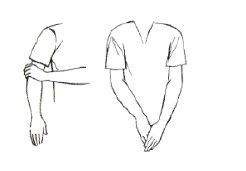
Regarding washing of the face and hands:
Wash by pouring water from top to the bottom. Washing the other way will invalidate your Wudhu. In general, wash a little beyond the required limit in order to make sure all parts are covered.
Wiping the head: Next, wipe the front most quarter of the head with the moisture that remains in your right hand. Wipe from the upper part of the head downwards (from the back of the head towards the face). It is recommended to wipe the length of at least one finger. When wiping the front most quarter of the head it is recommended to use three fingers together (the middle finger, index finger and ring finger). While wiping the head, your hand should not touch your forehead. Doing otherwise will cause the water of the forehead to mix with the wetness of your hand, and this will render the act of wiping your right foot invalid, since the act of wiping must be done with the wetness of the hands only.

Wiping the feet: Finally, wipe your feet with the moisture that remains in your hands. Wipe starting from the tip of the toes up till the ankle joint. Wipe your right foot with your right hand first, and then your left foot with your left hand. Perform this for each foot only once. It is better to wipe at least the width of three joined fingers (the middle finger, index finger and ring finger), and better yet to wipe your entire foot with your entire hand. At the time of wiping the foot, actually pull the hand from toes to the ankle joint (as described above) along the length of the toe-tips till the ankles. Do not just place your whole hand on your foot and pull up a little. Please note that wiping of the feet performed on socks or shoes are not valid.

Regarding wiping of the head and feet:
While wiping your head and feet, move your hand over them. Keeping your hand stationary and moving your feet / head under your hand will invalidate your Wudhu. However, there is no harm if your head and feet move slightly during the wiping. The parts you are wiping must be dry before you begin wiping, and if they are so wet that the moisture on your palm has no effect on them, the wiping will be void. Slight dampness on the part you are wiping is permissible as long as the moisture of the palm is immediately mixed with it when wiping.
Wiping must be done with the moisture remaining on the palms after washing. Do not re-wet your hands with new water. In the case where the palms become dry before wiping, the palms can be re-wet with water from the beard, moustache, eyebrows, or the other organs of Wudhu.
When To Perform Tayammum
Perform Tayammum in place of Wudhu or Ghusl when:
-
Not enough water is available for Wudhu or Ghusl.
-
Obtaining water for Wudhu will endanger your life or property or you are unable to procure water by any means.
-
Using the available water will leave insufficient water for drinking and pose a risk of thirst, illness, death or difficulty for yourself or your dependents.
-
Washing your face and hands with water will endanger your health.
-
Water is available but you do not have permission to use it.
-
There is a risk that performing Wudhu or Ghusl will cause the time of the entire or a part of the prayer to end.
-
If the body or clothing is ritually impure (najis) and the person possesses only as much water so that if he was to perform Wudhu or Ghusl, no more water would be available for making his body or clothing pure for prayer.
How To Perform Tayammum
Niyyat: Make your intention as, “I am doing Tayammum in place of Wudhu (or Ghusl), for the pleasure of Allah and to seek closeness to Him.”
Step 1: Strike the palms of both hands simultaneously on earth, sand, or stone (in order of preference) which is dry and clean. (See Figure 1).
Step 2: Pull both palms together from the beginning of the forehead where the hair grows down to the bridge of the nose. Both sides of the forehead joining the ears and over the eyebrows should be included. (See Figures 2 and 3)
Step 3: Then pull the left palm on the whole back of the right hand from the wrist bone to the fingertips. (See Figure 4)
Step 4: Then pull the right palm on the whole back of the left hand.
Step 5: Strike the palms together upon a valid surface a second time as in Step 1.
Step 6: Repeat Step 3.
Step 7: Repeat Step 4.
Figure 1:
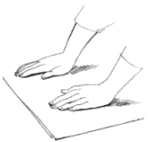
Figure 2:

Figure 3:

Figure 4:

Adhan And Iqamah
Adhan (Call to Prayer) and Iqamah
Adhan
4x
Allahu Akbar
Allah is the Greatest
2x
Ash-hadu an la ilaha illa Allah
I bear witness that there is no God except Allah
2x
Ash-hadu anna Muhammad ar-Rasulu Allah
I bear witness that Muhammad is the Messenger of Allah
2x
Ash-hadu anna Aliy-yan waliy-yu Allah1
I testify that ‘Ali is the vicegerent of Allah
2x
Hayya ‘ala as-salat
Make haste towards prayer
2x
Hayya ‘ala al-falah
Make haste towards success
2x
Hayya ‘ala Khairi al-’amal
Make haste towards the best of deeds
2x
Allahu Akbar
Allah is the Greatest
2x
La ilaha illa Allah
There is no god except Allah
Iqamah
“Allah is the greatest” (twice)
Allahu Akbar
“I bear witness that there is no god except Allah” (twice)
Ash-hadu an la ilaha illa Allah
“I bear witness that Muhammad is the Messenger of Allah” (twice)
Ash-hadu anna Muhammad ar-Rasulu Allah
“I bear witness that ‘Ali is the vicegerent of God” (twice)
Ash-hadu anna Aliy-yan waliy-yu Allah’
“Make haste towards prayer” (twice)
Hayya ‘ala as-salat
“Make haste towards success” (twice)
Hayya ‘ala al-falah
“Make haste towards the best of deeds” (twice)
Hayya ‘ala khairi al-’amal’
“Prayer has begun” (twice)
Qad qamati as-salat
“Allah is the greatest” (twice)
Allahu Akbar
“There is no god except Allah” (once)
La ‘ilaha illa Allah
The majority of scholar’s state that it is mustahab for a man or a woman to perform the adhan and iqamah before the daily obligatory salah, rather the iqamah should not be neglected. It is mandatory to perform the iqamah after the adhan, and it is not valid to perform it before the adhan.
- 1. According to the ruling of Ayatollah Sayed as-Sadiq Shirazi saying this is wajib (obligatory) in adhan and iqama. He states, “Evidently the phrase ‘Ash-hadu anna Aliy-yan waliy-yu Allah’ is the integral part of both adhan and iqamah, as some narrations point to that.” (Islamic Laws by Ayatollah Sayed as-Sadiq Shirazi page 135)
According to Ayatollah Sayed Taqi Modaressi As for bearing witness to the walaya of ʿAli, and that he is the Commander of the Faithful ‘Ash-hadu anna Aliy-yan waliy-yu Allah), the jurists have said that this is not actually part of the adhan or the iqama; rather it completes the testimony that Muhammad is Allah’s Messenger. Today, this has become an emblem of our sect, and therefore it is best to proclaim it in hope of divine reward.
Some of the other Shi’a scholars say that this phrase is not an integral part of Adhan and Iqamah, but that it is recommended (Mustahab).
Salat (Prayer)
…فَإِذَا اطْمَأْنَنْتُمْ فَأَقِيمُوا الصَّلَاةَ ۚ إِنَّ الصَّلَاةَ كَانَتْ عَلَى الْمُؤْمِنِينَ كِتَابًا مَوْقُوتًا
“…but when ye are free from danger, set up Regular Prayers: For such Prayers are enjoined on believers at stated times.” (Qur’an, 4:103).
How Imam As-Sadiq (‘A) Prayed
Hammad b. ʿIsa narrates: One day, Abu ʿAbd Allah [as-Sadiq] asked me: ‘Do you pray well, O Hamad?’ I said: ‘My master! I have in my keeping a valuable book on prayer.’ He said: ‘No problem. Stand up and pray!’
So, I got up in front of him, facing the qibla, and I began to pray, bowing and prostrating.
Then he said: ‘O Hammad! You don’t know how to pray well. It is a shame that a man should have spent sixty or seventy years in this world without offering a single perfect prayer!’
Feeling embarrassed, I said: ‘May I be your ransom! Teach me how to pray.’
So Abu ʿAbd Allah stood up straight, facing the qibla, and placed both his hands upon his thighs with his fingers closed, and brought his feet together until they were only the distance of three spread fingers apart. His feet pointed forward without turning aside from the qibla. He stood perfectly still in awe. Then he said: ‘Allahu Akbar’ and then recited [Surat] al-Hamd with clear enunciation, then he recited “qul Huwa Allahu ahad” (112:1) (Surat al-Ikhlas), then he paused for a breath while standing before saying ‘Allahu Akbar’ while standing.
Then he bowed and cupped his palms over his knees with their fingers spread out, and he pushed his knees back until his back was level, such that if you were to pour a drop of water or oil upon him it would not roll off [because of how level his back was]. He stretched out his neck and closed his eyes, before repeating ‘subhana Allah’ three times with clarity and fluency, and then said: ‘subhana Rabbi al-ʿAdhimi wa bihamdih.’
Then he rose, and when he was still, he said: ‘samiʿ Allahu liman hamidah.’ Then he pronounced takbir while standing and raising his hands to either side of his face.
Then he prostrated, placing his hands on the ground with the fingers together, while his elbows were aligned with either side of his face, and said: ‘subhana Rabbi al-ʿAla wa bihamdih’ three times, and he did not put any part of his body on another part. He prostrated on eight points of his body: His forehead, his two palms, his knees, and the big toes of each foot. These seven are obligatory, but placing the nose on the ground is sunna and this is irgham.
Then he raised his head from prostration and when he was sitting up straight, he said: ‘Allah Akbar’ and sat, resting his weight on his left side, placing the top of his right foot over the bottom of his left. Then he said: ‘astaghfiru Allah wa atubu ilayh.’ Then he said a takbir while sitting and prostrated again and repeated what he had said in the first prostration. And he did not rest on any part of his body on anything else while bowing or prostrating, and he allowed his elbows to point out sideways; he did not rest his arms on the ground.
He prayed two units (rakʿas) like this; then he sat in tashahhud with his fingers joined, and after he finished the tashahhud he said the taslim.
Then he said: ‘O Hammad! Pray like this; do not turn from side to side or play with your hands or fingers, and do not spit on your left or right, or in front of you.’1
The Five Daily Prayers
Muslims are commanded to perform five prayers per day. These prayers are obligatory on every Muslim above the age of puberty, with the exception being those who are mentally ill, menstruating, or experiencing post-partum bleeding. Those who are ill or otherwise physically unable to offer their prayers in the traditional form are permitted to offer their prayers while sitting or lying, as they are able.
The five prayers are all given certain prescribed times in which they must be performed, unless there is a compelling reason for not being able to perform them on time. Some Muslims offer voluntary prayers immediately before and after the prescribed wajib (obligatory) prayers. The number of raka’ah for each of the five obligatory prayers as well as the voluntary prayers (before and after) are listed below:
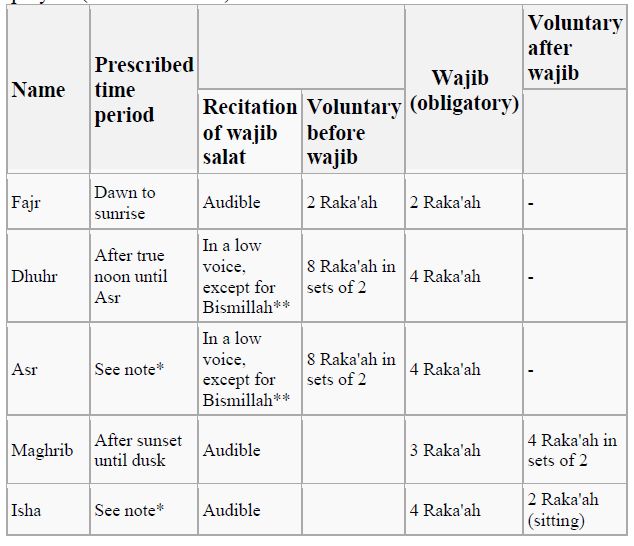
*Note: According to Shi’a Muslims, ‘Asr prayer and ‘Ishaa prayer have no set times but are performed from mid-day. Zuhr and ‘Asr prayers must be performed before sunset, and the time for ‘Asr prayer starts after Zuhr has been performed. Maghrib and ‘Ishaa prayers must be performed before midnight, and the time for ‘Ishaa prayer can start after Maghrib has been performed, as long as no more light remains in the western sky signifying the arrival of the true night.
** What is meant by reciting aloud is that the minimum level of your voice can be heard by others nearby, whereas the minimum level for reciting in a low voice is that the person reciting is able to hear it himself.2
Preparation:
Stand upright facing the Qiblah (direction of Mecca) and recite the adhan and iqama. Please note that all the recitations during the prayer must be in Arabic. Although approximate transliteration has been given below for each recitation, it is best to try and learn the Arabic script and pronunciations.
Niyyat: Form the following solemn intention in your mind: “I offer this ____ (name of a particular prayer) prayer, of ____ (number of units) rak’ah’s seeking closeness to God”.
The First Rak’ah:
Takbirat ul Ihram: Lift both hands up to the ears palms facing forward and say: Allaahu Akbar
God is the greatest
This sentence, the Takbir, will be repeated several times during the prayer.
Qiyam (standing): Remain in the standing position with arms by the side while performing the recitations in the next step, Qira’ah.

Ayatollah Sayed as-Sadiq Shirazi states to hold (takkatuf), which is to place the hands over one another across the body during salat invalidates the prayer. (Islamic Laws by Ayatollah Sayed as-Sadiq Shirazi page 158
Ayatollah Sayed Sistani states if a person folds his hands as a mark of humility and reverence, his prayers will be void, but this is based on precautionary rule. However, there is no doubt about it being haram (forbidden) if it is done believing that shariah ordains it. There is no harm if a person places one hand on another forgetfully, or due to helplessness, or taqiyyah (hiding one’s faith due to fear for his life), or for some other purposes, like, scratching. (Islamic Laws by Ayatollah Sayed Sistani #1138 and 1139) For more see chapter on Takkatuf
Qira’ah (recitation): Initially, recite silently:
“A’udhu billahi min nash shaytan nir rajeem
(I seek refuge in Allah from the cursed satan)”
Then recite the first Chapter of the Holy Qur’an, Surat al-Fatiha.
In the first and second rakats of Zuhr and Asr prayers one should say Bismillah loudly. It is mustahab (recommended) also to recite Surah al-Hamd and other Surah distinctly, with a pause at the end of every verse (i.e. not joining it with the next verse), and while reciting Surah al-Hamd and Surah, one should pay attention to the meanings of each verse.
(١) بِسْمِ اللَّهِ الرَّحْمَنِ الرَّحِيمِ
Bismillaahir-Rahmani, ar-Rahim
“In the name of Allah, the Beneficent, the Merciful” (1:1).
(٢) الْحَمْدُ لِلَّهِ رَبِّ الْعَالَمِينَ
Al-hamdu lillaahi rabbil-’alameen
“All praise is due to Allah, the Lord of the Worlds” (1:2).
(٣) الرَّحْمَنِ الرَّحِيمِ
Ar-rahmani, ar raheem
“The Beneficent, the Merciful” (1:3).
(٤) مَالِكِ يَوْمِ الدِّينِ
Maliki Yawm id-Deen
“The Master of the Day of Judgement” (1:4).
(٥) إِيَّاكَ نَعْبُدُ وَإِيَّاكَ نَسْتَعِينُ
Iyyaka na’abudu wa iyyaka nasta’een
“You alone we worship, and from You alone we seek help” (1:5).
(٦) اهدِنَا الصِّرَاطَ الْمُسْتَقِيمَ
Ihdina as-sirat al-mustaqeem
“Guide us to the Straight Path” (1:6).
(٧) صِرَاطَ الَّذِينَ أَنْعَمْتَ عَلَيْهِمْ غَيْرِ الْمَغْضُوبِ عَلَيْهِمْ وَلاَ الضَّالِّينَ
sirat al-ladheena an’amta ‘alayhim, ghayril maghdubi ‘alayhim, wa la’d-daalleen
“The Path of those upon whom Thou hast bestowed favours, not of those inflicted by Thy wrath, nor of those gone astray” (1:7).
Imam al-Sadiq (‘a) said: ‘If you are behind the prayer leader, and he has finished reciting al-fatiha, then you say: “All praise is for the Lord of the Worlds,” and do not say: “Amen (amin).3”
Ayatollah Sayed as-Sadiq Shirazi states to say “amin” (amen) after reciting al-Hamd invalidates one’s prayer. However, if one says this inadvertently, or on grounds of taqiyyah, to hide his faith and protect himself in dangerous surrounding, his salah is not rendered void4.
Ayatollah Sayed Sistani states that something that invalidates prayers is to say “Amin” (amen) after Surah al-Hamd. This rule, when applied to one praying individually is based on Ihtiyat (precaution), but if someone utters it believing that it has been ordained by Shariah (Islamic Law) it is haram (forbidden). There is no harm if someone utters it erroneously or under taqiyyah. (Islamic Laws by Ayatollah Sayed Sistani #1139)
Second, recite another complete Chapter of the Holy Qur’an (for example the short chapter Surat al-Ikhlas, number 112).
بِسْمِ اللَّهِ الرَّحْمَنِ الرَّحِيمِ
Bismillaahir-Rahmani, ar-Rahim
In the name of Allah, the Beneficent, the Merciful
(١) قُلْ هُوَ اللَّهُ أَحَدٌ
Qul Huwa Allaahu Ahad
“Say: He, Allah, is One” (112:1).
(٢) اللَّهُ الصَّمَدُ
Allaahu as-samad
“Allah is He on Whom all depend” (112:2).
(٣) لَمْ يَلِدْ وَلَمْ يُولَدْ
Lam yalid wa lam yulad
“He begets not, nor is He begotten” (112:3).
(٤) وَلَمْ يَكُنْ لَهُ كُفُوًا أَحَدٌ
Wa lam yakul lahu kufuwan ahad
“And none is like Him” (112:4).
Ruku’: After completing the second chapter, the worshipper would say the Takbir (see above) and then bow down until the hands can be placed on the knees. The following dhikr (remembrance/glorification) is recommended to be recited audibly once in this position:

Subhana Rabbiy al-’adheemi wa bi hamdih
Glory be to my Lord, the Great, and praise belongs to Him
Or also Subhana Allah (glory be to Allah) 3 times
Resume the standing position and recite audibly:
Sami’ Allahu liman hamidah
God hears the one who praises Him
Say Takbir, then go into Prostration (sujud).
Sujud (plural for sajdah, meaning “prostration”) is done by placing one’s forehead on earth in a special manner, with the intention of humility before God.
While performing the sujud, it is obligatory that both the hands (palms and thumbs at the minimum) and the knees, and both the big toes be placed on the ground. The following dhikr is recommended to be recited audibly in the sujud once:
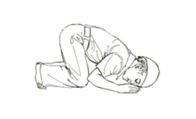
Subhaana Rabbi al-a’laa wa bi hamdih
Glory be to my Exalted Lord, and praise belongs to Him
Or also Subhana Allah (glory be to Allah) 3 times
The majority of scholar’s state that sajdah should be performed on earth, and on those things that are neither edible nor worn, and on things which grow from earth (e.g. wood and leaves of trees). It is not permissible to perform sajdah on things that are used as food or dress (e.g. wheat, barley and cotton etc.), or on things that are not considered to be parts of the earth (e.g. gold, silver, etc.). And in the situation of helplessness, asphalt and tar will have preference over other non-allowable things.5
After first sajdah, raise the forehead and sit up in a kneeling position (see illustration) with the ankle of the right foot in the sole of the left foot, with hands resting on the thighs and say Takbir, then recite audibly:

Astaghfiru Allah Rabbi wa atubu ilayh
I ask forgiveness of God, my Lord, and turn towards Him
Repeat Takbir again. Repeat the sajdah again and then sit up in a kneeling position and say Takbir.
Sit up for a moment and then rise while saying audibly:
Bi hawli-Llahi wa quwwatihi aqumu wa aq’ud
With God’s help and through His power I stand and sit
Second Rak’ah
After regaining the upright posture, recite Surat al-Fatiha and another Surah of the Holy Qur’an as in the first rak’ah. Then say Takbir, and then do Qunut.
Qunut: In performing Qunut, it is mustahab (recommended) to raise the hands to the proximity/level of the face, aligning the palms of the hands side by side, fingers joined, with the exception of the thumbs, with the palms of the hands facing skywards, and one should look into the palms of the hands. It suffices to recite any dhikr one wishes, even if one said Subhana Allah once.
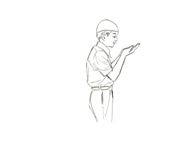
Recite audibly the following or any other du’a (invocation) you choose:
رَبَّنَا آتِنَا فِي الدُّنْيَا حَسَنَةً وَفِي الْآخِرَةِ حَسَنَةً وَقِنَا عَذَابَ النَّارِ
Rabbanaa aatinaa fid-dunyaa hasanatan wa fil-akhirati hasanatan wa qinaa ‘adhaab an-naar
“…O’ our Lord! Bestow upon us good in this world and good in the Hereafter, and protect us from the torment of the fire” (Qur’an 2:201)
Ayatollah Sayed as-Sadiq Shirazi states it is mustahab to perform Qunut in all prayers, obligatory and optional, and it should be performed before the ruku’ of the second rak’ah, and as per mustahab precaution it should not be missed out in the obligatory salat6.
Say Takbir, followed by the ruku’, then the two sujud, both as described for the first rak’ah
Tashahhud: After the second prostration resume the kneeling position, and recite audibly:
-
Al-Hamdu lillah
-
Ash-hadu an la ilaha illa Allaah, wahdahu la shareeka lah,
-
wa ash-hadu anna Muhammadan ‘abduhu wa Rasuluh
-
Allaahumma salli ‘ala Muhammadin wa Aale Muhammad
-
All praise be to Allah
-
I bear witness that there is no god apart from Allah, Who is alone and without partners.
-
I also bear witness that Muhammad is His servant and His messenger.
-
O God, bless Muhammad and the progeny of Muhammad.
If you are performing the Fajr prayer, please skip the rest and go to section entitled Completion.
If you are performing the Zuhr, Asr, Maghrib or ‘Isha prayer, continue by standing up for the third unit while reciting Bihawlillahi…. as described at the end of the section First Rak’ah.
Third Rak’ah
Tasbihat Arba’ah: After regaining the upright posture, either recite silently Surat al-Fatiha, or recite silently Tasbihat Arba’ah three times, as follows:
Subhaanallaahi wa’l hamdu lillaahi wa laa ilaaha illallaahu wallaahu Akbar
Glory be to God, and praise be to God; there is no god but Allah, and Allah is the Greatest
Perform the ruku’, stand up momentarily and then do the two sujud. This is exactly as described under section First Rak’ah.
If you are performing the Maghrib prayers, recite the Tashahhud next. Then skip the rest and go to Completion.
If you are performing the Zuhr, ‘Asr or’Isha prayer, continue by standing up for the fourth rak’ah while reciting Bihawlillahi…. as described at the end of the section First Rak’ah.
Fourth Rak’ah
This is identical to the third rak’ah. After the second prostration resume the kneeling position, and recite the Tashahhud.
Completion
After reciting the Tashahhud of the final rak’ah, recite the Taslim (Salutation) audibly, without deviating the face from the direction of the Qibla, which completes your prayer:
-
As-salaamu ‘alayka ayyuhan nabiyu wa rahma tul laahi wa barakaatuh
-
As-salamu ‘alaynaa wa ‘alaa ‘ibaadillaa his saaliheen
-
As-salamu ‘alaykum wa rahma tul laahi wa barakaatuh
-
God’s peace, mercy and blessings be upon you, O Prophet.
-
Peace be upon us, and upon the righteous servants of God.
-
Peace be upon you [all], and God’s mercy and blessings.
Thereafter proceed to say Takbir three times audibly. At this point, your prayer is completed.
Then, after the completion of your prayer, it is recommended to do sajdah shukr (prostration of thanks) and say Shukran lillah (Thank you, Allah!).
It is also recommended to do the Tasbihaat of Fatimah az-Zahra’ (‘a) which is:
1) “Allahu Akbar,” recited 34 times
2) “Al-Hamdu lillah,” recited 33 times
3) “Subhana Allah,” recited 33 times
Then you may proceed to do your own supplications in your own language or any of the recommended du’a that can be found in various books such as Mifatih ul Jinan by Sheikh Abbas Al-Qummi, Sahifa Sajjadiyya by Imam as-Sajjad (‘a), etc.
- 1. Mustadrak Wasaʾil Al-Shiʿa, Kitab Al-Salat, Abwab Afʿal Al-Salat, Bab 1, tradition no. 1, and this tradition can be found in the same chapter and section of Wasaʾil Al-Shiʿa with minor differences in wording.
- 2. Refer to Shara’i al-Islam Vol. 1, p. 83, Ch. Kitab as-Salat, Section Qirah.
- 3. Wasaʾil al-Shiʿa, v. 4, p. 756, h. 1.
- 4. Islamic Laws by Ayatollah Sayed as-Sadiq Shirazi page 158.
- 5. For example, see Islamic Laws by Ayatollah Sayed Sistani #1085 and also Islamic Laws by Ayatollah Sayed as-Sadiq Shirazi Islamic pages 150-151.
- 6. Islamic Laws by Ayatollah as-Sadiq Sayed Shirazi page 156.
Why Say Bismillah Aloud?
It is narrated by Imam Hasan Al-Askari (‘a) that to recite the Bismillah aloud in every salat is a sign of a true believer.1 It is also narrated that Imam ‘Ali (‘a) used to say his salat in this way. We read from Dr. Muhammad al-Tijani al-Samawi:
Such is the Holy Qur’an, and such is the Prophet whose conduct was the embodiment of the injunctions of the Holy Qur’an. Ahl al-Sunnah wal Jama’a, because of the intensity of their animosity towards ‘Ali Ibn Abu Talib and Ahl al-Bayt (peace be upon them), deliberately contradicted the latter in everything, so much so that their motto was to oppose ‘Ali and his Shi’as in every aspect, even if that meant contradicting a Sunnah (tradition of the Prophet) which they themselves regard as authentic.
Since Imam ‘Ali was famous for reciting the bismillah audibly even while reciting the inaudible prayers in order to revive the Prophet’s Sunnah, a number of the sahaba (companions) expressed their view that it is makrooh (disliked) to recite it in the prayers. So is the case with regard to holding the hands versus placing them on the sides, the supplication during the qunoot, in addition to other issues relevant to the daily prayers. 2 Anas Ibn Malik, therefore, used to weep and complain thus: “By Allah! I hardly find anything being done anymore which the Messenger of Allah used to do.” He was asked, “What about the prayers?” He said, “You have altered it, too.”3
We follow the example of the Prophet and the Imams from his Ahl Al-Bayt(‘a) who recited bismillah aloud. It was the Umayyads who were hostile to the family of the Prophet, who deviated from this practice to be different from the Shi’a.
Imam Nishaburi reports in his book Tafsir Ghara’ib Al-Qur’an that: “There is another charge that ‘Ali (‘a) used to amplify in raising his voice in the bismillah and during the reign of the Umayyads they have exaggerated in preventing this practice in attempt to obliterate every trace for ‘Ali (‘a).”
The first to start this practice was Mu’awiyah Ibn Abu Sufyan.4 So whoever says salat without reciting the bismillah aloud has contradicted the sunnah and followed the innovations of the Umayyad’s in obliterating the traces of ‘Ali (‘a), knowingly or unknowingly. This is why it is important to know the reasons behind the differences of opinion.
- 1. Karbala and Beyond by Yasin T. al-Jibouri page 125. Online at:
https://www.al-islam.org/karbala-and-beyond-yasin-t-al-jibouri - 2. The Shi’a the Real Followers of the Sunnah by Dr. Muhammad al-Tijani al-Samawi page 187 in the chapter The Sunnah and the Qur’an According to "Ahl al-Sunnah wal Jama’a"
Available online at:
https://www.al-islam.org/shiah-are-real-ahlul-sunnah-muhammad-al-tijani-... - 3. Al-Bukhari, Sahih, Vol. 1, p. 74
- 4. Commentary of Surah Fatiha in the Holy Qur’an, translated by S.V. Mir Ahmed ‘Ali.
Takkatuf
Takkatuf (Folding The Hands In Salat)

While performing salat you will see that a lot of Muslims hold their hands in different positions while in qiyam (standing position). Some will fold their hands across their chest, some by their navel, and some let their hands hang by their sides. You probably asked yourself, “Why do they do these things?” Let us first look at the word qiyam. This word when looked up means: upright, erect.
When you stand upright your arms should be straight as well. If your arms were folded then your body would be in qiyam but your arms would not be. To have the whole body erect would be the position of qiyam. According to The Five Schools of Islamic Law by Muhammad Jawad Al-Mughniyyah, all the 4 Sunni schools and the Shi’a school agree that holding the hands by the side is permissible. None of them states that takkatuf is obligatory.1 The Shi’a scholars say that takkatuf will void your salat, because it is a later bidah.2
Placing the right hand over the left hand while standing in prayer is what is called Takattuf.
We find that Imam ‘Ali (‘a) said “The believers should not put one hand on the other during standing erect in prayers like the disbelievers.”3
Al-’Allamah Ibn al-Mutahhar al-Helli says in Tathkirat al-Fuqahaa: al-Takkatuf invalidates the prayer and it is placing the right over the left during recitation and the scholars of the Shi’a sect agree on this—al-Sheikh and al-Murtada both said—al-Baqir (‘a) said: “And do not make Takkatuf (placing right over left), for it is something that the Zoroastrians do.”
Also, Muhammad Ibn Muslim asked one of the Imams about the man who places in prayer his right hand over his left. He (‘a) replied: “That is (called) al-Takkatuf, do not do it.”
Al-’Allamah Muhammad Hasan Najafi who was the head of the Shi’a sect in his time says in Jawahir al-Kalam:
“It was said about ‘Umar that when they brought him the prisoners from the non-Arabs (‘Ajam), they did Takkatuf (placing right over left) in front of him, so he asked about it and they told him that they did this as a sign of submission in front of their Kings, so he saw that it was good to do it for Allah in prayer but did not pay attention to the unpleasantness of imitating the Zoroastrians in Shari’ah.”
al-’Allamah Najm ud-Deen al-Tibsi says in Al-Irsaal wal-Takkatuf bayn al-Sunnah wal-Bid’ah pag.13-14:
“There are many narrations from Ahl Al-Bayt (‘a) prohibiting al-Takkatuf and describing it as being from Zoroastrianism”
And he also said on pag.18-19:
“It was said that it was innovated by the Caliph ‘Umar Ibn al-Khattab, he took it from the non-Arab prisoners.”
Ayatollah Sayed as-Sadiq al-Shirazi said in Sharae’e al-Islam by al-Helli, #235:
“It is what is called ‘al-Takattuf’ and al-Takkatuf that the ‘Aamah (Sunni’s) practice, following the path of ‘Umar Ibn al-Khattab, and ‘Umar had taken it from the Zoroastrians then inserted it into salat, this was one of his innovations and it was never done by the Prophet (S) nor his Ah ul Bayt (‘a).”
Grand Ayatullah al-Khoei says in Kitab al-Salat vol. 4 pages 445-446:
“It is no secret that the act of Takkatuf was never practiced during the time of the great Prophet (S), even though it was narrated through several chains that do not come through us (Shi’a) thus they are all fabricated and false. Then we should not be hesitant to class it as one of the later innovations after his time. As for the time of the first caliph as it is said or most probably the second as we see in the narration, that when they brought the Persian prisoners to ‘Umar, and he saw them in that state so he asked for the reason and they answered that this is what they do in front of their kings to glorify them, so he was pleased with it and ordered that it be done in prayer as Allah is worthier of praise”.
- 1. The Five Schools of Islamic Law” by Muhammad Jawad Al-Mughniyyah page 91.
Online at:
https://www.al-islam.org/five-schools-islamic-law-muhammad-jawad-mughniyya - 2. An unlawful and unauthorized addition into the religion.
- 3. Tuhaf al-Uqoul pg 127.
Why Takbir Three Times After Salat?
One of the characteristics of a believer is that after taslim in every obligatory prayer he must raise his hands up to his ears and then bring them back down to his thighs, repeating this action three times and each time say: Allahu Akbar. ‘Ali Ibn Ibrahim, Sayyid Ibn Tauss, and Ibn Babwayh Qummi have reported that Imam Ja’far as-Sadiq (‘a), through a very reliable chain of narration that Mufadhil Ibn Amr asked the Imam about the justification of the three takbirat after salat. The Imam replied that the Holy Prophet (S) after the conquest of Makkah offered the Zuhr prayer along with his companions near the black stone. The Prophet (S) after taslim repeated the takbir three times and in each time doing so raised his hands and said the following du’a:
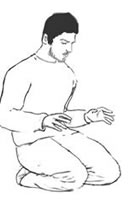
“Laa ilaha illallahu wahdahu wahdah wahdah wanjaza wahdah
Wa nasara ‘abdah wa ‘izza jundah wa ghalabul ahzaha wahdah
Falahul mulku walahul hamd yuhyi wa yumitu wa huwa ‘ala kulli shay in qadeer”
I bear witness that there is no god but Allah, He is alone He is alone He is alone. And he fulfilled his promise and awarded victory to his slave, and dignified his soldiers, and dominated the parties by himself. So, to him be the kingdom and to him be the praise. He gives life and death and he has power over everything.
Then the Prophet (S) turned his face towards his companions and emphasized not to abandon these three takbirat and du’a after every salat, and that whoever does so after taslim, he in fact thanks Allah for His bounties.
Also, one of the main authorities of Sunni literature, Sahih Muslim, we see that Ibn Abbas narrates: “We knew that the Prophet had concluded his prayers when he recited the three takbirat.”1
- 1. Sahih Muslim 1:219, Inquiries about Shi’a Islam, page 68 by Sayed Moustafa Al-Qazwini.
Hayya ‘Ala Khayri Al-’Amal
Hayya ‘Ala Khayri Al-’Amal (Hasten To The Best Of Deeds)
This phrase was first introduced into the adhan by the Prophet (S) at Ghadir Khumm. Ghadir Khumm is a place outside of Makkah where the Prophet (S) told everybody to stop after returning from Hajj during the last year of his life. When they stopped, he called all the Muslims together and ordered Bilal (ra) to call the adhan. When Bilal reached “hayya ‘alal falah” the Prophet (S) stopped him and said to repeat “hayya ‘ala khayri al-’amal” two times. This phrase means: Make haste towards the best of deeds.1 The deed he was speaking of holds great importance and upon completing it the religion was perfected.2 This deed was the appointment of ‘Ali (‘a) as his successor.
After the Prophet’s (S) martyrdom, Abu Bakr seized power while leaving the Prophet (S) unburied for three days, in spite of the Prophet’s (S) appointment of ‘Ali as the khalif (successor)! Abu Bakr and Umar conspired while the Ahl Al-Bayt(‘a) were preparing the funeral rites. This is where the split came about in the community. Some sided with ‘Ali (‘a) following the Prophet’s (S) instructions. These people were (and are) called the Shi’a (“Shi’a” meaning follower, and the term here specifically referring to “followers of ‘Ali”). Some sided with the usurper of khalifat Abu Bakr.3 These followers of Abu Bakr and ‘Umar are called the Sunni sect.
Bilal (ra) sided with ‘Ali (‘a) and thus as a form of protest quit calling the adhan to show people how serious this was! Abu Bakr got very angry and upset with Bilal (ra) and exiled him to Syria. He later died and was buried there. He was replaced by someone else and that person was told not to recite the phrase Hayya ‘ala khayri al-’amal. The unjust rulers were afraid that if it were recited the people would remember the rightful claim of ‘Ali (‘a) and realize the falsity of Abu Bakr’s rule.4
As followers of the Prophet (S) we acknowledge ‘Ali’s (‘a) right and recognize him as the first Imam. Knowing this, we call the adhan with the phrase Hayya ‘ala khayri al-’amal as the Prophet (S) ordered it. This separates the followers of truth from the followers of falsehood.
As-Salatu Khayrun Min An-Nawm
As-Salatu Khayrun Min An-Nawm (Prayer Is Better Than Sleep)
This phrase As-Salatu khayrun min an-nawm is said by the ahl-us-sunnah (Sunni sect) after hayya ‘ala al-falah in the adhan of the morning prayer, but they do not say it in the iqamah.
In The Five Schools of Islamic Law p.129, it states that this phrase is NOT a masnun (traditional) part of the adhan, and this is the opinion of Shafi’i, who is one of the four leaders of Sunni Jurisprudence.
The cause for the disagreement is the question whether it was said or not during the lifetime of the Prophet (S) or whether it was during the time of ‘Umar Ibn Al-Khattab. Ishaq has said: “This thing has been innovated by the people” and Abu ‘Isa said: “This phrase is something that the learned people have regarded with distaste. It is on the hearing which ‘Abdullah Ibn ‘Umar left the mosque!”
It is reported that once when ‘Umar was asleep he was awakened by a man named Malik using this phrase. ‘Umar liked the phrase and incorporated it in the adhan. This is why, as mentioned above, some Sunni’s disagree with this phrase. According to the scholars of the Ahl Al-Bayt, this phrase is not to be said, as it is a bidah.1
- 1. An unlawful and unauthorized addition into the religion.
Why Prostrate On Turbah
Then I was guided author, Muhammad al-Tijani al-Samawi, writes:
“I asked about the piece of clay on which they put their foreheads during the prayers and they call it ‘Al-Turbah al-Husayniyyah.’ He answered, ‘We all prostrate on the dust, but not for the dust, as some people claim that the Shi’a do, for the prostration is only for Allah, praise be to Him, the Highest. It is well established among our people, as well as among the Sunni’s, that the most favorable prostration is on earth or on the non-edible produce of the earth, and it is incorrect to prostrate on anything else. The Messenger of Allah (S) used to sit on the dust, and he had a piece of clay mixed with straw, on which he used to prostrate. He also taught his Companions to prostrate on the earth or on stones, and forbade them from prostrating on the edges of their shirts. We consider these acts to be necessary and important.
Imam Zayn al-Abideen ‘Ali Ibn al-Husayn [may Allah bless them both] took a Turbah [a piece of clay] from near the grave of his father Aba Abdillah Husayn (‘a), because the dust there is blessed and pure, for the blood of the chief martyr was spilt on it. Thus, his followers continue with that practice up to the present day. We do not say that prostration is not allowed but on Turbah, rather, we say that prostration is correct if it is done on any blessed Turbah or stone, also it is correct if it is done on a mat which is made of palm leaves or similar material.”1
The majority of Shi’a scholars state that sajdah should be performed on earth, and on those things that are neither edible nor worn, and on things which grow from earth (e.g. wood and leaves of trees). It is not permissible to perform sajdah on things that are used as food or dress (e.g. wheat, barley and cotton etc.), or on things that are not considered to be parts of the earth (e.g. gold, silver, etc.). And in the situation of helplessness, asphalt and tar will have preference over other non-allowable things.2
In the book Inquiries about Shi’a Islam3 page 68 by Sayed Moustafa Al-Qazwini we find the following:
“Other narrations say that the Holy Prophet (S) prohibited the Muslims from prostrating on materials other than the earth. One day he saw a man prostrating on some cloth from his turban. The Holy Prophet pointed to him and told him to remove his turban and to touch his actual forehead to the ground.”4
Despite the immense heat of the ground, the Holy Prophet (S) and his companions used to prostrate on it. A great companion of the Holy Prophet, Jabbir Ibn ‘Abdullah al-Ansari says, “I used to pray the noon prayers with the Messenger of Allah and I used to take a bunch of pebbles in my palm to cool them because of the enormous heat so I could prostrate on them.”5
Another companion of the Holy Prophet, Anas Ibn Malik narrates, “We used to pray with the Messenger of Allah during the enormous heat, and one of us would take the pebbles in his hand and, once they were cooled, put them down and prostrate on them.”6
Al-Khabbab Ibn al-Arth, another companion of the Holy Prophet says, “We complained to the Messenger of Allah about the intensity of the heat of the ground and its effects on our foreheads and palms (during prostration), and the Prophet did not excuse us from praying on the ground.”7
During the times of the first, second, third, and fourth caliphs the Muslims used to prostrate on the dust. Abu Umayyah narrates that the first caliph, Abu Bakr used to prostrate and pray on the earth.8
Prostrating on the earth was also the habit of the tabi’in (those who did not see the Holy Prophet but met his companions). Masruq Ibn al-Ajda’, member of the tabi’in, a faithful jurist, and a student of ‘Abdullah Ibn Mas’ud made for himself a tablet from the dirt of Madina and used it to prostrate on, taking it with him on his trips, especially when he boarded ships.9
The people closest to the Holy Prophet (S), the Ahl Al-Bayt (‘a), were also very firm in their practice of prostrating on the earth, and in doing so, were following the tradition of their grandfather, the Messenger of Allah. Imam Ja’far as-Sadiq (‘a), the sixth imam said, “Prostration is not permitted except on the earth and whatever grows from it except on those things that are eaten or made of cotton.”10
When he was asked whether having one’s turban touch the earth instead of the forehead was acceptable, he replied that this was not sufficient unless the forehead actually touched the earth. His companion and student, Hisham Ibn al-Hakam asked him whether all seven positions (forehead, hands, knees, and big toes) needed to touch the earth during prostration. Imam as-Sadiq (‘a) replied that as long as the forehead touched the earth, there was no need for the other six areas to touch the earth as well.
Thus, people can use carpets or prayer rugs to pray on as long as the forehead itself touches the earth. However, prostrating by putting the forehead on a piece of cloth, carpet, nylon, sheet, wool, or anything that is not a product of the earth (excluding items which are eaten or worn; things which prostration is not permissible) would not be considered prostrating on the earth.
Besides the issue of validity of prostration, prostrating on the earth has very significant indications and lessons for the believer. Prostrating itself is a gesture of humility and insignificance before the Almighty, and if it is done on the dirt then it will have more effect than prostrating on a carpet. The Messenger of Allah says, “Make your faces dusty and cover your noses with dust.”11
When Imam Ja’far as-Sadiq (‘a) was asked about the philosophy behind prostrating on the earth, he said, “Because prostration is surrendering and humility to the Almighty. Therefore, it shouldn’t be on what is worn and eaten because people are slaves of what they eat and wear, and prostration is the worshipping of Allah, so one should not put his forehead during prostration on that which is worshipped by the people (food and clothing) and that which conceits people.”12
The first to prostrate on the soil of Karbala (where Imam Husayn was beheaded and buried) was his son, ‘Ali Ibn al-Husayn Zayn al-Abidin (‘a) the fourth imam of the school of Ahl Al-Bayt, the great-grandson of the Messenger of Allah. Immediately after he buried his father in Karbala, he took a handful of the soil, made the earth into a solid piece and used it to prostrate on.
After him, his son Imam Muhammad al-Baqir (‘a) and his grandson, Imam Ja’far as-Sadiq (‘a) did the same. Imam Zayn al-Abidin (‘a) and Imam as-Sadiq (‘a) made prayer beads from the burial dust of Imam Husayn (‘a), and Imam as-Sadiq (‘a) narrates that the daughter of the Messenger of Allah, Lady Fatimah az-Zahra’ (‘a) used to carry prayer beads made from twisted wooden threads with which she would praise and glorify Allah, the Exalted. But after Hamzah Ibn ‘Abd al-Mutalib13 was killed in the Battle of Uhud, she took the soil from his grave and made prayer beads from it and used them to glorify Allah. People learned her habit and did the same when Imam Husayn (‘a) was martyred; taking the soil of his grave and using it to make prayer beads.14“
In Mifatihul Jinan by Sheikh Abbas Al-Qummi we find the following about the merits of Turbah:
Imam ar-Ridha’ (‘a) said “Whoever uses the rosary made of the clay of Imam Husayn’s (‘a) tomb repeating the following statements with each bead Almighty Allah shall record for him six thousand excellent points, erase six thousand evil doings of him, raise him six thousand ranks and decide for him six thousand times of intercession.
-
Subhana Allah (Glory be to Allah)
-
Al-Hamdu lil-Lah (Praise be to Allah)
-
La ilaha illa Allah (There is no god but Allah)
-
Allahu Akbar (God is the Greatest)”
Imam as-Sadiq (‘a) said “Whoever uses the rosary made of the clay of Imam Husayn’s (‘a) tomb imploring for Almighty Allah’s forgiveness one time only, shall be considered to have implored his forgiveness seventy times. Whoever holds in his hand such a rosary without uttering any statement of glorification, shall be considered to have uttered seven statements of glorification for each bead.”
- 1. Then I Was Guided, by Dr. Muhammad al-Tijani al-Samawi in the chapter “A Meeting with Al-Sayyid Muhammad Baqir al Sadr,” page 44. Online at:
https://www.al-islam.org/then-i-was-guided-muhammad-al-tijani-al-samawi - 2. For example see Islamic Laws by Ayatollah Sayed Sistani #1085 and also Islamic Laws by Ayatollah Sayed as-Sadiq Shirazi Islamic pages 150-151
- 3. Online at:
https://www.al-islam.org/inquiries-about-shia-islam-sayyid-moustafa-al-q... - 4. al-Hiythami, Sunan al-Bayhaqi. Vol. 2. 105. Ibn Hajar, al-Isabah li Ma’rifat al-Sahabah. Vol. 2. 201.
- 5. Sahih al-Nisa’i. Vol. 2. 204. al-Hiythami, Sunan al-Bayhaqi. Vol.1.
- 6. al-Hiythami, Sunan al-Bayhaqi. Vol. 2. 105. Nayl al-Awtar. Vol. 2.
268. - 7. al-Hiythami, Sunan al-Bayhaqi. Vol. 2. 106.
- 8. Al-Muttaqi al-Hindi, Kanz al-Ummal. al-Hiythami, Sunan al-Bayhaqi. Sunan al-Kubra. Vol. 4. 212. Vol. 2
- 9. Ibn Sa’ad, al-Tabaqat al-Kubra. Vol. 6. 53.
- 10. Wasa’il al-Shi’ah. Vol. 3. 592.
- 11. Al-Targhib wal-Tarhib. Vol. 1. 581.
- 12. Wasa’il al-Shi’ah. Vol. 3. 591.
- 13. The uncle, close friend and beloved companion of the Prophet.
- 14. Tarikh Ibn Asakir. Vol. 4. 342. Hafiz al-Kanji, al-Kifayah. 293.
Reciting The Name Of ‘Ali (‘A) In The Adhan
In the call to prayer, you will notice the Shi’a, after bearing witness to the oneness of Allah and the prophethood of our beloved Prophet Muhammad (S) also bear witness to what is known as the third testimony (shahadat ath-thalitha). This third testimony is bearing witness to the wilayat (guardianship) of the Commander of the Faithful, Imam ‘Ali (‘a) by saying “Ash-hadu anna Aliy-yan waliy-yu Allah.” Below are numerous sources to show proofs of where this originates, that it is permissible to say, and also the opinions of the great Shi’a scholars about this matter.
Qur’an And Ahadith
Shaykh Abdullah Maraghi, a prominent Sunni scholar, in his book As-Salafah fee Amr ul-Khilafah, has mentioned the following two reports regarding the beginning of the third testimony:
-
Salaman al-Farsi (ra) used to mention in adhan and iqamah, after the testimony of the messengership of the Messenger of Allah (S), the testimony to the mastership (wilayat) of Imam Amirul Momineen ‘Ali (‘a). A companion came to meet the Holy Prophet (S) and asked: “O’ Messenger of Allah, I heard a strange thing today, which I never heard before!” “What did you hear?” his eminence asked. He replied: “I saw Salman testify to the mastership (wilayat) of ‘Ali Ibn Abi Talib in the adhan after the testimony of prophethood! The Holy Prophet said: “You heard a nice thing.”
-
A companion came to the Holy Prophet and asked: “O’ Messenger of Allah, I saw Abu Dharr say in the adhan, after the testimony of prophethood, he also testified to the mastership (wilayat) of ‘Ali Ibn Abi Talib! The Holy Prophet said: “You have forgotten what I said in Ghadir Khumm: Of whomsoever I am the master, ‘Ali is also his master. One who breaks this pledge has not, but put himself in trouble.”
On the basis of these two reports, the mention of I witness that ‘Ali is the Wali of Allah in the adhan is having a long precedent and it originated during the lifetime of the Prophet (S) and he permitted it through silent approval.1
Shahadat ath-thalitha by Fatimah az-Zahra’ (‘a) – The first words after her birth:
“Then Fatimah (‘a) said: “I testify that there is no god but Allah, and My Father is Prophet of Allah (S) and ‘Ali (‘a) is the leader of the custodians and my children are leaders of the tribes.”2
Shahadat ath-thalitha in the Du’a of Imam as-Sadiq (‘a):
“There is no god but you and you are our Lord. And Muhammad is your servant and your prophet and messenger. And ‘Ali is the leader of the believers and the greatest proof and biggest sign and the greatest news in which people are confused”.3
Names of the Imams (‘a) on a Parchment written 2000 years before Adam (‘a):
Dawood Ibn Katheer ar-Riqqi has said:
I came to Abu Abdullah Ja’far Ibn Muhammad as--Sadiq (‘a) in Medina and he said to me: “Why have you not visited us since so long, O Dawood?”
I said: “I had something to do in Kufa.”
He (‘a) said: “Whom did you leave in Kufa?”
I said: “May my soul be sacrificed for you! I have left your uncle Zayd. I left him riding on a horse with his sword and calling loudly: “Ask me before you will miss me. I have great knowledge. I have known the abrogating and abrogated verdicts, the oft-repeated verses and the great Qur’an. Knowledge is between Allah and you.”
He (‘a) said to me: “O Dawood, things have affected you.”
Then He (‘a) called: “O Suma’a Ibn Mihran, bring me a basket of ripe dates!”
He brought him a basket of ripe dates. He took one, ate it, took the kernel out of his mouth and stuck it into the ground. It grew and fruited. He picked an unripe date from one of the bunches. He split it and took a piece of parchment out of it. He spread it, gave it to me and said to me: “Read it!”
It had two lines. The first line was “There is no god but Allah and Muhammad is the messenger of Allah.” The second line was “Surely the number of months with Allah is twelve months since the day when He created the heavens and the earth, of these four being sacred, that is the right religion. Amir Al-Mu’minin ‘Ali Ibn Abu Talib, al-Hasan Ibn ‘Ali, al-Husain Ibn ‘Ali, ‘Ali Ibn al-Husain, Muhammad Ibn ‘Ali, Ja’far Ibn Muhammad, Musa Ibn Ja’far, ‘Ali Ibn Musa, Muhammad Ibn ‘Ali, ‘Ali Ibn Muhammad, Hasan Ibn ‘Ali, al-Khalaf al-Hujjah.”
Then He (‘a) said: “O Dawood, do you know when this has been written in this piece of parchment?”
I said: “Allah, His Messenger and You are more aware!”
He (‘a) said: “Two thousand years before Allah had created Adam”.4
A Jew reciting Shahadat ath-thalitha while becoming a Muslim at the hands of Imam ‘Ali (‘a):
Background: A Jew from the descendants of Prophet Dawood (‘a) came to Medina after the martyrdom of the Holy Prophet (S) and had a few questions. Imam ‘Ali (‘a) answered his questions and hence he became a Muslim and said the following on the Hands of Imam ‘Ali (‘a) …
The Jew said: “By Allah you are right. This has been mentioned in the book of my father Dawood (‘a). The book has been inherited by one after another until it has reached me.” Then he took out the book written by Prophet Dawood (‘a) and said to Imam ‘Ali (‘a): “Give me your hand! I witness that there is no god but Allah and Muhammad is the messenger of Allah. It is he, of whom the Prophet Moses (‘a) has informed. And I witness that you (‘a) are the jurisprudent of this umma and the guardian of the messenger of Allah.”
Then Imam ‘Ali (‘a) began to teach him the laws of Islam5.
وَالَّذِينَ هُمْ بِشَهَادَاتِهِمْ قَائِمُونَ
“And those who stand firm in their testimonies [minimum 3 shahadat]” (Qur’an, 70:33).
وَالَّذِينَ هُمْ عَلَىٰ صَلَاتِهِمْ يُحَافِظُونَ
“And those who guard (the sacredness) of their prayer” (Qur’an, 70:34).
أُولَٰئِكَ فِي جَنَّاتٍ مُكْرَمُونَ
“And such will be the honored ones in the Gardens (of Bliss)” (Qur’an, 70:35).
The above verse of the Holy Qur’an clearly states in the Arabic text that the word testimonies is in the plural which means that we should stand firm on a minimum of 3 testimonies (shahadah) so as to enter heaven.
وَلَا تَجْهَرْ بِصَلَاتِكَ وَلَا تُخَافِتْ بِهَا وَابْتَغِ بَيْنَ ذَٰلِكَ سَبِيلًا
“Neither speak thy Prayer aloud, nor speak it in a low tone, but seek a middle course between.” (Qur’an, 17:110).
Jabir Ibn Abdullah Ansari asks Imam Muhammad al-Baqir (‘a) regarding this verse of the Holy Qur’an. Imam al-Baqir (‘a) replied saying:
“Do not say the Wilayat of Imam ‘Ali (‘a) in prayer aloud, but don’t hide it from ‘Ali (‘a). Recite it in a middle tone until I give you the permission to recite/declare it openly. This permission was granted on the day of GhadirKhumm”.6
فِطْرَتَ اللَّهِ الَّتِي فَطَرَ النَّاسَ عَلَيْهَا
“The nature made by Allah in which he has made men.” (Qur’an, 30:30).
Imam Muhammad al-Baqir (‘a) says regarding the above verse of the Holy Qur’an:
“That nature (Fitra) is ‘There is no God but Allah, Muhammad is the Prophet of Allah, ‘Ali Amir-al-Momineen is the Wali of Allah’7.
Imam Ja’far As as-Sadiq (‘a) when asked about the verse of the Qur’an: “And an announcement from Allah and His Messenger, to the people (assembled) on the day of the Great Pilgrimage” (9:3), said: ... Allah named him (‘Ali) Adhan from Allah. This (Adhan) is the name that Allah descended from the heaven for ‘Ali (‘a)8.
Views Of Shi’a Scholars
1) Faqih al-Ahl Al-Bayt (‘a) Muhammad al-Baqir Waheed Bahbani Hairi:
Whatever I have said proves the presence of Shahadat of ‘Ali-un-Wali-Allah. Because it’s being found in the general Hadith suffices and above this no other Hadith is required. Because it’s said that when you do Muhammad’s (S) dhikr, do ‘Ali’s (‘a) dhikr as well. Hence there is no harm that we include this in Adhan and Iqamat as a Juz (part).9
2) Faqih al-Ahl Al-Bayt (‘a) Abul Qasim Khoei:
We don’t need any Hadith to prove “‘Ali-un-Wali-Allah” in the Adhan and Iqamat, because Wilayat is a means for Completion of Risalat and strengthening of Iman. And Wilayat is 1 of those 5 things that are the basis of Deen. It is a clear sign and means of identification of Shi’a10.
3) Faqih al-Ahl Al-Bayt (‘a) Abd-un-Nabi Iraqi:
There are more than 10 Authentic Hadith regarding shahadat ath-thalita. My opinion is that Shahadat al- Thalitha is part of Adhan and Iqamat. The one who says that ‘Ali-un-Wali-Allah is not proven in Adhan and hence is Bid’at and Haraam, then this is a misunderstanding of a person who does not have knowledge of Fiqh.11
4) Faqih al-Ahl Al-Bayt (‘a) Mirza Aaqa Istehbaani:
Shahadat ath-thalita is a Juz (part) in Adhan and Iqamat.12
5) Faqih al-Ahl Al-Bayt (‘a) Sayed Muhammad Shirazi
Ash-hadu anna ‘Ali-an Wali Allah is a Juz (Part) of Adhan.13
6) Faqih al-Ahl Al-Bayt (‘a) Muhammad Taqi Mamqani:
The Shahadat al-Wilayat is proven for most of the Historians. Authentic are there on Shahadat ath-thalita. Hence taking it to be Juz (part) will not be wrong.14
7) Faqih al-Ahl Al-Bayt (‘a) Abdur Razzak Muqarram:
Examining the numerous traditions that prove that the Holy Prophet many times clarified that the Wilayat of his Successor is the completion of the 2 testimonies (Shahadatain), confirms that in the very life of the Prophet Shahadat ath-thalita after the Shahadatain was in the Adhan etc. Although it was difficult for Prophet Muhammad (S) to make the open declaration of Wilayat of ‘Ali (‘a) as obligatory because there were many people who would not accept the Merits of ‘Ali (‘a) [out of prejudice]. And how could they be satisfied with such an order that was a step in taking away the Successor ship from other than Imam ‘Ali (‘a)?15
8) Faqih al-Ahl Al-Bayt (‘a) ‘Ali Madad Qaini: After knowing the narration of Imam (‘a) “Whoever say’s La ilaha Illa Allah Muhammadun Rasulu Allah, he should say ‘Aliyun Amir Al-MumininWali-Ullah.” It is not difficult to believe that the Imam (‘a) was indicating that Shahadat ath-Thalitha is a Juz (part) of Adhan.16
9) Faqih al-Ahl Al-Bayt (‘a) Ibrahim Istehbati Shirazi Najafi:
Shahadat ath-thalita is a Juz (part) of Adhan.17
10) Faqih al-Ahl Al-Bayt (‘a) Sayed Husain Tabrizi:
In some narrations there exits the declarations of Wilayat like Sheikh As-Saduq has quoted. It becomes evident from the words of Sheikh As-Saduq and Sheikh At-Tusi that it has come in authentic narrations that Wilayat and Risalat are into one another and that the names of Prophet (saww) and Amir Al-Muminin(‘a) are always taken together.18
11) Faqih al-Ahl Al-Bayt (‘a) Muhammad Taqi Majlisi
It’s possible that this (Shahadat ath-thalita) would be a Juz (part) if there had been no Taqiyya.19
12) Faqih al-Ahl Al-Bayt (‘a) Sheikh Muhammad Raza Najafi:
Shahadat ath-thalita not being a Juz (part) of Adhan is due to Taqiyya.20
13) Faqih al-Ahl Al-Bayt (‘a) Sayed as-Sadiq Shirazi:
“Evidently the phrase ‘Ash-hadu anna Aliy-yan waliy-yullah’ is the integral part of both adhan and iqamah, as some narrations point to that.”21
Saying ‘Ali’s Name In Tashahhud Is A Recommended (Mustahab) Act
Someone asked Imam Muhammad al-Baqir (‘a) as to what is to be recited in the qunoot and Tashahhud of Prayer.
Imam Replied saying: “Recite that seems best, if this would have been fixed (as to what is to be recited) then people would have perished.”22
Someone asked Imam Muhammad al-Baqir (‘a) as to what is the minimum dhikr to be recited in the Tashahhud of Prayer.
Imam (‘a) replied saying: “Recite Shahadatain” (i.e. 2 shahadat).23
Sheikh As-Saduq also accepts this and he says the following in his Amali: “Sufficient for Tashahhud is the 2 testimonies and any more than that is worship (ibadat).”24
Tashahhud of Imam Ja’far as-Sadiq (‘a):
“...... I bear witness that no god but Allah alone with no partner and I bear witness that Muhammad is His slave and His Messenger..... I bear witness that you are the best Lord and that Muhammad is the best Messenger and that ‘Ali is the Best Wasi and Imam25.....”26
Faqih al-Ahl Al-Bayt (‘a) Sayed Ahmad Mustanabat says the following in his book Al-Qatra:
“I finish this chapter with that Tashahhud which Imam Ja’far as-Sadiq (‘a) used to recite in Prayer because have heard from a few people that they are in denial of the Third Shahadah in Adhan and Iqamat, although Sheikh Tabrisi in his book Ihtijaj has quoted the following hadith from Imam Ja’far as-Sadiq (‘a)”:
Imam Ja’far as-Sadiq (‘a) says: “When any one from you says ‘La ilaha illa Allah, Muhammadan Rasool Allah’ then he must say Alian Wali Allah.” 27
Sayed Ahmad Mustanabat continues by saying:
“This means that with the declaration of Tauheed and Risalat, the declaration of Wilayat of Imam ‘Ali (‘a) should also be necessarily given. People are ignorant of the fact that based on the above hadith of Imam Ja’far as-Sadiq (‘a) the declaration of the Wilayat of Imam ‘Ali (‘a) is among the recommended acts (mustahabat) of Prayer.”
“Below I quote the Tashahhud of Imam Ja’far as-Sadiq (‘a) because its meaning is very in depth and high and it’s very advantageous for those who think and ponder over it. This is quoted in the book Fiqh al-Majlisi by Muhammad Taqi Majlisi and is as follows:
...... I bear witness that no god but Allah alone with no partner and I bear witness that Muhammad is His slave and His Messenger..... I bear witness that you are the best Lord and that Muhammad is the best Messenger and that ‘Ali is the Best Wasi and Imam.....28
Faqih al-Ahl Al-Bayt (‘a) Sheikh Abdul Haleem:
Sheikh Abdul Haleem quoting the narration of Tashahhud with the Third Shahadah states:
“Some people consider the tradition of Tashahhud which is different from the one which is known among worshippers, as strange and shocking. And the truth is that there is no valid reason to be surprised in this because of the following reasons:
a) The way of Tashahhud which is common in our obligatory and recommended prayers is because that has become well known and famous among us and we recite it repeatedly and the same form of Tashahhud is present is the Taudhih ul-Masa’il (book of laws) of our Scholars and the forms of Tashahhud is not quoted in the Taudhih ul-Masa’il although in our books of Hadith and Fiqh there are many different forms of Tashahhud narrated from the Imams (‘a).
b) Faqih Sheikh Muhammad Husain Najafi in his book Jawahir-al-Kalam while discussing about Tashahhud says, “The worshipper has the right to recite Tashahhud based on any narration and it’s not in any way proven that a specific form of Tashahhud is obligatory. In fact, the lengthy Tashahhud based on the narration from Abu Baseer can also be recited. Hence any narration of Tashahhud from the Imam’s (‘a) can be recited in Prayer.”
c) All that is said by Sheikh Yusuf Behrani in his book Hadaiq-un-Nazira can be summarized as, “It is well known among the people that the Tashahhud with Shahadatain (2 declarations) is obligatory while the Tashahhud with more than 2 declarations is considered recommended.”
d) It is quoted in Al-Kafi that someone asked Imam Muhammad al-Baqir (‘a) as to what is to be recited in the qunoot and Tashahhud of Prayer.
Imam Replied saying: “Recite that seems best, if this would have been fixed (as to what is to be recited) then people would have perished.”
This narration is also present in Tahdhib and Wasa’il ash-Shi’a.
The various narrations of Tashahhud which are found in our books of narrations such as in Man La Yah Dharul Faqih and Mustadrak ul-Wasa’il, the count of these narrations goes well above 12. Hence it is quite normal to be surprised about this narration of Tashahhud.
The lengthy Tashahhud narrated from Abu Baseer which is quoted in the books Tahdhib and Wasa’il is considered as the most superior Tashahhud by Sheikh Muhammad Husain Najafi. And the next most superior Tashahhud is the one quoted by the Lover of Ahl Al-Bayt (‘a), author of the book Hadaiq-un-Nadhira which is quite similar to the Tashahhud quoted by Faqih Sayed Ahmad Mustanabat in his book Al-Qatra, this Tashahhud also contains the words “I bear witness that ‘Ali is the Best Wali.” This narration of Tashahhud is also quoted by Sheikh Noori in his book Mustadrak ul-Wasa’il. This Tashahhud is narrated by our Imams (‘a) and our Fuqaha and Scholars.
Hence don’t get swept away by the talk of those who oppose these narrations of Tashahhud. Many have been swept in this wave of confusion. Beware of them. Beware of them. Beware of them. And seek the intercession of Imam Az-Zaman (aj) that he may keep us safe from every conflict29.
Faqih Husain Baksh Jadah in his Taudhih ul-Masa’il (book of laws) ‘Anwar-ush-Shariya Dar Fiqh al-Ja’fariya’ quotes the following Tashahhud from Imam ar-Ridha’ (‘a):
“… I bear witness that no god but Allah alone with no partner and I bear witness that Muhammad is His slave and His Messenger… I bear witness that you are the best Lord and that Muhammad is the best Messenger and that ‘Ali is the Best Wali… O Allah sends Blessings on Muhammad Al-Mustafa and ‘Ali Al-Murtadha and Fatimah Az-Zahra’ and Hasan and Husayn, and the Imam’s from the progeny of Taha and Yaseen.”30
Sayed Muhammad Husaini Baghdadi was asked a question on the permissibility of recital of Tashahhud of Imam Ja’far as as-Sadiq quoted in the book Al-Qatra by Faqih al-Ahl Al-Bayt (‘a) Sayed Ahmad Mustanabat (which in turn quotes from Fiqh al-Majlisi), also taking support from the following hadith of Imam as-Sadiq (‘a) quoted in Ihtijaj al-Tabrisi:
Imam Ja’far as-Sadiq (‘a) says: “When any one from you says ‘La ilaha illa Allah, Muhammadan Rasool Allah’ then he must say Alian Wali Allah’”.31
Sayed Muhammad Husaini Baghdadi in reply said that “These are mu’tabar (respectable) narrations and acting on these is permitted.”32
Salam On The Imam’s (‘A) After Tashahhud
Peace be upon you O Prophet and his blessings and grace be upon you! Peace be upon you all messengers and angels and prophets. Peace be upon the Guided Imams who guide. Allah’s peace be on us and upon all pious servants of Allah33.
- 1. Our Questions by Ayatollah Hussain Tehrani page 499.
- 2. Ref: Bihar Al-Anwar Vol.16 p.81.
- 3. Ref: Tahdhib al-Ahkam, Sheikh Tusi Vol.3 p.146.
- 4. Ref: Al-Gayba, Nu’mani Chapter 4 Hadith18; Taweel al-Aayat Vol.1 p.203; Bihar al Anwar Vol.24 p. 243.
- 5. Ref: Al-Gayba, Nu’mani Chapter 4 Hadith 30; Bihar al Anwar Vol.10 p. 23.
- 6. Ref: Tafsir an-Noor uth-Thaqlain Vol. 3 p. 235, Tafsir al-Ayyashi, Tafsir al-Saafi, Tafsir al-Burhaan.
- 7. Ref: Tafsir al-Burhaan Vol.3 p. 262 and Tafsir al-Furaat
- 8. Ref: Taweel ul-Ayat p. 204 and Bihar Al-Anwar Vol.35 p. 293 and Ma’ni Al-Akhbar p. 298.
- 9. Ref: Al-Hidaya Fi Juziyat ul-Shahadat al-Wilayat, p. 14.
- 10. Ref: Mustanad Urwat ul-Wusqa, Vol.2, p. 288.
- 11. Ref: Al-Hidaya Fi Kaun un-Shahadat Bil-Wilayah Fi ‘l-Adhan and Wa al-Iqamah Juzi Kasair ul-Ajzia, p. 37 and Al-Hidaya Fi Juziyat ul-Wilayah, p. 161.
- 12. Ref: Sharh Risalat ul-Huqooq, Vol. 3, p. 113.
- 13. Ref: Al-Fiqh, Vol. 9, Chapter on Adhan.
- 14. Ref: Sahifat ul-Abraar, Vol. 2, p. 186.
- 15. Ref: Sirr ul-Eeman, p. 14.
- 16. Ref: Sirr ul-Eeman, p. 56.
- 17. Ref: Risalate Amaliya Zakhiratul Ibaad, p. 46.
- 18. Ref: Qawaid-ud-Deen p. 227.
- 19. Ref: Rauzat ul-Muttaqeen, Vol. 2, p. 246.
- 20. Ref: Sirr ul-Eeman, p. 41.
- 21. Ref: Islamic Laws by Ayatollah Sayed as-Sadiq Shirazi page 135.
- 22. Ref: Furu al-Kafi Vol. 3 p. 337 and Khulasat al-Haqaiq Vol. 1 p. 255.
- 23. Ref: Furu al-Kafi Vol. 3 p. 337.
- 24. Ref: Amali, Sheikh As-Saduq.
- 25. Ashhadu an la ilaha illa Allah, wa ashhadu anna Muhammadan abduhu wa Rasuluh, wa anna ‘Aliyan ni’mah wali, allahumma salli ‘ala muhammadin wa aale muhammad, is how this should be said if added as a mustahab act in tashahhud according to the view of Ayatollah Sayed as-Sadiq Shirazi.
- 26. Ref: Fiqh al-Majlisi p. 29.
- 27. Ref: Al-Ihtijaj Vol. 1 p. 230; Bihar Al-Anwar Vol. 27 Hadith: 1.
- 28. Ref: Al-Qatra Vol. 1 p. 328, Urdu – al Qatra Vol. 2 pg 92-93.
- 29. Ref: Shahadat al-Thalitha Al-Muqaddasa p. 224-230.
- 30. Ref: Anwar ush-Shariya dar Fiqh al-Ja’fariya p. 58.
- 31. Ref: Al-Ihtijaj Vol. 1 p. 230; Bihar Al-Anwar Vol. 27 Hadith: 1.
- 32. Please refer to the web page “Shahadat al-Salisa” for all of the links and scanned pages of the fatwas and books referenced. www.shahadatalsalisa.com
- 33. Ref: Mustadrak Al-Wasa’il Vol.5 p. 9 and Bihar Al-Anwar Vol.82 p. 287 and Al-Balad ul-Ameen p. 8.
Why The Hatred?
Who is this man and why do they hate him so much? What did he do to make them curse him from the pulpits for over 80 years? Why did they disassociate from him and punish the ones who loved him by death? Some they tortured by cutting out their tongues, others they killed, crucifying them, cutting off their heads and even burying some alive!
What did this man do to them for them to confiscate his wife’s property and source of income, leaving him and his family in the clutches of poverty? Why did they hate him so much that they waged civil wars against him? What drove them to set fire to his house, kicking the door in and smashing his beloved wife in-between, thus killing their unborn child?
Why did they hate him so much that they dragged him by the point of the sword to force his allegiance to the self-appointed ruler of the time? What did this man do to produce such hatred that they killed him while he was in prostration to his Lord?
Was this not the only man ever born inside the Holy Ka’bah? Was not this man raised by the Apostle of Allah (S) since he was five years old, following his every footstep? Was he not the first man to accept the message of Al-Islam? Was he not the first to offer salat with the Messenger of Allah? Was he not the only one, besides Prophet Muhammad (S), who never bowed down before an idol?
Was not this the same man who slept in the bed of the Prophet (S) readily risking his own life for the safety of Allah’s Messenger1? Was not this the greatest warrior in Al-Islam? Did not his steadfastness in battle earn him the title “Lion of Allah”? Was it not him who was the only one from amongst the Muslims to stand up against the pagan warrior, Amr, at the Battle of the Trench? Was it not him who cut this disbeliever in two saving the deen of Al-Islam? Was not this man the one who conquered the Jewish fort of Khaybar after others failed in their attempts?
Was not this man the same one Allah commands us to love in the Holy Qur’an2 , and purified him from all sins3, and made it binding on us to obey him4?
Was it not this man who married the leader of the women of paradise, who gave birth to his two sons, the leaders of the youths of paradise? Was this not the same person the Apostle (S) appointed as his successor on numerous occasions? Was this not the same man upon whom being appointed the successor, Allah perfected the religion5?
Was this not the same person Allah defines as the “self” of the Prophet (S), being that they were created from the same light6?
Was he not the one who, instead of rushing off for political power, stayed with the body of the Prophet (S) and performed his burial rights?
If all this is true, how can these people still hate this man and frown at the mention of his name? Did not the Prophet (S) say that without offering blessings on this man the salat will not be accepted? Was this man any other than the cousin and son-in-law of the Prophet (S), ‘Ali Ibn Abu Talib (‘a)?
Some Important Hadith To Remember Regarding The Ahl Al-Bayt (‘A)
-
Imam ‘Ali (‘a) said: “People often hate those things that they don’t understand”1.
-
Imam ‘Ali (‘a) said: “Whoever loves us, members of the Prophet’s family, should be prepared to face destitution”.2
-
Imam as-Sadiq (‘a) said: “It is surprising to hear people claim that they have derived all their knowledge from the Prophet (S) and having acted accordingly they are guided. And they believe that we, Ahl Al-Bayt, have not derived his knowledge, nor have we been guided by him, in spite of being his family members and descendants! The revelation descended in our homes and from us the knowledge reached the people. Do you believe that they knew and were guided while we remained ignorant and lost? This is indeed impossible!”3
-
The Prophet (S) said: “What has happened to some people in my ummah who become cheerful and jubilant when Ibrahim (‘a) and the progeny of Ibrahim are mentioned to them, but when I and my progeny are mentioned, they detest it and frown at it?! By He who sent me as a truthful prophet, if a person dies after having performed the deeds of 70 prophets but he has no liking for the authority of our Ahl Al-Bayt, Allah will not accept any of his obligatory or voluntary acts of worship!”4
-
Narrated by Ibn Abbas that the Prophet (S) said: “Cling steadfastly to the affection for us, the Ahl Al-Bayt. For whoever meets Allah with our love in his heart shall enter paradise by our intercession. By He who controls Muhammad’s (S) breath, the acts and deeds of a servant shall not benefit him except coupled with our recognition and love!”5
-
Imam ‘Ali (‘a) said: “Whoever loves us, his faith will benefit him and his works will bring him close to Allah. Whoever does not love us, his faith will not benefit him and his works will not bring him close to Allah even though he should strive night and day in prayer and fasting”.6.
-
Imam as-Sadiq (‘a) said: “We are those that obedience to whom Allah has made an obligation. Nothing is proper for the people except to know us, nor are the people absolved from being ignorant about us. He who knows us is a believer (mu’min) and he who knows us and denies us is a disbeliever (kafir). He who neither knows us nor denies us is misguided, until he returns to the path of guidance, which Allah has made an obligation for him as a binding obedience to us. If he dies in his misguidance then Allah will do with him what he pleases”.7
-
Imam al-Baqir (‘a) said: “The one who is unaware of the oppressions done upon us, the one who is oblivious of the snatching away of our rights, and the one who is not aware of the misbehavior of the ummah towards us, surely he is among those oppressors”8
-
Abu Dharr (ra) narrated that the Prophet (S) said to ‘Ali (‘a): “O’ ‘Ali, Allah has made me and you from the same tree. I am its root and you are its branch. Allah will throw a man into hell by his face if he cuts its branch!”9
-
The Prophet (S) said: “The example of my household is that of Noah’s (‘a) ship. Whoever boards it will get rescued and the one who opposes the boarding of it will drown”10
-
Imam al-Baqir (‘a) said: “If a man keeps standing the whole night for salat, keeps on fasting during the day, gives out all his wealth as alms, and performs hajj all the years of his life while he does not recognize the guardianship of the vicegerent of Allah so as to love him and perform all his practices under his guidance and leadership does not have any right out of his rewards and is not from among the faithful”11
-
Imam al-Baqir (‘a) said: “The person who serves Allah according to a religion so putting himself in great inconvenience and hardship for it, and doesn’t have an Imam fixed by Allah, then his endeavor is unaccepted and he is lost, gone astray, and a wandering person in a state of perplexity. Allah is the enemy to his practices and his example is that of a sheep that has lost her shepherd and herd wandering here and there all-day long. And by Allah, similarly, in this ummah too anybody who starts a morning in a condition that he doesn’t believe in the Imam appointed by Allah, an Imam who is apparent, evident, just, and equitable. He will start the morning in a condition that he is gone astray and perplexed. And if he dies in this very condition, he will die a death of disbelief (Kufr) and hypocrisy (Nifaq).”12
-
Imam ‘Askari (‘a) said: “An age will approach when people’s faces would be laughing and their hearts would be dark, bleak, and dirty. The sunnah to them would be bidah and bidah would be considered sunnah among them. The faithful would be belittled and debased among them and the transgressors would be honorable and respected among them. Their lords and chiefs would be ignorant and aggressive ones. And the religious scholars would be on the threshold of aggressors and tyrants”.13
-
The Prophet (S) said “Allah said: ‘I will punish every group of Muslims who recognized the leadership of any unjust ruler whom I did not select, even if the individuals of such a group are pious and fear Allah. Likewise, I will forgive every group of Muslims who recognized exclusively the leadership of the just imams (‘a) whom I appointed, even if the individuals of such a group wrong themselves and commit bad deeds.”14
-
Ibn Abbas asked the Holy Prophet (S) to advise him. The Prophet (S) said “I advise you to love ‘Ali Ibn Abu Talib (‘a). I swear by Allah who sent me as a Prophet that Allah will not accept the good deeds of any slave without first questioning him about his love for ‘Ali (‘a), and Allah knows the truth. So, if the slave had the wilayat (guardianship), Allah will accept all the deeds of the slave, despite his shortcomings. If the slave did not have the wilayat, Allah will not question him about anything else and will order him to be taken to Hell”.15
-
Imam ‘Ali (‘a) said “If a man worships Allah between rukn and maqam and fasts every single day of his entire existence without believing in our wilayat, he will not benefit in any way.”16
-
The Prophet (S) said “The dwellers of paradise are those who obey me and submit to ‘Ali Ibn Abi Talib (‘a) after me and accept his wilayat (guardianship). The inmates of the fire are those who deny his wilayat, breach the covenant and fight against ‘Ali (‘a) after me”.17
-
Imam as-Sajjad (‘a) “Allah has made 5 religious duties mandatory and everything Allah makes mandatory is beautiful; Salat, zakat, hajj, fasting, and our wilayat (guardianship). People obeyed Allah in the first 4 and ignored the 5th. I swear by Allah that the first 4 are not complete without the 5th.”18
-
The Prophet (S) said “If everyone loved ‘Ali Ibn Abi Talib, Allah would not have created hell.”19
-
Ibn Abbas asked the Prophet (S) “Is there anyone who hates ‘Ali (‘a)?” The Prophet (S) replied “Yes, some people who think they are from my nation hate him and they have nothing to do with Islam. One of the signs of those who hate ‘Ali (‘a) is that they elevate people who are lower than ‘Ali (‘a) above ‘Ali (‘a).”20
“Praise be to Allah Who made perfect His religion and completed His favor with the establishment of the commander of the faithful, ‘Ali Ibn Abu Talib’s (‘a) love and authority! Praise be to Allah Who blessed us to be among those who cling and hold to the love and authority of the commander of the faithful and all the Imams, peace be upon them all!”
- 1. Nahjul Balagha #172.
- 2. Nahjul Balagha #111.
- 3. Al-Amali by Shaykh As-Saduq.
- 4. Al-Amali by Shaykh As-Saduq.
- 5. Al-Amali by Shaykh As-Saduq.
- 6. Kitab Al-Irshad by Sheikh Mufid.
- 7. Usul Al-Kafi vol. 1 Al-Usul pt. 2-4 “The Book of Divine Proof,” p. 60.
- 8. Bihar ul-Anwar, vol. 55, p. 77; Eqaabul Amal, p.208.
- 9. Abu Dharr, The Great Companion of the Prophet. Online at:
https://www.al-islam.org/great-companion-prophet-s-abu-dharr-ra - 10. Discourses of the 14 Infallibles.
- 11. Discourses of the 14 Infallibles.
- 12. Discourses of the 14 Infallibles.
- 13. Discourses of the 14 Infallibles.
- 14. Fadail al Shi’ah - Hadith #12.
- 15. Bisharat al-Mustafa, p. 64, Hadith 9; Amal al-Tusi, vol. 1, p. 104; Bihar al-Anwar, vol. 16, p. 370 and vol. 28, p. 157, Tawil al-Ayaat, vol. 1, p. 277.
- 16. Bisharat al-Mustafa, p. 402, Hadith 30.
- 17. Bisharat al-Mustafa, p. 212, hadith 2; Bihar a-Anwar, vol 39, p. 208.
- 18. Bisharat al- Mustafa, p. 160, hadith 143; Bihar al-Anwar, vol 23, p. 105.
- 19. Bisharat Al-Mustafa, p. 114; Bihar Al-Anwar, vol 39, p. 249; Amali As-Saduq, p. 523; Kashf Al-Ghummah, vol 1, p. 99; Manaqib Al-Khawarezmi, p. 28; Tawil Al-Ayat, vol 2, p. 497.
- 20. Bisharat al Mustafa, p. 64, hadith 9; Amal at Tusi, vol 1, p. 104; Bihar al Anwar, vol 16, p. 370 and vol 28, p. 157; Tawail Al-Ayat, vol 1, p. 277.
Dua Al-Faraj
دُعاءِ الفَرَج
اللّهُمّ صَلّ عَلَى مُحَمّدٍ وَآلِ مُحَمّدٍ
O’ God, bless Muhammad and the family of Muhammad.
اَللّهُمَّ كُنْ لِوَلِيِّكَ الْحُجَّةِ بْنِ الْحَسَنِ
O’ God, be for Your representative, the Hujjat (proof), son of AlHasan,
صَلَواتُكَ عَلَيْهِ وَعَلى آبائِهِ
Your blessings be on him and his forefathers,
في هذِهِ السّاعَةِ وَفي كُلِّ ساعَةٍ
In this hour and in every hour,
وَلِيّاً وَحافِظاً، وَقائِداً وَناصِراً، وَدَليلاً وَعَيْناً
a guardian, a protector, a leader, a helper, a proof, and an eye
حَتّى تُسْكِنَهُ أَرْضَكَ طَوْعاً، وَتُمَتِّعَهُ فيها طَويلاً.
until You make him live on the earth, in obedience (to You), and cause him to live in it for a long time.
اللّهُمّ صَلّ عَلَى مُحَمّدٍ وَآلِ مُحَمّدٍ
O’ God, bless Muhammad and the family of Muhammad.
2nd Chance Books For Prisoners
Dedication
This initiative is dedicated to our beloved 11th Imam Hasan al-ʿAskari (ʿa), who spent the majority of his life in prison and under house arrest by the corrupt ruler of the time. He is the great grandson of our beloved Prophet Muhammad (S) and father of our beloved 12th Imam al-Mahdi (ʿaj).
Mission
Our mission is to deliver knowledge to those individuals who are less fortunate in life through the dissemination of various books. We strive to teach and inform those who are looking for a second chance and desire to walk the straight path, but are unable to access the necessary information passed down to us by the beloved Infallibles (peace be upon them all).
About Us
2nd Chance Books is a 501c3 non-profit organization that was founded in order to assist incarcerated Muslims by providing them with educational materials, a support system, and tools for rehabilitation. The organization is comprised of a team of dedicated, devoted individuals, including the founders of this organization, who came together to provide services for those in need and those seeking guidance. The partnered organizations 2nd Chance Books, SABA Prison Project, al-Kisa Prison Project, and IEC Houston. 2nd Chance is under the guidance of several scholars, Such as Moulana Nabi Raza Abidi, Shaykh Mateen Charbonneau, Shaykh Saed ‘Ali Kulayni, Moulana Qamar Hasani.
This program is independently funded by donations from the community. We want to stress the importance of helping fellow believers who are less fortunate than ourselves.
Facts & Statistics
The USA has the highest incarceration rate in the entire world. While Americans only represent 5% of the entire world’s population, it comprises nearly 25% of the entire world’s incarcerated population, with 2.3 million inmates. Most of these prisoners will fall victim to the cycle of the revolving door and become repeat offenders if they do not have the proper resources to educate themselves properly while serving their sentences.
2nd Chance seeks to provide the proper tools for change: free Islamic books on topics such as beliefs, ethics, morality, and family structure in Islam. The aim is for these books to be used as a tool for self-development and reform.
Some goals of this program are molding leaders, transforming prisoners’ bad habits into good ones, achieving social reform, producing better citizens who will actively help their communities, and promoting awareness of the true teachings of Islam by teaching the morals and ethics of the Noble Prophet and his divine household.
For prisoners who are reading this we want you to know that we are honored to be at your service. Please write us and let others who are interested in seeking knowledge about Islam to contact us at the address below.
2nd Chance Books
3735 Franklin Rd. SW
Suite 236
Roanoke, VA 24014
For more information please contact:
Email: [email protected]