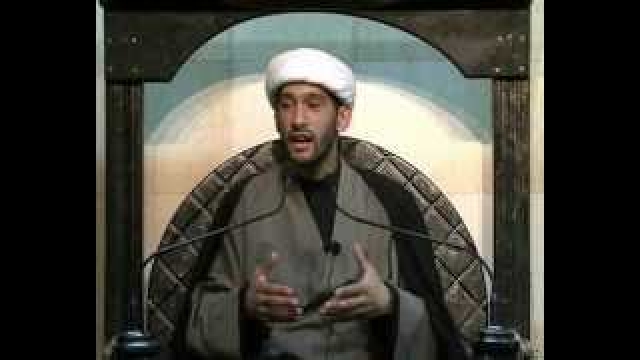
Tafsir Du'a Al-Iftitah 1/14 - Ramadan 1433/2012

Sallu 'ala Muhammad wa aali Muhammad [Allahuma salli 'ala Muhammad wa ali Muhammad]. Before we begin, there are a few announcements that we have been asked to make. As we know there are many of our family members, friends around the world who are sick, who are unwell. And also we are receiving news that the problems in Syria have been exported very locally towards the area Sayyida Zaynab salam Allahu alayha. We know that those people who are in the closer vicinity, they are having to leave. They are being sent far away. Some of them are under attack. We know that they're having to take a refuge. Let us pray for all of those around the world who are in need and InshaAllah. Our friends, family members and especially those in the Sayyida Zaynab area for their protection and well being.
Bismi-Llah, Al-Rahmani, Al-Rahim. “Amman yujibu al-mudhtarra idha da‘ahu wa yakshifu us-su’u” (27:62). “Amman yujibu al-mudhtarra idha da‘ahu wa yakshifu us-su’u” (27:62). “Amman yujibu al-mudhtarra idha da‘ahu wa yakshifu us-su’u” (27:62). “Amman yujibu al-mudhtarra idha da‘ahu wa yakshifu us-su’u” (27:62). “Amman yujibu al-mudhtarra idha da‘ahu wa yakshifu us-su’u” (27:62). Ya Allahu, Ya Allahu, Ya Allah, Ya Allahu, Ya Allah. Bi Fadhlika wa bi Rahmatika, ya Arham Ar-Rahimin. Salawat [Allahumma salli 'ala Muhammad wa Aali Muhammad wa ajj al-Farajahum].
I would like to take this opportunity to extend my thanks to the community for inviting us over these Holy nights. It is an honor to be here. I look forward to serving the community as best as I can in a InshaAllah and making new friend along the way. Sallu 'ala Muhammad wa aali Muhammad [Allahumma salli 'ala Muhammad wa Aali Muhammad].
'A'udhu bil-Lahi, min al-Shaytan, al-rajim.Bismi-Llah, Al-Rahmani, Al-Rahim. Al-hamdu lil-Lahi, Rabbi Al-'Alameen. "Al-hamdu lil-Laahi alladhee hadana li hadha, wa ma kunna linahtadiya lawla ann hadana Allah" (7:43) [All praise is due to Allah Who guided us to this, and we would not have found the way had it not been that Allah had guided us]. Wa as-salat, wa as-salamu 'ala ashrafi Al-Anbiya'i, wa al-Mursaleen, Khatam an-Nabiyyin, Sayyidin il-Mumajjad, Bashirin il-Musaddaq, Al-Mustafa al-Amjad, Mahmood al-Ahmad, Abil Qasimi Muhammad [Allahuma salli 'ala Muhammad wa ali Muhammad]. Wa 'ala ahlih, at-tayyibin, at-taharin, al-masoomeen. Wa la'ana Allahu ala adh-Dhaalimina min al-awwalina wa al-Akhirin.
Amma Ba'ad, qala Imam Zaynu al-'Abidin, alayhi as-salam [Allahuma salli 'ala Muhammad wa ali Muhammad]: al-hamdulil-Lahi alladhee ja'la min tilka subli ash-Shahr, Shahr Ramadhan, Shahr As-Siyam, wa Shahr Al-Islam, Shahr At-Tuhoor, wa Shahr at-Tamhis, wa Shahr Al-Qiyam, alladhee unzila fih al-Qur'an, udalli an-nasi wa bayinati min al-Huda wa al-Furqan. Salawat [Allahumma salli 'ala Muhammad wa Aali Muhammad].
Awaited Saviour, Master of our age Imam az-Zamana. My respected scholars, elders, brothers and sisters, salamu alakum jami'an wa rahmatu Allahi wa barakatu [wa alaykum as-salam, wa Rahmatu Allahi ta'ala wa barakatu].
The verses that we have read at the end of the Arabic Khutba come to us from the 44th supplication of Sahifa As-Sadjadiyya, given to us by our 4th Imam, Imam Zayn Al-'Abidin, salawat Allahi wa as-salamu alayh [Allahumma salli 'ala Muhammad wa Aali Muhammad]. It is his Du'a welcoming the Holy month of Ramadhan. Before we describe and discuss this particular Du'a, I would like to take this opportunity to introduce our discussions and the themes that we will be having over these next couple of weeks, inshaAllah.
Our evening programs will be dedicated towards the commentary of Du'a Iftitah. As we know, the Du'a Iftitah has been given to us by our master and Imam of our Age, Imam Al-Hujja, ajal Allahu Ta'ala faraja ush-sharif [Allahumma salli 'ala Muhammad wa Aali Muhammad]. And therefore, considering there is such an emphasis for you and I to recite this particular Du'a every single night of Shahr Ramadhan, we want to explore this particular Du'a, what it means and the impact that it has upon us, in this month and of course throughout the whole of our lives.
We specifically want to take the concept and the theme of understanding why this Du'a has been given to us for Shahr Ramadhan, what is the relationship between the verses of Du'a Iftitah and this particular month and considering its author, the Imam of our time, what is its relationship between him and the particular words within this Du'a? So InshaAllah this will be our theme from tomorrow night for the coming weeks.
During the day in our session, in the afternoons after dhohr, we have our Tafsir session InshaAllah. Our discussion will be upon practical tools, practical techniques as to how to ponder upon the Holy Qur'an. You see we know that Qur'an has this line, this wonderful Verse where it says: "afa la ya-tadabaruna al-Qur'an?"'(4:82). Do they not ponder upon the Qur'an? And there is much emphasis, especially in this month, that you and I, when we read the Qur'an, we don't just read the translation and the meaning, but we try to ponder upon the words, we try to really delve into the ocean that is the Holy Qur'an.
The question I posed rhetorically tonight is: if I ask my brothers, my sisters, my youngsters, my youth, ponder upon the Qur'an, one question that is normally asked is, well, how do I ponder upon the Qur'an? What are the techniques? How do I build upon the thoughts that I have? And very importantly, when I have a thought, how do I know whether that thought is correct or not? How do I know whether my conclusion is the right conclusion? How do I reconcile these issues? And therefore these two topics InshaAllah allow us to explore two fundamental issues within this wonderful month, the Holy Qur'an and also Du'a, hoping that we can really explore what this month is there for you and I to build upon for the rest of our lives. Sallu 'ala Muhammad wa aali Muhammad [Allahumma salli 'ala Muhammad wa Aali Muhammad].
The Du'a that we recited as we stated, comes to us from Sahifa as-Sajadiyya, and this is chapter numbe,r Du'a number 44, of Sahifa as-Sajadiyya. The one immediately after number 45, is Imams Du'a bidding farewell to this particular month, and therefore, this Du'a is one that we find is unique, because we do not have another month in the Islamic calendar which is both welcomed and also bidden farewell to. And therefore, straightaway we are encouraged to read this particular Du'a.
Imagine our whole year is building up towards Shahr Ramadhan. We look forward to this month. We realize that the blessings in this month are unparalleled and therefore, when the Imam, alayhi as-salat wa as-salam, provide us with a Du'a welcoming this month, it is almost to the point of obligatory. It is spiritually obligatory that tonight we ensure that we read this particular Du'a, and find what treasures are in there from the words of the Imam, in welcoming this particular month.
In fact, when we look at this particular Du'a, we find that it's not just a supplication, it's not just seeking proximity towards Allah Subhana wa Ta'ala. The words within this particular Du'a, are an exposition of this particular month. It actually describes what this month is about. It describes its attributes. It describes our interaction with this month. It lists for us clearly, what our intentions should be, and which particular actions we should formulate within this particular month. Therefore, the Du'a actually should be considered as a manual.
When we say or Qur'an says to us that we have prescribed fasting upon you just as we have prescribed fasting upon those before you so that you have Taqwa, "la'allakum Tattaqun" (2:183), well we say, what is this Taqwa? How do I identify, how do I understand what this Taqwa is? And the answer comes from us from this to Du'a. If we want to realize what the objective of this particular month is, let the fourth Imam, alayhi as-salat wa as-salam, describe clearly what the actions are of this particular month.
Let us now recite a few lines from this particular Du'a. Let us become acquainted with some of the gems that are within this particular Du'a. And then InshaAllah, we will try to analyze one particular word within this supplication, so that we see how the Imam himself brings this particular month to us. Let us start with a Sallu 'ala Muhammad wa aali Muhammad [Allahumma salli 'ala Muhammad wa Aali Muhammad].
The Imam says, all praise belongs to Allah. All praise belongs to Allah. For having guided us towards His praise. And by virtue of us praising Him, He has allowed us to become aware of His blessings upon us. We have thanked Him for what he has given to us. And by virtue of us thanking Him, He has allowed us to begin that path of being recompensed with a reward of the good doers. When I thank Allah Ta'ala, it is because He has allowed me to thank Him. He has made me thank Him. The result of that thanking, is that I am recompensed amongst those people who have been amongst the good-doers.
All praise belongs to Allah, for He has favored us through His religion, Islam. And all praise belongs to Allah who has favoured us with this religion, and has guided us amongst His roads. And amongst those roads are this particular month, His month. Which month? The month of Ramadhan, the month of fasting, the month of submission, the month of purification, the month of purging of the hearts, the month of standing at night in prayer, the one who has revealed the Qur'an in this month as a guidance for all mankind and a distinguisher for us. This is the opening lines of the Du'a.
As it continues, Imam, alayhi as-salat wa as-salam, now delves into the kinds of actions that He expects from us. As we said, this Du'a is a manual for us. If we want to see how we act, we look at these particular lines. He says: My Lord, employ me in this month. Make me work. Employ me in this month, in those things which will make You pleased with me. Do not allow my ears to listen to idle talk. Do not allow my eyes to become diverted. Do not allow my arms to be stretched forth towards that which is impermissible. Do not allow my feet to carry me towards those places which are unlawful, and do not allow my stomach to be filled with anything that you have prohibited.
Now, these lines, they are not just a Du'a. It's not just for us to recite them as a parrot, we are to engage with these lines. I am genuinely asking for these things. This month, when I am sitting with my friends, when I am sitting with my family, I do not delve into unnecessary idle talk. I trainee myself in this month. I train my family members, my youth, my children, in this month, to elevate their thinking, to elevate what they want to participate in. And therefore, this is why the Imam starts with these kinds of lines. He continues, in the Du'a.
My Lord, I ask You, that You help strengthen the bond of kinship. In Shahr Ramadhan, he is mentioning this, the month of Ramadhan is to bring kinship close together, strengthen that bond of kinship, to the extent that I bring them gifts in this month. Subhana Allah, it is not just a phone call, it is actually going to partake with family members as much as possible.
My Lord, let me interact with my neighbors, the Imam continues, Let me interact with my neighbors as much as possible. He continues, My Lord, I ask You, this is a line of waseela, an outstanding line of waseela. He says, My Lord, I ask You, by this month, I ask You by the right of this month, and by the right of all those who have worshiped You in this month, whether it be an angel who has become close to You, or it is a prophet who You have sent, or it be a special human being whom You have picked from the universe. Be pleased with my actions. Help me to fulfill those things which I am supposed to fulfill within this world. And O my Lord, make incumbent upon me the reward of the same person whom You have seen who is striving hard within this month.
My Lord, I may not be worthy. I know I fall short. I am a weak human being. I am trying, but I recognize that there are human beings who are exemplary human beings. I ask You by them, because I can't reach their standard. But I ask You by them, to fulfill that, and make incumbent upon me, the same reward that you are going to give to them. Look at these lines from the Imam. And then he concludes with a wonderful, again, line which provides us with a clear direction as to what this month is really about.
He says, My Lord, help me to fast during the day, and to stand at night in prayer. Help me, help me to achieve that. I am weak. I become tired. I have gathering. But help me that when the night comes, I curtail that gathering. If the gathering is going on, I have the strength to say: it is one and a half hours until Fajr. I bid you farewell. Please excuse me. There is a time when I have fulfilled my social obligation. But there is a time when I am now in Communion with my Lord, Allah Subhana wa Ta'ala. Look at the line! Help me to fast in the day, but also help me to stand its night. I need Your help to fulfill this within these nights. And therefore, my Lord, help me to inherit Paradise just like those true servants of Yours will inherit paradise. Sallu 'ala Muhammad wa aali Muhammad [Allahumma salli 'ala Muhammad wa Aali Muhammad].
This is an extract. This is an extract from the Du'a number 44 of Sahifa as-Sajjadiyah by our forth Imam, welcoming Shahr Ramadhan. It is a manual for you and I, to engage in tonight and every night and InshaAllah we will be able to review our own actions in accordance with this Du'a, and see are we fulfilling what the Imam has prescribed, in accordance with these particular words.
The line that we stated in the Arabic Khutba is one of the opening lines in Du'a, we want to analyze for a few minutes, inshaAllah. Our Master says: al-hamdulil-Lahi alladhee ja'la min tilka subli ash-Shahr, Shahr Ramadhan, Shahr As-Siyam, wa Shahr Al-Islam, Shahr At-Tuhoor, wa Shahr at-Tamhis, wa Shahr Al-Qiyam. Our master says: all praise, all thanks belongs to Allah Sabhana wa Ta'ala, Who has guided us amongst His roads, and all praise belongs to Allah, for amongst those roads is His month, amongst the pathways to Allah is His month. Which month? The month of Ramadhan, the month of fasting, the month of submission, the month of purification: Shahr At-Tuhoor, wa Shahr at-Tamhis. Shahr at-Tamhis means the month in which we are purged.
What does purging mean? Purging is the equivalent to Taskia. Taskia is this purification, the process that takes place. So when I want to be purified from something, I need to be cleaned, or when something becomes purified. If my cloth is najis, or it's dirty, I must clean it and that purges it from the najasa, from the stain, from the dirt that is alongside the cloth. The Imam states that this month is the month of purging, the month of the purging of the heart. And therefore, we need to understand what is this purging?
Because when you look at it Qur'anically, it is a unique term. It is one which is profound in meaning and can only be found twice within the Holy Qur'an. You find this word tamhes and its derivatives only twice within the Qur'an. Both of them are in Surah Aali 'Imran, between verses 140 and 155. Allah Subhana wa Ta'ala says: "Wa liyumahhisa Allahu alladheena amanoo, wa yam-haqa al-kafireen" (3:141). He wishes to purge those who believe, but He will deprive this blessing from the unbelievers. Those who believe, He will purge them, He will purge their hearts, He will make them clean, He will put them through this purification process. But for those who disbelieve, He will keep this blessing away from them.
The next verse that says this same word, the only verse, the second verse in Qur'an that says this: "Wa liyabtaliya Allahu ma fi sudoorikum, wa liyumahhisa ma fi quloobikum" (3:154). Allah Subhana wa Ta'ala says that He tests the hearts, and having tested the hearts, if you are worthy of being purified, He will purify the heart. "Wa liyabtaliya Allahu ma fi sudoorikum, wa liyumahhisa ma fi quloobikum" (3:154). The hearts will go through a test, and at the end of it, should you be successful, you will be purified.
The question we must pose here is where are these two verses? What are these in context to? And if these are the only two times this word tamhis and its derivative are found within Qur'ank, what is the link between this and this Du'a when Imam calls this Shahr at-Tamhis?
These two verses are found only in accordance with the battle of Uhud, only in regards to the battle of Uhud. And therefore for the Imam who has absolute and profound knowledge of the Holy Qur'an, who knows that these two verses, and these words are only linked to the battle of Uhud; for him to utilize them, describing the month of Ramadhan, there must be some relationship between these two. Otherwise he would have used a different word.
The Imam, he is the inheritor of the Prophet. Allah Subhana wa Ta'ala says: "Wa ma yantiqu 'an il-hawawa" (53:3), " 'an huwa illa Wahyun yoohaa" (53:4), he doesn't speak of his own whim. It is nothing except an inspiration to him, for the Imam to specifically use the word Tamhis. For him to legislate that this month is the month of Tamhis, Shahr at-Tamhis, and for it to only be found within the Holy Qur'an under the guise of the Battle of Uhud, there must be something linked. There must be a relationship between these two issues.
What does Qur'an Al-Majeed say about the Battle of Uhud? And what can we find within these very same verses of Surat Aali 'Imran that when we analyze them, we can see there is a direct relationship between Shahr Ramadhan and the battle of Uhud? As we know the battle of Uhud, second battle in Islam, the Muslims came forth, and when they came forth, there were groups of Muslims. There were some who acted in certain ways, and some who acted other ways. As they were engaging in the battle, the Muslims who were winning this battle, the Prophet had told certain people to stay within their positions. Don't leave your positions no matter what you see going on. Strategically, you are in an area which has to be there to defend us.
Unfortunately, certain Muslims became greedy for material wealth, as opposed to the victory of Islam upon its enemies. And when they saw this material wealth, they literally left their own posts, ran down from the mountain leaving the rest of their army exposed. And as turned what happened was the enemies were able to come back and slaughter many of the Muslims. There were three types of groups of people of Muslims who engaged in the battle of Uhud.
The first group was the group that didn't even want to be present in the battle of Uhud. They were so hypocritical within themselves, that when the Prophet was calling people to the battle of Uhud, they preferred to stay at home. They didn't even want to get engaged. There was another group of people in the battle of Uhud that when they were engaged in the battle itself, their purpose, their intention was there to gain material wealth. And then there was the third group within this battle. They were there for genuine reasons. They loved to be there to defend Islam. They loved to be there to defend the Prophet. They loved to be there to attain that victory and go through the test that Allah Subhana wa Ta'ala, has placed them with.
For the Imam, alayhi as-salat wa as-salam, to state that this month is Tamhis, the month of Purging, and for Uhud to be described that the believers come out of Uhud as the ones who are purged, there is the same relationship between these issues. There will be these same three groups of people within the Muslim Ummah: the first group will not even want to enter into Shahr Ramadhan. They will prefer to sit at home. If you ask them would you prefer to continue eating and drinking as normal, or would you prefer to go hungry for 12 hours? They would prefer not to even engage in Shahr Ramadhan. It's the equivalent. And then there is the second group of people who they enter into Shahr Ramadhan, but they are just there physically. They are there physically. They will engage, they will stay hungry and they will stay thirsty. But this is the maximum benefit that will be rewarded from this. The same way that there was people in the battle of Uhud who were there physically. There will only be people in Shahr Ramada who are there physically.
But then there is that third group of people in the battle of Uhud. Similarly there will be that third group of people in Shahr Ramadhan. They will love to be in this month. They have been looking forward to this month since Eid last year. They have been counting down. They have been practicing fasting for this time. They will engage in recitation of Qur'an. They will engage in recitation of Du'a. They will engage in standing in worship in the night. And just like those people in the battle of Uhud who were successful, they were the ones who were purged. So will those people in Shahr Ramadhan, who also goes through it with their whole heart, will also become purged at the end of the month. It's exactly the same. For the Imam to state that there is Tamhis from this month, there is a similitude here between them.
But here the analysis goes further. The link and the relationship continues. We find as we stated that the Muslims in the battle of Uhud they were challenged to the very core of who they were. Imagine you are on the battlefield 1 minute you're winning this battle, the enemies are being defeated, you see them fleeing, but because of what others are doing, you see that now the enemies are coming back upon you. Instead of you being victorious, all of a sudden your own companions are being slaughtered. Allah Subhana wa Ta'ala explains the reason for this within the Holy Qur'an. Why would I allow? I am Allah Ta'ala. I want my religion of Islam to become established. I don't want defeat in the battle of Uhud. I don't want to draw in the battle of Uhud. Why would I allow this circumstance from victory to defeat to take place?
Allah Subhana wa Ta'ala in Qur'an says: "wa tilka al-ayyam nudawiluha baina an-nas, wa liya'lama Allaahu alladheena amanoo" (3:140). I allow these days to take place where the change of circumstance happens. For the reason that I wish to see whom amongst you actually believe. I wanted to see those people who are on the mountain, and I wanted to see what their faith was really like. I wanted it to become manifested. And I wanted those people in the battle of Uhud, who were fighting hard, and truthfully, and struggling, and I wanted to see their faith becoming manifested into our Ummmah, so everybody could see how hard they would struggle.
In the same way in Shahr Ramadhan, Allah Subhana wa Ta'ala knows who believes. He knows already whose heart is pure, and whose heart He wants to purge. But He gives us Shahr Ramadhan for the same reason. He wants to put us in that state, where He sees us struggling and striving hard for His sake. He wants to see us go through those difficulties so at the end of it, He can call to his Angels, and say I recognize by action those people who believe, they are recognized by their own actions within Shahr Ramadhan.
Continues. The Holy Qur'an continues to describe the event of Uhud and it continues to give us this parallel to the events for Shahr Ramadhan. It says to us: "Am hasibtum an tadkhul ul-Jannnah wa lamma ya'lami Allaah alladheena jahadoo minkum?" (3:142). Do you think that you will enter into Paradise until Allah has seen whom amongst you is going to strive hard? Whom amongst you is going to struggle in the battle of Uhud? Similarly again Allah Subhana wa Ta'ala will say: will I give you Paradise just for physically being present in Shahr Ramadhan? Is it just about the hunger and the thirst? It can't be my Lord!
Because we have our youth amongst us who are eight and nine and ten who are just starting Shahr Ramadhan for the first time. They are going through hunger and thirst. If it was just about hunger and thirst then there will be no reason to purge the heart. Allah Subhana wa Ta'ala wants to see who is going to strive hard within this month, and make a change within the self, to the extent that when Ahl ul-Bait peace be upon them, describe Fasting and in describing the Nafs they also make this link between Shahr Ramadhan and the battlefield itself.
For example our Holy Prophet of Islam, Muhammad al-Mustafa, salla Allahu alayhi wa alihi wa sallam [Allahumma salli 'ala Muhammad wa Aali Muhammad], is narrated to have said: "As-Sawm ujunna", fasting is a fortress for you. Can you see how the Prophet himself is bringing in these military terminologies? The theme continues: "As-Sawm ujunna", that Fasting is a fortress for you. You will build up that fortress to the extent where your weaknesses cannot enter anymore. You have built up yourself.
The commander of the faithfuls Ali ibn Abi Talib, salawat Allahi wa as-salamu alayh [Allahumma salli 'ala Muhammad wa Aali Muhammad], states: "Midanukum anfusakum", your soul is your battlefield. "Midanukum anfusakum" your soul is your battlefield. In this month I will be tested just like in Uhud, the Muslims were tested, I will have to battle my own self. The weakened I have brought with me in Rajab and Sha'ban will continue in Shahr Ramadhan. I must fight hard, strive hard in order to defeat those weaknesses.
If I am lazy, in this month, is the month to overcome them. If in this month I listen to things I should not be listening to, this is the month to purify myself from it. If I look at things speak about things which I shouldn't. This is the month of practice and perfection that I am gaining towards. The Prophet, when he was leading the battle of Badr. Imagine the bodies are scattered. He turns to his companions and he says, oh my dear companions. Congratulations be upon you. You have just finished Jihada Al-Sageer. You are now entering Jihad Al-Kabir. Yah Rasul Allah, we've just been fighting with swords, with Spears. We leave our companions and our family members on the battlefield bludgeoned to pieces. What do you mean? We have only been fighting the small fight, this small, this easy struggle. Why now are you saying we are welcoming the larger struggle? He says the easy struggle was this struggle on the battlefield. The real struggle, the hardest struggle is the one in here. That is when you are put to the test. That is what the difficulty is and that is what this month is about.
For the Imam to state that this is Shahr At-Tuhoor, wa Shahr at-Tamhis, wa Shahr Al-Qiyam, he is giving us the depth of this month. In a wonderful analogy he is saying that this is a month of purification. This is a month of purging. But the only way you will be purged is the same way the Mu'minin from Uhud were purged. They strived, struggled, became worthy of being purged. To exit this month, you must also become worthy of being purged from those same weaknesses.
How do we do that? How do we actually come across this? There are so many of the du'a that have come to us from our Imams, and they have specified, and they give us the clear secrets of how to engage from this particular night onwards. Our Prophet has a Du'a in Mafatih Al-Jinan; he says: "my Lord. O Allah! Shower upon me blessings in the month of Rajab and Shaban. Deliver me to the month of Ramadhan. Deliver me. Allow me to enter into Ramadhan. Deliver me into the month of Ramadhan. Help me in fasting and standing in prayer before You. My Lord, do not allow, the only thing that I gain in this month to only be hunger and thirst.
If Prophet is asking for this, imagine what we should be asking for. And then there is the Du'a that we recite at the end of Du'a Iftitah: "Ilahi, waqafa as-sa'iluna bi babih, wa lagh il-fuqarahu bi janabik, wa waqafat safinat al-masakini 'ala sahil babi judika, wa karamek. Ilahi, in kunta la taghfiru fi hadha Shahr ash-Sharif, illa li man akhlasa laka fi siyamihi wa qiyamih. Fa man li 'l-mudhnib il-muqassir ila ghariqa fi ba'adi dhunubihi, wa af'ami. Ilahi, riabi'a as-saymun, wa fa'za al-qa'imun, wa naja al-mukhlisun, wa nahnu 'abidu kul mudhribun". My Lord, my anchor. The anchor of the ship has now begun, and has laid down its anchor, at the seas of Your mercy. My Lord, in this month if the one who fasts and worships You is the one who is successful, then what about me, the sinner? How will You judge me? My Lord the one who fasts, the one who stands in prayer, is the one who is successful. The one who is achieving sincerity is the one who has achieved within this month.
These are the standards that we are looking towards. This is what this month is about. When I look at my month, and I assess where I was last year, within this month, and I now look towards this month, the question is where was I last year, and where am I this year? How much have I moved spiritually? Has my Qur'an improved? Has my prayer improved? Has my fasting improved? And for me to judge, I am able to look at these particular facets laid out by Ahl Al-Bayt, peace be upon them, and therefore, I can use these as a means to assess myself.
There is an outstanding tradition that comes to us from the Holy Prophet of Islam, Hazrat Muhammad Al-Mustafa, salla Allahu alayhi wa alihi wa sallam [Allahumma salli 'ala Muhammad wa Aali Muhammad]. He says in Shahr Ramadhan, the Shayatin are locked away, and in Shawwal, from the first of Shawwal, the Shayatin, their locks are open. How do we understand this tradition? Do I understand literally, that in the unseen realm the Shayatin are being locked? And then the moment Eid comes, Allah Subhana wa Ta'ala, tells the gatekeepers of hell, unlock them now. And they are allowed back into the realm of Dunya? Is this how I understand it, literally?
Well here the question is posed: around the world there is different first of Shahr Ramadhan. In London, it is going to be one day, here is somewhere else. So for me are the Shayatin locked for me, in Africa, but the rest of the world, they are unlocked until tomorrow? Is that what the tradition means? It can't mean this. There must be more to this tradition.
What it means is in Shahr Ramadhan, by virtue of my own struggle, by virtue of my increase of Qur'an, by virtue of my increase in du'a, increase in standing in prayer, engaging in the fast as it is supposed to be, I am the one who locks the Shayatin that have been circling me. And at the end of Shahr Ramadhan, if I am the one who does not continue the recitation of Qur'an, if I am the one who has not gained anything from those fasts, if I am the one who does not continue recitation of du'a, standing in prayer, I am the one who unlocks my own Shayatin to come and encompass me again from the first of Shawwal.
I am the one in control. I am the one who locks the Shayatin, and I am the one who is capable of keeping them locked for the rest of the year, until Shahr Ramadhan next year. These brothers and sisters is Shahr Ramadhan, is how our fourth Imam describes it. It is that month of purging, where we enter into this month with our weaknesses.
Let us tonight take stock of ourselves. We will have time for Baraza, we have the whole month. We have time for sports, we have the whole month. Tonight, being the first of this month, let us take half an hour. Bring a pen and pad before you sleep. Assess ourselves. What weaknesses do I have? What things would I like to improve of myself within this month? And make this the target from this night on, and continue this month InshaAllah as we mean to go on.
InshaAllah tomorrow night we begin our series which is the discussion the commentary of Du'a Iftitah, and InshaAllah from Tuesday afternoon inshaAllah we will begin our series in the afternoons which is: practical techniques towards pondering upon the Holy Qur'an". And inshaAllah will sit together and learn from each other and benefit maximum from this particular month.
Please raise your hands and let us pray that are together. We ask You, Ya Allah, through the wasila of the Holy Qur'an and the Holy Ahl Al-Bayt, peace be upon them all. We ask You to hasten the reappearance of the Awaited Savior. We ask You, ya Allah, to allow us to be alongside him at all times, in our life and in our death. If we are to pass away from this world before we see his coming, raise us from our graves to be alongside him [Ya Allah]. We ask we are Allah, there are many people around the world who are in such a Diony. There are places which are going through war and turmoil. People that are hungry, without shelter, without education, without medicines. Ya Allah in this month grant them Shafa grant them safety and security and victory. We ask You, ya Allah, help us in this month of fast, as You have ordained for us to fast. We ask You, ya Allah, in this month help us to increase our servitude of You and understanding of the Qur'an. We ask You, ya Allah, to forgive our sins, the sins of our parents, and marhomeen, and all those whom we love. All those they love us. And we ask You, ya Allah, for the opportunity to die in the love of Muhammad and aali Muhammad.
Wa as-salamu alaykum jami'an, wa Rahmatu Allahi, wa barakatuh.