

Basic Fasting Guidelines
Sayyid Muhammad Rizvi
Originally Published by: Al-Furqan, Vol.2.1, No. 16. 25 Sha‘ban 1428/ 8 September 2007
Things That Are Forbidden In Fasting (Muftirat As-Sawm)
(A) Related To Head & Mouth
1 & 2 . Eating and drinking.
3.Intentionally letting the thick dust or smoke enter throat.
4. Vomiting intentionally even if it is for a medical purpose.
5.Submerging the head completely into the water1.
(B) Related to Private Parts
6.Sexual inetercourse.
7. Intentionally remaining in state of janabat2 till the time of fajr dawn.
A person becomes junub3 & goes to sleep:
(a) with intention of not doing ghusl before dawn= fast is batil invalid.
(b) with intention of doing ghusl before dawn: i. But did not wake up before dawn =fast is okay.
ii. woke once & went back to sleep till fajr =fast + do qaza4.
iii. woke up twice went back to sleep till fajr fast do qaza it is recommended to pay kaffara5.
Similarly, intentionally remaining in state o hayz period for a woman whose bleeding has stopped and has enough time to do ghusl or , at least, tayammum befor fajr.
8. Doing anything that would cause discharge of semen.
9.Using liquid enema.
(C) Moral/Ethical
10. Kizb (lying) of the highest type - falsely attributing a statement to Allah, the Prophets, and the Imams-makes the fast batil6.
Note: If a person does any of the muftirat intentionally,then the fast will become batil. However, doing any of these unintentionally does not harm the vildity of fasting.
Those Exempted From Fasting
1. An elderly person who cannot fast at all or it causes great difficulty for him /her:
-
There is no qaza for them at all ; however, they have to pay fidya7.
-
Fidya for each day of fasting is 750 grams of wheat or rice; although giving 1.5 kg of wheat or rice is better.
2. A person whose medical condition does not alloy him her to stay thirsty e.g. diabetic:
-
If this person recovers from the medical problem, then it is wajib for him her to do qaza. However, if there no chances of recovery from that illness, then he /she is exempted.
-
Such a person also has to pay fidya for each day of fasting.
3. A pregnant or a nursing woman: if fasting would harm her of the child's health.
Such a woman has to do qaza; and also pay fidya.
What About Travelers Fasting?
If a traveler stays for ten days continuously in one city, then he can fast; but if he is going to stay in one city for less than ten days, then he cannot fast - he will have to make up do qaza the days he missed after the month of Ramadhan.
However, a“frequent traveler“ will fast as normally and also say the prayers fully.“Frequent traveler“ means a person:
a. whose work itself is traveling (e.g..,driver,pilot).
b. whose work involves travelng (e.g., salesperson, construction worker, consultant who visits the clients), and
c. whose work –place is more than 24 miles away from the city limits of his home-town.
The Special Nawafil Of Ramadhan
The special nawafil8 or the month of Ramadhan are to be recited as follows:
1st to 20th day ---- > 20 rak'at (2 rak'at × 10) each night.
19th,21st & 23rd ---- > 100 rak'at (2 rak'at × 50) each of the three eves.
21st to 30th ---- > 30 rak’at (2 rak'at ×15) each of the ten nights.
The total numbers of the special nawafil of Ramadhan comes to 1000 rak'at. However, it is important to note that these nawafil prayers, from the Shi'a Islamic perspective , cannot be said in congregational form jama at ; it can only be said in individual form furada.
The Prophet (S) said,“...I recommend you to say prayers in your homes because the best of a person's prayers is in his home except for the obligatory (prayers).“
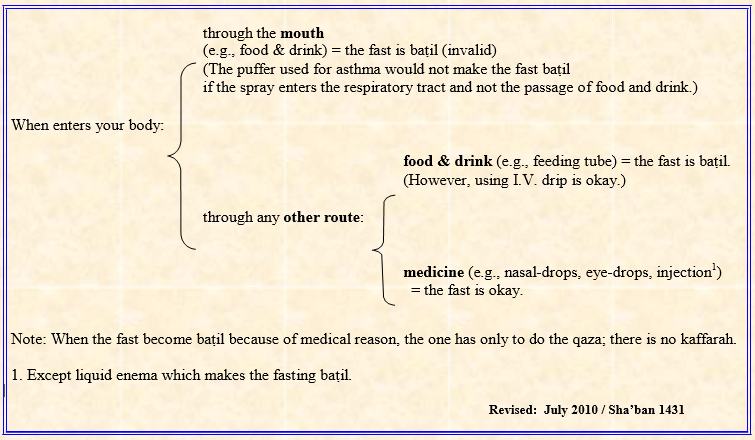
Fasting & Use Of Medicine
The Prophet's Sermon Welcoming The Month Of Ramadhan
Translated by Sayyid Muhammad Rizvi from Shaykh as-Saduq's 'Uyun Akhbar ar-Ridha, vol.2, p. 265.
*****
“O people, indeed the month of Allah has approached you with blessings mercy and forgiveness. In the eyes of Allah, it is the best of all months; its days are best of all days, its nights are best of all nights, and its hours are best of all hours.
“It is a month in which you have been invited to be guests of Allah, and you have been made in it the people who have honour of Allah. Your breathing in it is tasbih (singing the praise of God), your sleep in it is an act of ibadat (worship), your deeds are accepted, and your prayers are answered to. Therefore, ask your Lord with sincere intentions and pure hearts to help you in fasting during this month and in reciting His Book, For the most unfortunate is one who is deprived of Allah's forgiveness in this great month.
“By your thirst and hunger, remember the hunger of the day of judgement and its thirst. Give charity to the poor and needy among you; lower your glances from what is not permissible for you to see, and refrain [from hearing] what is not permissible for you to hear. Show sympathy to the orphans of the people, and sympathy will be shown to your orphans. Repent for your sins, and raise your hands in supplications at the time of your prayers for that is the best of times in which Allah looks towards His servants with mercy, answers them what they whisper to Him, responds to them when they call upon Him m gives to them when they ask Him, and accepts their prayers when they pray to Him.
“O People, your souls are dependent on your deeds, therefore, release them from Hell-Fire by asking for forgiveness. Your backs are burdened with your wight of sins, so lighten their burden by lengthening the sajdahs prostrations; and He shall not threaten with Fire when people will stand in prayers for the Lork of the Universe.
“O people, whosoever among you gives iftar9 meal to break the fast to a believer who is fasting during this month, his rewards with Allah will be the releasing of his neck from the Hell-Fire and forgiveness for his past sins”.
Someone asked: “O Messenger of Allah, not all of us have the ability to do that, “He said: “Fear the Fire! Even by breaking a date, Fear the Fire! Even by drink of a water!”
“O people, whosoever among you improves his character [khulq] during this month m he shall have the pass for going over the Sirat [the bridge] on the Day [of Judgement] when the feet shall slip. Whosoever lessens the burden of work from his slave and subordinates, Allah shall lessen his reckoning of his deeds from of his deeds for him. Whosoever prevents his evil from people, Allah shall prevent His anger from him on the day he shall meet Him. Whosoever severs the link with his relations in this month, Allah shall sever His mercy from him on the day he shall meet Him.
“Whosoever fulfils a duty in this month, his rewards will be multiplied seventy times compared to the same deed done during other months. Whosoever increases the Salawat on me during this month, Allah shall make their scales heavy [i.e., full of good deeds] on the day when He shall be lightening the burdens of other good doers. Whosoever recites a verse of the Qur’an during this month, he shall have the reward of one who has completed the recitation of the entire Qur’an during the other months.
“O people, the doors of Paradise are open during this month, so ask your Lord not to close them on you; and the doors of Hell are closed, so ask your Lord not to open them up for you. The satans are in chains, so ask Allah not to impose them upon you.”
Imam 'Ali (‘a) stoop up and said: “O the Messenger of Allah, what is the best deeds during this month? “The Prophet (S) said: “O Abu al-Hasan! The best of deeds during this month is to refrain from what Allah has prohibited”.
Then the Prophet (S) cried. 'Ali (‘a) asked: “O Messenger of Allah, what made you cry?” The Prophet (S) said ,“O 'Ali, I am crying for the injustice that will be done against you in this month, It is as if I see you that while you are praying to your Lord, the most wretched of the mankind....struck you with his sword on your head so that its blood coloured your beard”.
'Ali (‘a) asked: “O Messenger of Allah, will this happen while I am at peace with my faith?” The Prophet replied: “You will be at peace with your faith, O 'Ali, whoever kills you is as if he has killed me, whoever hates you is as if he hates me, whoever curses you is as if he has cursed me because you are to me like my own soul, your soul is from my soul and your nature is from my nature. Verily Almighty Allah created me and you, then He selected me and you, and chose me for prophethood. O ' Alim you are my heir, the father of my descendants m the husband of my daughter and my successor to my community in my life as well as in my death. Your command is my command and your prohibition is my prohibition. I swear by the One who raised me as the Prophet and made me the best of creation, you indeed are the proof of Allah upon His creation, trustee of His secret His vicegerent towards His servants”.
- 1. According to Ayatullah Sistani, submerging the head into water is strongly disliked but not forbidden.
- 2. Janabat is a state of ritual impurity najasat caused by sexual intercourse or discharge of semen.
- 3. Junub means the person on whom ghusl al-janabat becomes obligatory.
- 4. Qaza means to make up the fast during other days after Ramadhan.
- 5. Kaffarah means penalty.
- 6. Batil means null, void, invalid.
- 7. Fidya is different from kaffarah. Fidya is a “compensation” whereas kaffarah is a “fine”.
- 8. Nawafil means recommended or supererogatory prayers.
- 9. Iftar is the meal to break the fast.
