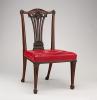
Chair

One of the basic pieces of furniture, a chair is a type of seat. Its primary features are two pieces of a durable material, attached as back and seat to one another at a 90° or slightly greater angle, with usually the four corners of the horizontal seat attached in turn to four legs—or other parts of the seat's underside attached to three legs or to a shaft about which a four-arm turnstile on rollers can turn—strong enough to support the weight of a person who sits on the seat (usually wide and broad enough to hold the lower body from the buttocks almost to the knees) and leans against the vertical back (usually high and wide enough to support the back to the shoulder blades). The legs are typically high enough for the seated person's thighs and knees to form a 90° or lesser angle.

204102

Sayyed Mohammad Al-Musawi, Sayyed Mohammad al-Musawi is originally from Iraq and heads up the World Ahlul Bayt Islamic League in London. Other than being involved in various humanitarian projects, he frequently responds to... Answered 5 months ago

If the Najis fabric is from pork or dog or non Halal animal skin, then there is no way to clean or purify such material. If the Najis fabric is not Najis Al-A'yn, then you can wash it with water and make it Taahir.

Wassalam.

200857

Zaid Alsalami, Shaykh Dr Zaid Alsalami is an Iraqi born scholar, raised in Australia. He obtained a BA from Al-Mustafa University, Qom, and an MA from the Islamic College in London. He also obtained a PhD from... Answered 6 months ago

Bismihi ta'āla

The fact that you've said "might have touched" and "unsure" makes the scenario hold no weight. In matters of taharah and najasah, it is only certainty that you act upon. As long as the cushion was washed, that is more than enough, and dismiss your other thoughts.

And Allah knows best.

194177

Sayyed Mohammad Al-Musawi, Sayyed Mohammad al-Musawi is originally from Iraq and heads up the World Ahlul Bayt Islamic League in London. Other than being involved in various humanitarian projects, he frequently responds to... Answered 11 months ago

It depends in what he can do and he can not do. He is responsible to do everything which he can in his Salah, like standing (Qiyaam). If he is unable to do Rukoo’ or Sojood, then he sit in a chair and do whatever he can. While sitting in a chair, Sojood is on a table in front of him, or he can take the Turbah (Mohr) in his hand and put his forehead on it.

Wassalam.

181582

Zaid Alsalami, Shaykh Dr Zaid Alsalami is an Iraqi born scholar, raised in Australia. He obtained a BA from Al-Mustafa University, Qom, and an MA from the Islamic College in London. He also obtained a PhD from... Answered 1 year ago

Bismihi ta'ala

If they are incapable of standing up, even with leaning, or prostrating on ground, or if they do so, there is unbearable pain, they can use the chair to perform their acts of salat, based on what they can do normally, or cannot. 

And Allah knows best

59954

Sayyed Mohammad Al-Musawi, Sayyed Mohammad al-Musawi is originally from Iraq and heads up the World Ahlul Bayt Islamic League in London. Other than being involved in various humanitarian projects, he frequently responds to... Answer updated 6 years ago

It depends on his real ability and the extent of it. Every Muslim is responsible to perform his worship in the proper way as far as he can. If there is a real inability, then what ever is possible for him is obligatory on him. If he can not stand at all, then he can pray while sitting, but if he can stand for a while then unable to continue standing, then he has to stand for Takbiratul Ehraam and what ever he can, then when he feels unable to continue, he can sit. If he can sit and pray, he can not then pray lying on bed unless he reaches to a stage that he can not sit. Standing is must as far as it is possible even part of it. Same with sitting for those who are unable to stand, then lying on bed for those who can not sit either at all, so they sit, or some times, so they sit according to their present ability.

Rokoo' and Sojood is performed also according to the extent of the ability.

Wassalam.