
Cleanliness In Islam
The Holy Prophet (S) said: “Try to be clean as much as you are able to. Verily, Allah has based the foundation of Islam on cleanliness; hence, never can a person enter Paradise but the clean ones.”1
Imam Musa al-Kadhim (‘a) said:
There are five traditions about the head and five others related to the body. The first five concerning the head are:
-
Rinsing the mouth
-
Trimming the mustache
-
Combing the hair
-
Rinsing the nostrils
-
Letting the beard grow
The second five concerning the body are;
-
Circumcision
-
Shaving the pubic hair
-
Depilating the arm-pit hair
-
Clipping the nails
-
Cleansing the private parts (after using the rest-room)”2
All this is done for cleanliness. For example, shaving the armpits is good for keeping down odor, since the hair traps in odors. Clipping the nails removes dirt from under them. Shaving the pubic hairs keeps down odor and also allows you to keep yourself clean. We should strive to be as clean as possible when we stand before our Lord in prayer. These aspects deal with the physical purification, which is the first level of purifying oneself.
Wudhu And Tayammum
Wudhu (Ablution) and Tayammum (Ablution in the absence of water)
يَا أَيُّهَا الَّذِينَ آمَنُوا إِذَا قُمْتُمْ إِلَى الصَّلَاةِ فَاغْسِلُوا وُجُوهَكُمْ وَأَيْدِيَكُمْ إِلَى الْمَرَافِقِ وَامْسَحُوا بِرُءُوسِكُمْ وَأَرْجُلَكُمْ إِلَى الْكَعْبَيْنِ… فَلَمْ تَجِدُوا مَاءً فَتَيَمَّمُوا صَعِيدًا طَيِّبًا فَامْسَحُوا بِوُجُوهِكُمْ وَأَيْدِيكُمْ مِنْهُ
“O Believers! When you prepare for prayers, wash your faces and your hands up to the elbows, and wipe your heads, and your feet to the ankles” … “and [if you] do not find water then betake yourselves to clean earth and wipe your faces and your hands with it” (Qur’an, 5:6).
Prior to performing the daily prayers, and as a recommended or obligatory prerequisite to other acts of worship, Muslims must purify themselves—this is usually done with water. The minor form of this purification with water is called Wudhu, while the major form is called Ghusl. If water is not available, the purification can be performed with clean earth or soil, and is called Tayammum.
When To Perform Wudhu
Every Muslim must be in a state of spiritual purification before performing the daily obligatory prayers. The same state of purification must also be achieved before numerous other acts of worship such as optional prayers, touching the script of the Qur’an, and the rites of the pilgrimage (Hajj). In most cases, it is sufficient to perform Wudhu in order to achieve this purification. However, at other times, a Ghusl must be performed. Please note that Ghusl (Full Wash) is not covered in this book.
How To Perform Wudhu
Niyyat: Make your intention as, “I am performing Wudhu for the pleasure of Allah, and to seek closeness to Him”.
Washing the face: First, remove anything on the face (and hands) that may prevent water from reaching the skin before beginning Wudhu (physical items such as a watch, ring, make-up, etc… or even things such as paint or anything which would act as a barrier over the skin). Take a handful of water in the right hand and pour this water over the face from the top (just above the forehead). Then, using the right hand, wipe the face from the tip of where the hairline is to the bottom of the chin such that the water reaches all parts from the hairline to chin, and the entire horizontal plane of the face within the reach of the span of the hand from the middle finger to the thumb. To ensure that all external parts have been washed, include a bit of the inner parts of your nose, lips, and eyes in the washing. You do not, however, need to wash the complete inner portion of these parts. Washing once as described above is obligatory. A second such washing is recommended while subsequent washings are prohibited.
Washing the arms: Using the left hand, pour water over the right arm from the elbow to the fingertips and then, with the same hand, wipe the water over both sides of the arm to ensure that all parts are washed. Then do the same for the left arm by using the right hand. The washing must be done from the elbows to the fingertips and not vice versa. Pour water from a little above the elbow to ensure that the whole forearm is covered. Wash in such a way that the water penetrates the hair, if any, and reaches the skin. Again, washing once as described above is obligatory. A second such washing is recommended while subsequent washings are prohibited.

Regarding washing of the face and hands:
Wash by pouring water from top to the bottom. Washing the other way will invalidate your Wudhu. In general, wash a little beyond the required limit in order to make sure all parts are covered.
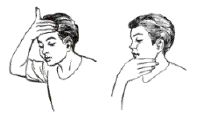
Wiping the head: Next, wipe the front most quarter of the head with the moisture that remains in your right hand. Wipe from the upper part of the head downwards (from the back of the head towards the face). It is recommended to wipe the length of at least one finger. When wiping the front most quarter of the head it is recommended to use three fingers together (the middle finger, index finger and ring finger). While wiping the head, your hand should not touch your forehead. Doing otherwise will cause the water of the forehead to mix with the wetness of your hand, and this will render the act of wiping your right foot invalid, since the act of wiping must be done with the wetness of the hands only.

Wiping the feet: Finally, wipe your feet with the moisture that remains in your hands. Wipe starting from the tip of the toes up till the ankle joint. Wipe your right foot with your right hand first, and then your left foot with your left hand. Perform this for each foot only once. It is better to wipe at least the width of three joined fingers (the middle finger, index finger and ring finger), and better yet to wipe your entire foot with your entire hand. At the time of wiping the foot, actually pull the hand from toes to the ankle joint (as described above) along the length of the toe-tips till the ankles. Do not just place your whole hand on your foot and pull up a little. Please note that wiping of the feet performed on socks or shoes are not valid.

Regarding wiping of the head and feet:
While wiping your head and feet, move your hand over them. Keeping your hand stationary and moving your feet / head under your hand will invalidate your Wudhu. However, there is no harm if your head and feet move slightly during the wiping. The parts you are wiping must be dry before you begin wiping, and if they are so wet that the moisture on your palm has no effect on them, the wiping will be void. Slight dampness on the part you are wiping is permissible as long as the moisture of the palm is immediately mixed with it when wiping.
Wiping must be done with the moisture remaining on the palms after washing. Do not re-wet your hands with new water. In the case where the palms become dry before wiping, the palms can be re-wet with water from the beard, moustache, eyebrows, or the other organs of Wudhu.
When To Perform Tayammum
Perform Tayammum in place of Wudhu or Ghusl when:
-
Not enough water is available for Wudhu or Ghusl.
-
Obtaining water for Wudhu will endanger your life or property or you are unable to procure water by any means.
-
Using the available water will leave insufficient water for drinking and pose a risk of thirst, illness, death or difficulty for yourself or your dependents.
-
Washing your face and hands with water will endanger your health.
-
Water is available but you do not have permission to use it.
-
There is a risk that performing Wudhu or Ghusl will cause the time of the entire or a part of the prayer to end.
-
If the body or clothing is ritually impure (najis) and the person possesses only as much water so that if he was to perform Wudhu or Ghusl, no more water would be available for making his body or clothing pure for prayer.
How To Perform Tayammum
Niyyat: Make your intention as, “I am doing Tayammum in place of Wudhu (or Ghusl), for the pleasure of Allah and to seek closeness to Him.”
Step 1: Strike the palms of both hands simultaneously on earth, sand, or stone (in order of preference) which is dry and clean. (See Figure 1).
Step 2: Pull both palms together from the beginning of the forehead where the hair grows down to the bridge of the nose. Both sides of the forehead joining the ears and over the eyebrows should be included. (See Figures 2 and 3)
Step 3: Then pull the left palm on the whole back of the right hand from the wrist bone to the fingertips. (See Figure 4)
Step 4: Then pull the right palm on the whole back of the left hand.
Step 5: Strike the palms together upon a valid surface a second time as in Step 1.
Step 6: Repeat Step 3.
Step 7: Repeat Step 4.
Figure 1:

Figure 2:

Figure 3:
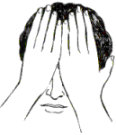
Figure 4:

