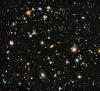
Universe

The universe (Latin: universus) is all of space and time and their contents, including planets, stars, galaxies, and all other forms of matter and energy. While the spatial size of the entire universe is unknown, it is possible to measure the size of the observable universe, which is currently estimated to be 93 billion light-years in diameter. In various multiverse hypotheses, a universe is one of many causally disconnected constituent parts of a larger multiverse, which itself comprises all of space and time and its contents; as a consequence, ‘the universe’ and ‘the multiverse’ are synonymous in such theories.

63189

Zoheir Ali Esmail, Shaykh Zoheir Ali Esmail has a Bsc in Accounting and Finance from the LSE in London, and an MA in Islamic Studies from Middlesex University. He studied Arabic at Damascus University and holds a PhD... Answered 6 years ago

Bismillah 

Thank you for your question. While the enactment God's Will is not limited by time, in His dealing with creation He chooses to work through processes and physical laws such as cause and effect. So while He can do whatever He wants in an instant, He chooses not to do that in every instance.

May you always be successful 

63188

Amina Inloes, Amina Inloes is originally from the US and has a PhD in Islamic Studies from the University of Exeter on Shi'a hadith. She is the program leader for the MA Islamic Studies program at the... Answer updated 6 years ago

It is possible that Allah created the entire universe just for humanity; however, there are some hints that there are other creations out there and we simply don't know them. For instance the Qur'an speaks of the things that we do not know. A narration from Imam Ali (A) mentions that the other stars in the sky are cities or civilizations (mada'in) like the cities on earth. I think it is reasonable to assume that in the vast universe there are other beings, whether or not we will ever know of them during the span of existence of humanity, God knows best. However, what can be said is that what we have on earth is comfortable for us - especially if we consider the conditions of other planets like Jupiter - and that part of the miracle of creation is that we can look out at the sky and stars from our own vantage point and see it perfect for ourselves, in terms of timekeeping, light, heat, etc, and yet it can still host many other creations. 

61881

Zoheir Ali Esmail, Shaykh Zoheir Ali Esmail has a Bsc in Accounting and Finance from the LSE in London, and an MA in Islamic Studies from Middlesex University. He studied Arabic at Damascus University and holds a PhD... Answered 6 years ago

Bismillah

Thank you for your question. The scriptural sources are clear in the fact that God cannot be known in His entirety with the faculties that humans possess. This is because a being limited to time and space cannot expect to understand a Being who is unlimited in every way. The system of creation is perfect in the sense that there is no imperfection in the way it functions and that indicates towards the Attributes of God, but those Attributes are only comprehended to the extent of our ability. The further one is able to explore the creation the better they will comprehend the Attributes from that perspective. The level of that investigation depends also on the epistemological tools that they are using. There is no way to fully understand the mind of God, especially through a process of induction from His creation.

May you always be successful

53222

Zoheir Ali Esmail, Shaykh Zoheir Ali Esmail has a Bsc in Accounting and Finance from the LSE in London, and an MA in Islamic Studies from Middlesex University. He studied Arabic at Damascus University and holds a PhD... Answered 6 years ago

Bismillah

Thank you for your question. This is a scientific issue not specifically directly discussed in any scriptural sources that i know of. It is interesting as it would mean that energy is metaphysical, but it would have to be proven before any type of research into its implications would be carried out.

May you always be successful. 

53282

Amina Inloes, Amina Inloes is originally from the US and has a PhD in Islamic Studies from the University of Exeter on Shi'a hadith. She is the program leader for the MA Islamic Studies program at the... Answered 6 years ago

The idea that the Ka'ba is the "House of God" is metaphorical. It is called the "House of God" because it is an ancient center of worship and a sacred land with special spiritual characteristics that people can physically go to to have a stronger sense of God or the spiritual world. Also, according to narrations, angels frequently visit it.

However, according to mainstream Islamic belief, God does not exist in any physical place or time. This is because the universe is created, and God is not material or confined by space or time. God is aware of everything in the universe and in control of it but not actually in it. (That is, a refutation of pantheism)

Some might say that the universe is a manifestation of God or Gods' attributes, or that material creation is dependent on God for its continued existence, but God is not actually inhabiting the universe. Indeed, in the Qur'an, God introduces the possibility of multiple universes (since "God of all the worlds" can also mean "God of all the universes") and speaks of the creation and destruction of the universe. Of course, sometimes mystics and others have their own ideas about the nature of the divine.