
Chapter 1: God
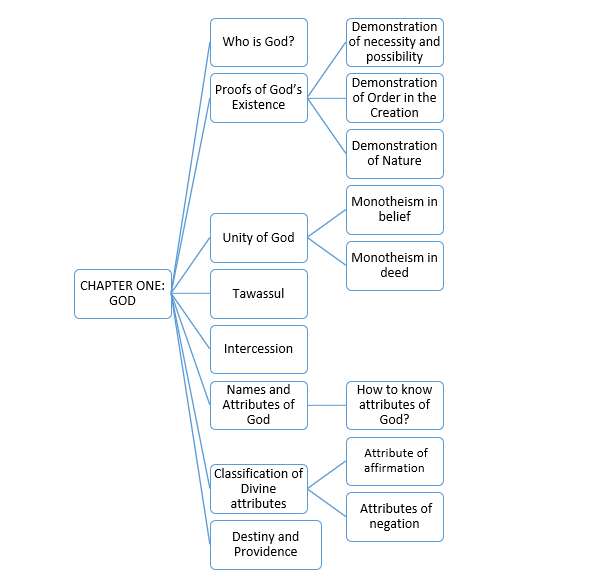
Who Is God?
God is the only All- Sufficient and Eternal being who existed before everything and He will exist forever. No one has created Him and nothing is qualified to be His partner or child; the All- Creator who originated the heavens, the earth, and whatever exists between them1.
One of His creations is the human being2.
God is All- Infinite, non- physical, All- Perfect, etc. He is beyond our imagination, for nothing is similar to Him and He is not finite. Attempting to imagine God, is limiting He who is infinite to our finite minds.
He has created human beings and provided them with guidance through which human beings can know Him as much as possible, however, the human being does not know or honour Him as He truly deserves3. We should take into serious consideration that God is greater than what people describe or imagine4.
Proofs Of God’s Existence
So, God exists, but what’s the proof? Let’s take a look at the Qur’an which has provided us with various proofs for God’s existence. The pillar of these reasons is our God-given intellect, our power of ratiocination. Intellect has a crucial role in the teachings of the Qur’an and the Qur’an repeatedly praises the wise who use reason. Here are the proofs the Qur’an presents.
Demonstration Of Order In The Creation
Imagine being given a device which has a specific order and specific rules as to how it functions. Let’s say it’s a car, or a plane, or maybe something new that you haven’t seen before. What is your first idea? ‘Who’s created it’ because there must be a creator with a specific plan and an aim for any organized creation. Could it have been created with no intention, by nobody and for nothing; a complete coincidence by nothing? Did smartphones suddenly come into existence from nowhere?
If you see thousands of copies of something, does your reasoning lead you to think that they must have come to existence by sheer coincidence? Could all the complex and smallest parts that connect together to form a single complex unit have come to existence by coincidence? Is that how we have airplanes?
Obviously, there must be a creator. This is the demonstration of order which is classified as follows:
-
Man and the universe are organized creations, following scientific laws.
-
Every systematic and scientific creation should have creator(s).
Conclusion: There must be an incredibly intelligent creator for Man and the universe. This is an undeniable fact, no doubt about it.5
The Qur’an gives different examples about the signs of the scientific creation of the human being and the universe in order to guide human beings that there is indeed a creator behind this creation. But who is it? The Qur’an introduces Him: God, the All- Mighty and All- Wise who has created all this for a reason. There is wisdom behind our creation, and God invites us to discover it. 6
There are several verses in the Qur’an that talk about demonstrations of order, but we’ll suffice to mentioning only two:
“Indeed, there are (clear) signs in the creation of the Heavens and the earth and in the alternation of the day and night for the wise” (3:190).
We clarify the mentioned verses as follows:
The way the creation has been organized, the earth, the heavens, the alternation of day and night, are signs of an existing creator(s). The wise who use their reasoning will perceive that there must be a wise and powerful designer and creator for this.
“Do you not consider that the birds are kept in the sky! It is God who keeps them (there). Indeed, there are signs in it for the people who believe” (16:79).
How can birds fly? How can they stay in the air without falling? What system has been designed for them?
Hundreds of years after this verse, scientists took a good look at the bird and created the airplane. Airplanes have a wise creator, we all agree, but birds don’t?
We can find thousands of examples that show it is impossible to have such creations without a lasting, wise, and knowing creator.
This demonstration states that every systematic and scientific creation should have a creator or creators, so human beings and the universe, both of which are systematic and scientific, must have a creator too.
Demonstration Of Nature
God created the human being and He provided him with a Divine nature7.
This nature enables him to seek and find God in his heart if his heart is not covered with neglect, therefore, when he is in distress, without help and hope, he finds that there is someone, a powerful one who can help him.
This is because God has created this feature in the nature of human beings, however, if human beings are engaged in daily life, their natures are hindered by neglect, so they cannot see God in their hearts; this is why God sometimes strikes human being with calamity and disasters in order to uncover his heart from neglect that they may heed to truth and grow humble8.
Not only has God created human beings with Divine nature but also His religion has been designed in accordance with the Divine nature placed within human’s nature9 because of this fact, God invites human beings to follow the religion of God, which is in accordance with the nature of human beings and human beings’ ability to seek God within his heart.
imagine you are in a ship in the ocean, suddenly the ship is engulfed with the stormy water of the sea and you see that you will die, you lose your hope in all material means, however, a ray of hope rises within you that there is a Powerful One who is able to save you. It is because God, your creator, has created this nature in your soul that you feel His presence without seeing:
“And when they are on a ship (in the sea and see their death with their eyes) then they sincerely pray to God (for help) but when we save (and take) them to (safe) land they ascribe partner(s) to God” (29:65).
Even though the love for worshipping God is in the nature of the human being, he still needs knowledge and guidance to awaken this nature which is under the cover of neglect during the attractive daily life, otherwise, human being in spite of His nature can be lead astray or deceived. In addition to what we said, even though the Divine nature placed in the souls of human being seek God but human beings need guidance to recognize God as He deserves otherwise, they may make a mistake and worship false deity or deities instead of the One Real God, the All- infinite.
Demonstration Of Necessity And Possibility
This demonstration says that God is All- Sufficient while creation is needy, and the needy depend on the All- Sufficient in order to exist. The needy depend on the All- Sufficient for receiving existence; the following verses mention this fact:
“Oh People! You are in (great and real) need of God; and God is the All-Sufficient, the All- Praised.” (35:15).
“And it is He who makes you rich and gives you wealth.” (53:48).
In order to clarify this demonstration, we explain some points as follows:
Any being can either be dependent (needy) or independent (self-sufficient). The former depend on others for their needs and existence.
It’s like a chain. A depends on B, while B depends on C, and C depends on D. D will also depend on something else, say E, unless it is self- sufficient. So, our ratiocination judges that this chain must stop somewhere, we must reach a self- sufficient being, otherwise we have an infinite regress. For this chain to function, at the end there must be a self- sufficient being that emanates existence.
Unity Of God

Unity of God is the pillar of the teachings of the Qur’an and other Divine religions. In fact, God is One, infinite, non-physical, and simple10 existence. All of the attributes of God and His essence is one reality. His essence and attributes are equal. The Qur’an puts great emphasis on this. division between God’s essence and attributes is only a purely mental division; unity of God is mainly discussed in two parts:
-
Monotheism in belief
-
Monotheism in practice
Monotheism In Belief
Things a monotheist should believe:
Unity Of Divine Essence
God is one, simple and infinite in His essence; His essence has not been composed of subunits. To prove the unity of God, the Demonstration of Tamanu‘ is mentioned in the Qur’an:
This demonstration indicates that if there were more than one real God, they would have quarrelled and competed against each other, each trying to grab more power than his competitor, thus we would have corruption in the universe and lack of order, harmony, and coordination. Imagine the Greek and Egyptian Gods for instance.
Obviously, this is not the case. In fact, we have a very harmonious and organized creation. So, there must be one powerful and wise Lord who exercises power exclusively. Take a look at the world around you, at science, this harmony and coordination in the creation demonstrates a Single Lord who manages them. The Qur’an mentions this fact as follows:
“If there had been gods beside God in them11, they would have fallen into ruins, so God, the Lord of the throne, is glorified greater than what they say (and ascribe to Him)” (21:22).
Unity Of Divine Attributes
Although we attribute many traits to God, it does not mean that God is constituted of many attributes but rather He is one simple and infinite reality, the All- Perfect and the attributes of God are only our way of trying to fathom God’s reality. We want to introduce Him better to the human mind, because no word can describe Him as He deserves.
There is no difference between God’s attributes and His essence, they are equal, with no separation between them.
Unity Of Divine Deeds
All deeds in the creation go back to God, directly and indirectly, and nothing occurs without His permission.
God is the sole independent creator of the existence. He has created all things. Everyone else’s actions are dependent on God. It is He who has provided them with power, intellect, and free will, otherwise we would have been completely unable. Only God is All- Independent. He is the creator of existence and is needless of all. therefore, all events, are actually His deeds because they are done with his permission. In this sense, even evil deeds are attributed to God12, although He is displeased with it, yet He does not prevent His servants from revealing their evil intentions because this is a necessary factor for the Divine test.
It is worth mentioning that even though evil deeds are attributed to God however He never commits evil deeds Himself and is never pleased with it. God created us and gave us power and free will, but He commanded us to use that power for goodness, although some humans and jinns misuse their power and serve the evil. Usually, God doesn’t prevent the evildoers because He tests them. Had He prevented them from such deeds then testing would be meaningless. In order to clarify more, we divide Divine deeds in two parts:
There are some verses of the Qur’an in which God attributed the deeds and actions in the creation exclusively to Himself e.g. He says, “I created …”
In these types of verses God directly states that He is the All- Creator i.e. the Unique All- Independent creator; there is no one equal to Him, and all creation depends on Him. God has also designed intermediaries and scientific laws used in, and by creation, but He Himself has designed and created the different factors, elements, and intermediaries and given them their role.
All of being work with God’s power and permission directly or indirectly. In other words, all depend on Him and He is the only Independent Creator.
Where does that put the rest of the creators? Like the creators of electronic devices, or this book? Their creation is not spontaneous in its origin, they have sought and used other people’s help, and used materials that had existed before. They are working under God’s permission and power.
A question is raised here. Is it wrong to think that a particular doctor, for instance, has cured us with his drugs? This is a misunderstanding, so long as you know that neither the doctor nor his drugs are independent of God, it is neither wrong nor sinful, but if one imagines they are independent of God or equal to Him, that is a grave mistake, as the Qur’an says.
The following verse is an example of this type of performer or doer:
“You did not kill them but God killed them, and you did not throw when you threw but this is God who threw (for you, therefore, you only applied the power, will, and intellect etc. that God has granted you and you depend on Him,) that He may test the believers with a good test. Indeed, God is All-Hearing, All-Knowing” (8:17).
The second type of the verses attribute deeds to other performers in addition to God; He mentions the intermediaries in this type of verses through which His commands run, contrary to the first types of deed in which, He does not mention intermediaries and he only attributes deeds to Himself as the source of all things. In the second type He mentions the intermediaries and secondary performers, that is because, God desires to perform and manage His deeds through some intermediaries. This is why He mentions the intermediaries as dependent and secondary performers.
This does not mean that God needs them nor does it mean He has partners in the creation, but rather God gives roles to them and they are dependent on God in all aspects. All the things that people perform are in this group.
It is better that we add that even though human beings are dependent on God in all aspects, but God has given us free will to choose the path of our life.
Important aspects of unity of deeds are as follows.
Unity Of Governance
God has created the heavens and the earth and manages their affairs. So first there is creation, then governance. He leads the creation towards its goal. This fact is explicitly mentioned in the Qur’an. Some of these verses are:
“Say, who is the Lord of all the heavens and the earth? Say, God” (13:16).
“God is your Lord and the Lord of your fathers who lived before” (37:126).
Unity In Legislation
The right of legislation is exclusively for God. He, as the All- Creator and the All- Wise. He knows best what is needed and how the needs of the creation should have been fulfilled on the way to perfection and prosperity; His law is in accordance with the facts of creation, but the ignorant wrongfully interpret God’s law under the title of Islam or create false laws as they wish. They create a bad and deficient image of God’s law because they know God’s law prevents them from their illegitimate ways. God warns that whoever issues laws against what God has given has gone astray13.
Hence, the Messengers of God who were allowed to issue commands and judge with truth14, i.e. God’s law, did so according to the will of God. They were obedient to God, which is why they were chosen and why God commands the rest to be obedient to them.
Unity In Sovereignty
The Qur’an discloses that God is the All- Sovereign, any other sovereignty requires the permission of God15. These people are chosen and sent by God, they are the Messengers and those chosen by the Messengers. They are the vicegerents of God on earth and they have the right to exercise power on the basis of God’s law. They do not break God’s law. God says to David:
“O David! We chose you as a Caliph on the earth” (38:26).
Divine Will
God is able to perform whatever and whenever He desires, so when He desires to create something, all that is required is His will, and the being immediately comes into existence16.
You may raise a question that why some things take time then? Why does it take a child 9 months to be born, although God has built it, why did it take minutes or hours or years for the earth to be created after the big bang, although God had willed it?
It is worth mentioning that it is God who has willed that the world and all things in the world function through natural and systematic ways within specified times and conditions; He has done so in order to pave the way for ideal life of living beings and in order that He may test mankind in natural conditions.
Two Types Of Divine Will
In order to clarify the aforementioned issue we mention two types of Divine will, as follows:
Legislative Will
God created law and issues commands to His servants to observe the law. That is, they should perform the compulsory and recommended deeds and avoid the forbidden, such as oppression. It is worth mentioning that even though He wills, no one is forced, otherwise that would retard the aim of Divine tests. Those who practice His commands are following His (legislative) will, and if they disobey, they disobey His (legislative) will.
Generative Will
Generative will of God is His creation; when He desires to create something He only wills and it comes into existence without hesitation. In this case, no one can disobey God. e.g. God has willed that the earth orbits the sun, so no one can change it.
A point worth considering:
Those who lead people against God’s will are called Taghut. The believers are forbidden from following the Taghut, because they lead mankind astray. There may be some goodness in them, but their harms are greater; God strongly forbids believers to refer to them as leaders or judges:
“Have you not seen those who imagine that they believe in (the teachings) which has been sent down to you and in (the teachings) which has been sent down (to the prophets who lived) before you, (but) they ask the Taghut17to judge between them (when they have an argument) while they have been ordered to refuse obeying them? And Satan desires to lead them far astray” (4:60).
“Those who believe fight in God’s path, and those who disbelieve fight in the path of the Taghut” (4:76).
Monotheism In Practice
In this classification of unity: we introduce the deeds that the believers should do exclusively for God e.g. the believers should only worship God or trust only in Him.
Monotheists should consider the following aspects in their deeds:
Unity In Worship
Worshipping means becoming humble before someone or something, holding the belief that he/she/it is Lord, it is such because you consider that all things are in his/her/ its power and he/she/it can independently change your fate or solve your problems. Thus, God commands human beings to worship Him alone and avoid worshipping and following Taghut18; this is why He sent the Messengers to deliver His message and show the right way of worshipping God in order to enable human beings to prosper.
Thus, respecting people e.g. their parents19, teachers etc. holding belief that they are servants of God, dependent on Him or using different types of tools and means to reach one’s goals and objectives is recommended in life but the believers should take into consideration that it is God who created all things and all of them are in need of him and they cannot have any effect or do anything without His permission:
Therefore, we draw conclusion that if you hold the belief that someone is completely independent and he is able to cause harm or bring benefit without God’s permission it is forbidden because human beings should take into consideration that all things are in hands of God and if a human being exercises power it is God who has given power and life to him and other existents, whether he misuses power or uses it in accordance to God’s law. But if you become humble in front of someone like your parents as a sort of respect and obedience to God and hold the belief that they are the servants and creatures of God and dependent to Him and they are unable to do anything without His permission, it is not forbidden but rather in actual fact it is a way of worshipping God because you respect and show kindness to someone for the sake of God and in accordance to God’s law and commands. Like when God commanded the Satan to prostrate to Adam20; but Satan disobeyed God and neglected that it is God who commands to prostrate to Adam and if he had prostrated to Adam he would have obeyed and worshipped God rather than Adam.
Unity In Obedience
God is the All- Creator, the All-Wise, and the Only Eternal One who depends on nothing but Himself i.e. He is Self- Sufficient21. Therefore, only God and those who have received permission from God must be obeyed 22 e.g. the Messenger and his holy family, because they invite to whatever God commands23.
Our destiny is God. We cannot exist without Him. The All- Compassionate and All- Merciful designed laws and rules to guide us to salvation and prosperity, that is, the eternal heaven with its permanent pleasantness and serenity.
God loves His servants and wants all the best for them, but He never forces us. We have been given free will, intellect, and Divine guidance through the best teachers. God promises to help those who take to his path, which is why He and His Messengers should be obeyed:
“O Those Who Believe! Obey God and obey the Messenger and those who are in authority among you. If you get involved in an argument about any matter, refer it to God and the Messenger if you have belief in God and the Last Day” (4:59).
“Whoever obeys the Messenger, indeed, he has obeyed God” (4:80).
Hence, we come to these conclusions:
-
God deserves to be obeyed alone. It means human beings should perform their actions according to His directions and commands and avoid obeying those who oppose God and His law (i.e the Taghut). The believers who have belief in God and His promises, if they desire to attain the good eternal life should obey God’s Law, which has been clarified by His Messenger along with those who are chosen by God and introduced by the Messenger, i.e. the Holy Household of the Messenger, otherwise they will fail to prosper.
-
This obedience is not a blind following nor does it prevent human beings from improvement. Divine guidance directs us, lest we suffer from misguidance. Human beings lack knowledge in many aspects which God is fully aware of, e.g. the details about the soul and the Hereafter.
-
Those who claim to accept God but refuse His Messenger have in fact disobeyed God Himself, because He commands us to be obedient to the Prophet.
-
Divine laws do cause limits, but those limits do not deprive us from prosperity, rather they pave our way towards true felicitousness. We must refrain from harmful things otherwise we shall lose. When we accept this, it becomes clear that the limitations Divine law causes are the keys to prosperity.
Unity In Loving
The believers love God as He should be loved and they love nothing more than God. They prefer His pleasure over all things.
“The believers love God deeper” (2:165).
He is the All- Beautiful, the All-Sufficient, the All- Knowing, He loves His servants, so the true believers love Him too. Unity in love means the believers should prefer the love of God over the love of others and they should love God deeper than others. We should prefer God over ourselves. We also love ourselves, our children, family, and belongs, but this love should not prevent us from fulfilling our Divine duties, and we should prefer God and his messenger more.24
Hence the believers avoid sins because they love God, as Joseph who preferred to be imprisoned but he did not commit sins25.
This does not mean that we shouldn’t love our parents, spouses, children, friends, etc. In fact, God is Compassionate and He wants us to be compassionate too. What’s important is to have a deeper love for God than anything else.
Unity In Trusting
Trusting in God the All- Powerful is a quality of the true believers. The believers are certain that God is All- Powerful and nothing can exist without His permission. They are sure that all things are in God’s hands, so they do their best in all aspects but they are not anxious about the result:
“The believers put their trust in God” (3:122).
Trusting in God alone means that the believers are certain that all things are under the power of God, so they are not anxious about the result of their deeds so long as they perform their duty. Their hearts are at peace.
The hearts of the believers are at peace about God and His promises, and at the same time, they do their best and seek God’s help to perfect it. Thus, trusting in God does not mean laziness, because the Qur’an has taught that the value of human beings is only measured according to his strive and effort:
“Only whatever human being strives for belongs to him” (53:39).
“And whoever desires (to gain the permanent life of) the Hereafter and struggles (to achieve it), while he is a believer, then his efforts will be appreciated” (17:19).
This is a law in the world that those who give up working, struggling, and acquiring knowledge, will not be successful in the world or the Hereafter, because human beings take the fruit of their own deeds, so not only should he struggle for his life but should also do his best to achieve the rewards of the life to come. But if we fulfil our duty, then the result is with God:
“Put your trust in God, and (know that) God is enough for you as a guardian” (4:81).
Tawassul
Tawassul literally means using a means to achieve a goal. A believer can use different means to receive Divine mercy and forgiveness. These means are not independent from God, for they have been created by God Himself in order to help mankind to receive His mercy. God commands the pious to seek means for proximity to God26. These means can be Taqwa, prayer, reciting the Qur’an, or asking the Messenger to pray for forgiveness. As the children of Jacob asked him to pray to God for their forgiveness27.
We know that when people die, they are transferred to the Hereafter, so in fact, they are not dead in the sense of ceasing to exist, but they are living in the World of Unseen. Some of these people, such as martyrs and the Messenger and his holy family are near to God in the Hereafter, therefore, if the believers ask the Messenger 28 or his holy family or a martyr to pray to God it is not a sin, but a way which God has made to show His mercy on people. We can ask for anything, for instance, forgiveness, a blessing, or to salute the Prophet and his family. These are the methods and ways that God has created. Some disbelievers and polytheists pray to idols in the hope of achieving benefit. This is an unpermitted and wrong way 29.
Intercession
Intercession (Shafa‘at) means that the Messenger and the pious will intercede for some believers on the Day of Judgment so that they are forgiven by God.
Intercession is not nepotism or friendship. Unlike earthly life where nepotism and connections serve the disbelievers to get away with their crimes, the Hereafter accepts no such thing. Such connection will not serve the wrongdoers on the Day of Judgment.30
Believing that God will show mercy to some sinner on the Day of Judgment because of the prayers of His special servants, including the Messenger and his Holy Household, it is neither a sin nor forbidden. These special servants are introduced in the following verses:
“And only those who have made a covenant with God have (the right of) intercession” (19:87).
“He knows what is before and behind them, and they only intercede those whom God is pleased with and they stand in awe of Him” (21:28).
The aforementioned verses prove the existence of intercession on the Day of Judgment, however, intercession cannot cover for everything, for instance, cheating, mocking God, ignoring the truth. No! this group will not be saved or interceded for, as the Qur’an mentions31.
So, to sum up, intercession is a mercy from God for sinners who are qualified for it, as defined by God. Intercession does not violate God’s sovereignty, in fact it confirms it, for the Prophet prays to God for an intercession to be accepted. Intercession is not done independently from God. Believers must sincerely have faith in God’s Unity. Among our duties, we must refrain from wrong deeds such as mocking the Messenger and his family, or denying intercession.
Names And Attributes Of God
How To Know The Attributes Of God?
A: Book And Tradition
One of the reliable ways to know God’s attributes is His book along with the teachings and traditions of His Messenger. God as the All-Wise and All- Knowing, knows Himself best and He introduced Himself in His book, therefore, the Book and the teachings of the Messenger are the most reliable way to know God’s names and attributes.
B: Ratiocination
Intellect and reason are God’s favour bestowed on human beings. It paves the way for human beings to think, understand, and make judgment. Look and analyse the great signs of creation, the winds, clouds, suns, stars, Man’s physiology and that of the animals, and discover the qualities of our creator, such as power, knowledge, wisdom, and mercy.
Reasoning is an exclusive feature of Man. We discover the realities through our reasoning. This is why the Qur’an repeatedly criticizes those who do not use reason32 and it clarifies the signs and teachings to the wise who use reason.33
The importance of using reason is undeniable in the Qur’an, thus the Qur’an condemns those who do not use reason and turn a blind eye to truth; the Qur’an introduces such people as those who are like the deaf, the dumb, and the blind, or like the animals or worse.34
God constantly invites us to study His creation, for it reveals some of the attributes of its creator, such as power and knowledge. Think about the greatness of the universe and the human body and is it possible not to say Subhana Allah35? God repeatedly mentions some of His signs in the creation in order to introduce Himself lest His servants go astray.
“We will show them Our signs in the universe36and in their soul37so it becomes evident to them that He is true” (41:53).
“There are (clear and convincing signs) for those who use reason in (studying) the creations of the heavens and earth, and alternation of nights and days, and the ships which run on the sea, by which people earn profit, and the water which God sends down from the sky, by which He revives the earth after it is dead, and dispersion of all creatures on earth, and in the movements of the winds and clouds, which are controlled between the sky and the earth” (2:164).
A point worth mentioning:
God, the Infinite, the Independent, the Self-sufficient, source of all goodness; the sole flawless existent. He has no components or ingredients. He is not physical and has not been constituted of anything. No one is equal to Him and all things depend on Him. He is All-Perfect; words cannot describe Him as He deserves. That is why many words, attributes and names are used to describe Him. The Qur’an uses different attributes and names to introduce God too; all of the names and attributes are different features of One infinite God. The Qur’an uses different attributes to say that God is flawless because words are too weak to introduce God, the All- Infinite.
Classification Of Divine Attributes
The attributes of God are discussed in two aspects:
Attributes Of Affirmation
Attributes of affirmation (Sifat al- Thubutiyah)
The qualities which are attributed to God e.g. the All- Independent, All- Mighty, All- Sufficient.
This can be classified in two parts:
-
Attributes of essence; life of God, knowledge, and power of God.
-
Attributes of deeds e.g. provider, creator.
Attributes Of Essence
We said that God’s essence and attributes are equal, they are one. So there is no difference between attributes and essence of God, but we use this type of defining to introduce God, so we can understand better38.
The attributes of essence are divided into three main attributes:
Knowledge
One of the main attributes of God is His infinite knowledge. He knows all things. He knows how to create and what to create. He knows the past, present, and future, for He is beyond time. His knowledge is incomparable with the knowledge of human beings, it is exclusive to Him and he can disclose some parts of it to whomever He wills 39, for instance His Messengers. The fact that God knows the future and the fate 40 does not contradict our free will, this special knowledge does not interfere with the freewill of human beings.
Might
God is All- Mighty. He can do all things as He created the heavens, the earth, and the human being. He is able to recreate, resurrect, or create their likes.
Question: Is God able to do impossible things?
Impossibility is discussed in two aspects: The event or thing which is naturally impossible to occur. For instance, can a dead person be alive?
Events which are rationally impossible for instance, passing a camel through a needle's eye without changing the size of the camel or needle's eye is rationally impossible; this is the perfect order that God has designed with His infinite knowledge and wisdom, therefore, when God grants the needed capacity to the subject, then performs it, because they are not qualified enough to receive God’s powers, so even though God is able to do all things, but they do not have the capacity to take it.
Life
God is primordial and eternal. All life emanates from Him. He is Self-Sufficient, while the rest of creation depends on Him, like the beams of light which depend on the source of light. If the source is cut, they will not exist anymore.
Attributes Of Negation
Attributes of negation (Sifat al-Salbiyah)
Contrary to the creation, God has no flaws or limits, indeed, no one is equal to Him. God’s knowledge is not limited like human being, His power is also unlimited, unlike Man, because He is infinite, Self- Sufficient, All- Independent, therefore, His attributes are infinite too, without any limits or flaws.
Attributes of negation mean that some attributes or qualities which degrade God’s Real Exalted position must not be attributed to God; thus, we negate all sorts of limitations, flaws, and weaknesses from God e.g. being physical, seeable, touchable.
So, when we read in the Qur’an about some attributes of God such as, hands of God, face of God, we should take into serious consideration that these are linguistic expressions used artistically for us to understand and they do not convey literal meanings. Some ignorant people in the past41 took these expressions literally, thus limiting God to the flaws of being a physical entity; the Qur’an says He is not like anything42 because all things except Him are mortal.
- 1. Refer to Holy Qur’an, 42:11.
- 2. Refer to Holy Qur’an, 23:12.
- 3. Tabrisi 1372 Sh, 7/152
- 4. Refer to Holy Qur’an, 6:100; 21:22; 23:91; 37:59; 43:80.
- 5. Refer to Holy Qur’an, 14:10.
- 6. Refer to Holy Qur’an, 6:102; 13:16; 40:62, …
- 7. Refer to Holy Qur’an, 30:30. Tabari 1412 A.H., 21/26, Bahrani 1995, 4/342, Fayd al-Kashani 1415 A.H., N. Makarim Shirazi 1373 Sh., 16/418, F.-D. Razi 1420 A.H., 25/99.
- 8. Refer to Holy Qur’an, 7:94.
- 9. Refer to Holy Qur’an, 30:30.
- 10. I.e. God has not been composed of other parts. He has no parts or ingredients; He is One, He is simple.
- 11. The heavens and the earth.
- 12. Refer to Holy Qur’an, 113:2.
- 13. Refer to Holy Qur’an, 5:44.
- 14. Refer to Holy Qur’an, 12:67.
- 15. Refer to Holy Qur’an, 12:67; 6:62.
- 16. Refer to Holy Qur’an, 16:40; 24:45. N. Makarim Shirazi 1374 Sh, 2/551, Tabatabaʾi 1417 A.H., 3/197
- 17. . Those who do not judge according to God’s teachings.
- 18. Refer to Holy Qur’an, 16:36.
- 19. Refer to Holy Qur’an, 17:24.
- 20. Refer to Holy Qur’an, 2:34; 7:11; 17:61; 18:50; 22:77; 41:37.
- 21. Refer to Holy Qur’an, 2:263; 2:267; 27:40; 31:12; 39:7; 64:6.
- 22. Refer to Holy Qur’an, 3:50; 26:108; 71:3.
- 23. Tusi 1405 A.H., 10/132, Tabatabaʾi 1417 A.H., 71/3, A. l.-F. Razi 1408 A.H., 19/423, Tabari 1412 A.H., Tabrisi 1372 Sh, 10/543, F.-D. Razi 1420 A.H., 30/649.
- 24. Refer to Holy Qur’an, 33:6; 5:38; 2:177; 9:24.
- 25. Refer to Holy Qur’an, 12:33.
- 26. Refer to Holy Qur’an, 5:35.
- 27. Refer to Holy Qur’an, 12:97.
- 28. Refer to Holy Qur’an, 12:95- 98.
- 29. Refer to Holy Qur’an, 17:57.
- 30. Refer to Holy Qur’an, 2:48; 2:254; 2:255.
- 31. Refer to Holy Qur’an, 74:48.
- 32. Refer to Holy Qur’an, 2:171; 5:58; 5:103; 8:22; 10:42; 10:100, etc.
- 33. Refer to Holy Qur’an, 2:269; 3:7; 13:19; 14:52; 38:29; 39:18; 2:164.
- 34. Refer to Holy Qur’an, 8:22; 10:42; 7:179; 25:44.
- 35. Ibn ʿAshur 1405 A.H., 2/75, N. Makarim Shirazi 1373 Sh., 1/551, A. l.-F. Razi 1408 A.H., 2/267, F.-D. Razi 1420 A.H., 4/162, Suyuti 1404 A.H, 1/163
- 36. E.g. earth and heavens.
- 37. In themselves, in their souls or spirit.
- 38. Refer to Holy Qur’an, 7:180.
- 39. Refer to Holy Qur’an, 72:27.
- 40. Refer to Holy Qur’an, 31:34; 57:4; 64:11; 3:29.
- 41. Refer to Holy Qur’an, 7:190; 9:31, …
- 42. Refer to Holy Qur’an, 42:11.
