
Usool Ad-Deen
Roots or the Fundamentals of the Faith are Five:
-
Tawhid - The Unity of God.
-
Adalah - The Divine Justice.
-
Risalah - The Apostleship
-
Imamah - The Divine Guidance.
-
Qiyamah - The Day of Final Judgment.
‘Tawhid’ - The Divine Unity
The Existence Of God
Man has got himself sunk so deep in the lust of the immediate pleasures in the fulfilment of his carnal desires that he is now helpless against his rebellious self and feels his inability to get out of its clutches. Some have drenched the cloak of their souls so badly that they have lost the hope of its ever being cleaned of the blots and in their despair makes them resort to deluding their minds by the denial of the existence of God Himself, to fool themselves for the time being with the false and grossly deceptive arguments that neither there is any supreme authority, nor their rebellion is ever going to be subjected to any questioning or requital by anyone. On the other hand, none with common sense can ever doubt about the existence of God. One can even deny his own existence in some philosophic sense or the other, but can never deny or even doubt the undeniable, the undoubtable phenomena of every effect having a cause of it.
The basis of all scientific investigations is the fact that there could be no effect without a cause. The Holy Qur’an has, only in a few words of a single interrogatory clause, cornered the denier of the existence of God, himself to be convinced that there is God, without any doubt, Who is the Originator of the phenomena of cause and effect. Mankind is questioned by the Holy Qur’an.
أَمْ خُلِقُوا مِنْ غَيْرِ شَيْءٍ أَمْ هُمُ الْخَالِقُونَ
“Were they created by nothing? Or are they themselves the creators?” (52:35).
The only answer to the above question could be that neither man was created by nothing (i.e., by none) nor did man create himself, which means to accept that man was created by something or someone and that thing or that ultimate cause must be the Self-existing One, the Cause of the causes as the Original Causative Potency of the whole system of cause and effect. And if the unreasonable argument of the ever-existing cycle of the cause and effect, be advanced, the final silencing answer will be that there should be the Omnipotent Absolute Sovereignty which has effected the Cycle and effected and maintains its continuity and does not allow it to break or stop, and that Absolute Supreme Authority is God.
This is the briefest argument against the unreasonable argument of a deluded atheist which could never be broken.
I hereunder give a very brief note once issued by Hujjat ul-Islam Ayatullah Hajj Aga Mirza Mahdi Pooya Yazdi.
The Phenomena Of Cause And Effect
“None with common sense and the average intelligence can ever doubt about the existence of God. One can as well deny his own existence in some sense or the other rather than denying or even doubting about any effect being without any causative factor.
Cause
The being by which another being exists or on which the existence of another being depends, is called a Cause.
The existence of an effect cannot depend on a non-being. This implies that the chain of an effect and its cause should end in a self-existing cause, otherwise it would mean the existence of a being by a non-being, the absurdity of which is self-evident.
Having the definition of the cause and the effect, in view, mankind has been questioned by the following verse of the Holy Qur’an:
أَمْ خُلِقُوا مِنْ غَيْرِ شَيْءٍ أَمْ هُمُ الْخَالِقُونَ
“Are they created of nothing, or they created themselves?” (52:35).
The basis of all scientific investigations is that there could be no effect without a cause. The word ‘Cause’ is a term meaning a thing somehow responsible for the existence of a being. And this is of two kinds, the Structural and the Creative.
The Structural cause means the parts or the components in a whole. There are the subordinate factors, the one is the Matter and the other the Form; the former is called the Material and the latter is called the Formal cause. Thus, the structural cause consists of these two subordinate causes.
The Creative cause means the factor which produces the parts and effects their arrangement. This cause consists of two sub-factors, i.e., the Genetic and the Objective, i.e., the former is called the First or the Active, and the latter is called the Ultimate or the Final cause.
No man with common sense, has ever denied or doubted the necessity of the Structural cause. Everything owes its existence to its component parts and to the Form in which they are arranged together.
Effect
Every being of composite nature is an effect, i.e., its existence is not by itself, as it depends at least on its parts and its existence is caused by them. The parts of a being or beings cannot be non-beings. The question arises whether the parts exist by themselves, or they are composite wholes depending on their parts? we have to trace back the process till we reach the Final components, which can be said that it is a being of Non-composite nature existing by itself on which the whole edifice of the effects and their causes, stands.
No being of a dimensional nature presentable in the term of Space and Time, can ever be of a non-composite nature as the simplest and the smallest being which occupies space, is still dimensional and geometrically divisible and depends on its parts.
Therefore, no dimensional being can be taken as a Self-existing being as the First or the Beginning of the chain of beings is based on non-beings, the absurdity of which is self-evident; or we are forced in the search of a Self-existing being of a Non-composite nature, to step out of the realm of the chain of cause and effect, i.e., standing on a self-existing being of a non- dimensional nature. This means that the whole dimensional realm, presentable in the term of space and time, is an effect, and the phenomena of a non-dimensional and non-material being. On this ground we have to say goodbye to the dimensional and the material realm and proceed in search of the Self-Existing being responsible for the phenomena of the chain of cause and effect in the realm where the experimental logic and method, has no approach to it at all.
We said that any being of composite nature depends for its existence on its parts at least, and hence it is an Effect, a Phenomena and Unreal. Here it is to be pointed out that the parts and the components of a composite being may be of two kinds, concrete and abstract.
The Concrete
The concrete parts are those which our mind sees them and sets side by side in the realm outside the mind, such as the parts of an organic, chemical, or geometrical compound.
The Abstract
The abstract parts are those found in a being in the course of the mental operation and the analysis, otherwise outside the realm of mind, the parts are merged into each other as an entity such as the logical parts of a definition Genus and the Differentia. The aspect found in an idea which is common to another one and the aspect which is peculiar to one and which is not found in anyone else.
In any case, composition means dependence on the parts. Hence the composite being becomes an effect and a phenomenon and thus unreal, be the parts, concrete or abstract. Because though the abstract parts, genus, and differentia, are merged as one outside the mind yet in reality they are two different things.
Therefore, the same would be the case of the beings dependent on abstract parts required in logical definition. They are also effects, phenomena, and unreal and not self-existing beings.
Hence as we, in our search have to step out of the limitation of space and time (in search of the self-existing being) have also to step further out beyond the logical limitations which consists of the abstract parts of genus and differentia. Hence unlimited, not presentable in the term of space and time, genus, and differentia, beyond all dimensional and un- dimensional limitations and as such it cannot be one. Because the idea of the two self-existing beings implies limitations of both, of having a common aspect of being self-existing and the aspect by which they are distinguished from each other. Hence composite and dependent on their parts.
The conclusion is that the self-existing being is one, the real unit, which is not divisible at all, in any sense of the term, and in any respect or form in any aspect imaginable. Hence it is the real unique, the like of it in any sense, is not possible.
This Unique Unit by which the finite beings in part and as a whole are existing, is not absent from itself. Hence it is conscious of itself. Consciousness means presence of the Knower to the Knower, presence of one thing to (or for) the other.
If the thing or being itself is present to itself, then the being is conscious of itself and consequently becomes conscious of anything else which is present to it or stand by it. But if the being (or thing) is absent from itself, it cannot be self-conscious hence not conscious of other things standing by it.
All the dimensional beings are composed of dimensional parts and every dimensional part occupies a portion of space not identified with the portion occupied by the other parts. Hence every dimensional part is absent from the other dimensional parts. The conclusion is that all the dimensional beings are devoid of self-consciousness and consequently devoid of consciousness at all. On the other hand, anything (or being) which is undimensional and non-material, be it composed of parts (such as finite mind) of logical nature (genus and definition) or be composed of no part at all (such as the absolute unit in question which is unlimited and finite) itself is not absent from itself. Because whether it has no part at all or it consists of parts, which does not occupy definite portion of space, are merged into each other and their separation is only mental and a conceptual process.
Regarding the undimensional being of absolute unit, it is obvious that it cannot be absent from itself on account of its absolute unity. In the case of the undimensional beings which are finite, though they consist of parts and hence dependent, yet the parts are one and identified outside the mind and the realm of conception. Hence, they also are not absent from their own selves. Each is present to itself; hence conscious of itself and consequently conscious of whatever it is.
The conclusion is that whatever is undimensional is conscious and whatever is conscious is undimensional and vice versa. Hence the absolute unit by which all beings exist and stand and is necessarily present in every being, is Self-Conscious and conscious of all that exists by it. Hence Living. Therefore the reference to the absolute unit responsible for the whole phenomena called Universe, should be in terms of ‘He’ instead of ‘It’. “(A.P.)
The Existence Of God
The purely rationalistic quality of Islam is self-evident from the appeal to the human intellect made in the following verses of the Holy Qur’an, so that every man and woman might himself or herself decide about the faith in the existence of the Self-Existent Omnipotent Sovereign Being. The attention of every human being is invited to the truth eloquently declared by the creation of the universe and the perfect harmony with which the smooth functioning of the universe as a whole, as one compact unit goes on:
هُوَ الَّذِي أَنْزَلَ مِنَ السَّمَاءِ مَاءً لَكُمْ مِنْهُ شَرَابٌ وَمِنْهُ شَجَرٌ فِيهِ تُسِيمُونَ
“He it is Who sendeth down water from the heavens for you; from it ye drink, and by it (groweth) trees on which ye pasture your cattle” (16:10).
يُنْبِتُ لَكُمْ بِهِ الزَّرْعَ وَالزَّيْتُونَ وَالنَّخِيلَ وَالْأَعْنَابَ وَمِنْ كُلِّ الثَّمَرَاتِ إِنَّ فِي ذَٰلِكَ لَآيَةً لِقَوْمٍ يَتَفَكَّرُونَ
“He groweth for you thereby corn, and the olives, and the palm-trees, and the grapes, and of all the fruits; Verily in this is a sign for a people who reflect” (16:11).
وَسَخَّرَ لَكُمُ اللَّيْلَ وَالنَّهَارَ وَالشَّمْسَ وَالْقَمَرَ وَالنُّجُومُ مُسَخَّرَاتٌ بِأَمْرِهِ إِنَّ فِي ذَٰلِكَ لَآيَاتٍ لِقَوْمٍ يَعْقِلُونَ
“And (He hath) made subservient for you the night and the day and the sun and the moon; and the stars have been made subservient by His decree; Verily in this are signs for a people who understand” (16:12).
وَمَا ذَرَأَ لَكُمْ فِي الْأَرْضِ مُخْتَلِفًا أَلْوَانُهُ إِنَّ فِي ذَٰلِكَ لَآيَةً لِقَوْمٍ يَذَّكَّرُونَ
“And what He hath produced in the earth of varied hues (and qualities); Verily there is in this a sign for a people who are mindful (with gratitude)” (16:13).
وَهُوَ الَّذِي سَخَّرَ الْبَحْرَ لِتَأْكُلُوا مِنْهُ لَحْمًا طَرِيًّا وَتَسْتَخْرِجُوا مِنْهُ حِلْيَةً تَلْبَسُونَهَا وَتَرَى الْفُلْكَ مَوَاخِرَ فِيهِ وَلِتَبْتَغُوا مِنْ فَضْلِهِ وَلَعَلَّكُمْ تَشْكُرُونَ
“And He it is Who made subservient the sea that ye might eat from it fresh meat and take out from it ornaments which ye wear, and thou seest the ships cleaving through it, and that ye might seek of His grace, and that ye might give thanks” (16:14).
وَأَلْقَىٰ فِي الْأَرْضِ رَوَاسِيَ أَنْ تَمِيدَ بِكُمْ وَأَنْهَارًا وَسُبُلًا لَعَلَّكُمْ تَهْتَدُونَ
“And He hath cast great mountains (standing firm) in the earth lest it may shake with you, and rivers and the roads that ye be guided aright” (16:15).
وَعَلَامَاتٍ وَبِالنَّجْمِ هُمْ يَهْتَدُونَ
“And landmarks (too), and by the star they are guided (to the right way)” (16:16).
أَفَمَنْ يَخْلُقُ كَمَنْ لَا يَخْلُقُ أَفَلَا تَذَكَّرُونَ
“What! Is He then who createth like unto him who createth not? Will ye not then consider?” (16:17).
سُبْحَانَ الَّذِي خَلَقَ الْأَزْوَاجَ كُلَّهَا مِمَّا تُنْبِتُ الْأَرْضُ وَمِنْ أَنْفُسِهِمْ وَمِمَّا لَا يَعْلَمُونَ
“Hallowed is He Who created pairs (of) all things, of what groweth the earth, or their selves and of what they know not” (36:36).
وَالشَّمْسُ تَجْرِي لِمُسْتَقَرٍّ لَهَا ذَٰلِكَ تَقْدِيرُ الْعَزِيزِ الْعَلِيمِ
“And the sun travelleth unto a resting-place fixed for it; That is the decree of the All-Mighty, the All Knowing” (36:38).
وَالْقَمَرَ قَدَّرْنَاهُ مَنَازِلَ حَتَّىٰ عَادَ كَالْعُرْجُونِ الْقَدِيمِ
“And (as for) the moon, We have fixed for it stages till it returneth to be bent like an old palm branch” (36:39).
لَا الشَّمْسُ يَنْبَغِي لَهَا أَنْ تُدْرِكَ الْقَمَرَ وَلَا اللَّيْلُ سَابِقُ النَّهَارِ وَكُلٌّ فِي فَلَكٍ يَسْبَحُونَ
“It is not (expedient) for the sun that it should overtake the moon, nor can the night outstrip the day; and each (of these luminaries) rotate on in (its peculiar) sphere” (36:40).
أَوَلَمْ يَرَ الْإِنْسَانُ أَنَّا خَلَقْنَاهُ مِنْ نُطْفَةٍ فَإِذَا هُوَ خَصِيمٌ مُبِينٌ
“What! Seest not man that We created him from (a drop of) sperm? (and) yet lol he is an open disputant! (36:77).
إِنَّمَا أَمْرُهُ إِذَا أَرَادَ شَيْئًا أَنْ يَقُولَ لَهُ كُنْ فَيَكُونُ
“His command, when intendeth He anything, is only that He sayeth unto it ‘Be’ then (and there) it is” (36:82).
فَسُبْحَانَ الَّذِي بِيَدِهِ مَلَكُوتُ كُلِّ شَيْءٍ وَإِلَيْهِ تُرْجَعُونَ
“Therefore, Hallowed is He in Whose hand is the kingdom of all things, and unto Him ye shall all be returned” (36:83).
أَفَلَمْ يَنْظُرُوا إِلَى السَّمَاءِ فَوْقَهُمْ كَيْفَ بَنَيْنَاهَا وَزَيَّنَّاهَا وَمَا لَهَا مِنْ فُرُوجٍ
“What! See they not up unto the heaven above them how have We made it and adorned it; no gaps are therein” (50:6).
وَالْأَرْضَ مَدَدْنَاهَا وَأَلْقَيْنَا فِيهَا رَوَاسِيَ وَأَنْبَتْنَا فِيهَا مِنْ كُلِّ زَوْجٍ بَهِيجٍ
“And the earth, We have spread it out, and have cast We therein mountains and have cast We therein the growth of all beauteous kinds” (50:7).
There are many similar verses in the Holy Qur’an which invite man’s attention to prove the existence of the Omnipotent Originator of the Universe and the Sovereign Lord of it.
The Unity Or The Oneness Of God
The simple logic which establishes the phenomena of cause and effect, is sufficient to make one helplessly accept that the ultimate or the original causative potency, cannot but be One and the Absolute One, for if there be more than One, then again, the arguments starts, which is the cause that controls the number to be only so many, not more or less. And what compels the variance that distributes them into the number, to remain joined or united. Ultimately the Causative potency effecting the harmony between the different components will naturally be one and the Absolute one which will be indivisible and not dependent on any component or partner in its unity Absolute.
The first and the foremost demand of Islam, rather the one rock on which the whole edifice of the religion of Islam stands, is the Unity or the Oneness of God, and not a word against the perfect sense or the meaning of it, is in the least tolerable. It has been most vehemently declared:
إِنَّ اللَّهَ لَا يَغْفِرُ أَنْ يُشْرَكَ بِهِ وَيَغْفِرُ مَا دُونَ ذَٰلِكَ لِمَنْ يَشَاءُ وَمَنْ يُشْرِكْ بِاللَّهِ فَقَدِ افْتَرَىٰ إِثْمًا عَظِيمًا
“Verily God forgiveth not (anything) be associated with Him, but He forgiveth what is besides that whomsoever He pleaseth; and whoever associateth (aught) with God, hath indeed devised a great sin” (4:48).
وَإِذْ قَالَ لُقْمَانُ لِابْنِهِ وَهُوَ يَعِظُهُ يَا بُنَيَّ لَا تُشْرِكْ بِاللَّهِ إِنَّ الشِّرْكَ لَظُلْمٌ عَظِيمٌ
“And when said Luqman unto his son, while he was exhorting unto him: ‘Oh! my son! associate not aught with God for verily associating (aught) with God is the greatest iniquity’” (31:13).
The most repeated warning in the Qur’an is against polytheism called ‘Shirk’.
All Apostles Preached Only The Unity Of God
All apostles of God preached only the Unity or the Oneness of God. The Holy Qur’an declares this fact in clear cut words:
وَمَا أَرْسَلْنَا مِنْ قَبْلِكَ مِنْ رَسُولٍ إِلَّا نُوحِي إِلَيْهِ أَنَّهُ لَا إِلَٰهَ إِلَّا أَنَا فَاعْبُدُونِ
“And sent We not before thee (O’ Our Apostle Muhammad!) any apostle but revealed We unto him that ‘Verily there is no god but I; so worship ye Me (alone)’” (21:25).
The one identical object of all the messengers from God, was to bring home to man the absolute Sovereignty of the Lord of the universe. All the various schools of thought about God, other than the one preached by the apostles of God, are the subsequent innovations of the corruptive minds of the self-made leaders of their own created religious orders. Some divided the godhead into two imaginary equal units of goodness and badness, and some distribute it to an unreasonable and inconceivable trinity, and some believed in the multiples of the number of the various aspects of the godhead and into the innumerable incarnations. It is Islam that stressed upon the Absolute Unity of God without the least possibility of any division of His Unity or any kind of association with Him, whatsoever.
The Ancient Prophets Preached Only The Unity Of God
The Hindu Scriptures the Bhagvat Gita:
“I am the Father of the universe, the Mother, the Supporter and the Grandsire, I am the HOLY ONE to he known:” Ch. 11/17
“But those who meditate on Me and worship Me and NO OTHER and are ever devoted, to them I ensure the power to gain the new and preserve the old” Ch. 11/22
“I am the unborn without a beginning” Ch. 10/3
“I am the Origin of all, from Me proceed all things” Ch. 10/8
“I am the ‘Soul’ O! Arjuna, seated in the hearts of all creatures, I am the ‘Beginning’, the ‘Middle’ and the ‘End’ of all beings” Ch. 10/20
God is addressed with the following words:
“Thou art the Imperishable, The Supreme to be realised. Thou art the ‘Abode of the universe’ Thou art the ‘Undying Guardian’ of the eternal law. I believe that Thou art the ‘Primal Being’” Ch. 11/18
“Tor by Thee alone are filled these interfaces of heaven and earth and all the quarters of the sky, ‘O Mighty One’” Ch. 11/20
“Why should they not bow to Thee ‘O Mighty One’ Who art the ‘Creator’ of them all, being the ‘Primal’ cause even of Brahma, ‘O Infinite.’
“Lord of gods, abode of the world. Thou Art ‘Imperishable” Ch. 1/37
Swami Devanand Saraswati in his introduction to the commentary of the Vedas says:
“Besides that Parmeshawar, there is no other second”
It is quite evident from the above quotations from the sacred scriptures or the Vedas that the great sages who appeared in the sub-continent of India, preached nothing but the Unity of God, but owing to the lack of the necessary maturity in the receptive capacity of the people of the age, they could preach only the overall or the general view of the Oneness of the Lord of the Universe and could not give all the necessary details about the Absoluteness of the Divine Unity. Consequently, the people got indulged in the theory of the incarnation of God, not only in man but also in the various other creatures of His viz., the animals like the cow, birds like the white kite, serpents like the cobra, trees like the ‘Pipple’, rivers like the Ganges, Krishna and Cauveri, mountains like those in South India and besides all these the several other gods and goddesses and fixed up the various Moorties (Idols) - or forms for them.
The same thing happened among the people of the Church started in the name of Jesus with its fanciful sonship of Jesus and the worship of the Virgin Mary and the other saints solemnised by the self-assumed authority of the Church started by Constantine the King of Rome who enthroned himself as the First Pope on the throne of the Papacy founded by himself without any sanction even from the very Book which he himself named as the Holy Bible which was nothing but the compilation of the stories about Jesus edited by persons who had not even seen the Holy Teacher of Nazareth.
An intelligent comparative study of the Unity of the Holy Qur’an will make it clear, how perfect is the Islamic Oneness of the All-Divine Self Existent, leaving no room for anyone to get astray from the right course to know the Absolute Sovereignty of the Only True God.
The Holy Scriptures Revealed Prior To The Holy Qur’an
A Shi’a Muslim believes in the truthfulness and the sanctity of all the Holy Scriptures revealed to the Apostles of God preceding the Holy Prophet, and the Holy Books being the revealed Word of God.
The following verse of the Holy Qur’an defines a true Muslim:
وَالَّذِينَ يُؤْمِنُونَ بِمَا أُنْزِلَ إِلَيْكَ وَمَا أُنْزِلَ مِنْ قَبْلِكَ وَبِالْآخِرَةِ هُمْ يُوقِنُونَ
“And who believe in that which hath been sent down unto thee (O’ Our Apostle Muhammad) and that which hath been sent down (unto the other apostles) before thee, and of the hereafter, they are sure” (2:4).
There is no other religion besides Islam which demands of its adherents to acknowledge the truthfulness of the other scriptures or the heavenly revelations, besides the one of its own. This is another proof positive of the universality of Islam as the religion of mankind as a whole.
كَانَ النَّاسُ أُمَّةً وَاحِدَةً فَبَعَثَ اللَّهُ النَّبِيِّينَ مُبَشِّرِينَ وَمُنْذِرِينَ وَأَنْزَلَ مَعَهُمُ الْكِتَابَ بِالْحَقِّ لِيَحْكُمَ بَيْنَ النَّاسِ فِيمَا اخْتَلَفُوا فِيهِ وَمَا اخْتَلَفَ فِيهِ إِلَّا الَّذِينَ أُوتُوهُ مِنْ بَعْدِ مَا جَاءَتْهُمُ الْبَيِّنَاتُ بَغْيًا بَيْنَهُمْ فَهَدَى اللَّهُ الَّذِينَ آمَنُوا لِمَا اخْتَلَفُوا فِيهِ مِنَ الْحَقِّ بِإِذْنِهِ وَاللَّهُ يَهْدِي مَنْ يَشَاءُ إِلَىٰ صِرَاطٍ مُسْتَقِيمٍ
“Mankind was but one people; and God sent apostles as bearers of good tidings and warners and sent down with them the Book with the Truth that it might judge between men in that wherein they differed and none differed therein; but those very (people) whom it was given unto, after clear signs had come unto them, through revolt among themselves; whereupon God guided those who believed, by His will, regarding that which the people differed about the Truth and verily God guideth whomsoever He willeth to the Right Path” (2:213).
نَزَّلَ عَلَيْكَ الْكِتَابَ بِالْحَقِّ مُصَدِّقًا لِمَا بَيْنَ يَدَيْهِ وَأَنْزَلَ التَّوْرَاةَ وَالْإِنْجِيلَ
“He hath sent down unto thee the Book with Truth confirming what was before it; And He sent down the Torah and the Evangel” (3:3).
مِنْ قَبْلُ هُدًى لِلنَّاسِ وَأَنْزَلَ الْفُرْقَانَ إِنَّ الَّذِينَ كَفَرُوا بِآيَاتِ اللَّهِ لَهُمْ عَذَابٌ شَدِيدٌ وَاللَّهُ عَزِيزٌ ذُو انْتِقَامٍ
“Aforetime, a guidance for people and sent down the Distinction (Furqan); Verily for those who disbelieve in the signs of God, for them is severe punishment; God is a Mighty Lord of Retribution” (3:4).
The Holy Qur’an
It is the essential belief of Shi’ism or the Islam-Original, and of every true follower of Islam who calls himself a ‘Shi’a’ that the present Qur’an, that which is in our hands today, is the Holy Book of God, revealed to the Holy Prophet Muhammad, as arranged and compiled during his lifetime and read out to him and it contains nothing less or more than what was revealed, and the present arrangement of it, is the order in which the various verses were assorted and arranged at the command of the Holy Prophet himself. This is the uncorrupted or the undisturbed Word of God, the preservation of which has been guaranteed by God Himself:
إِنَّا نَحْنُ نَزَّلْنَا الذِّكْرَ وَإِنَّا لَهُ لَحَافِظُونَ
“Verily We have sent down the Reminder (the Qur’an) and verily We (Ourself) unto it will certainly be the Guardian” (15:9). 1
The Hadith (tradition) of Thaqalain in which the Holy Prophet declared that he had left behind him Two important things, the Book of God and his ‘Ahl Al-Bayt’ and they will never be separated from each other, is a proof positive that during the lifetime of the Holy Prophet there did exist the Holy Qur’an in its complete and perfect form to be called The Book of God.
Otherwise, mere distorted fragments, some in the hands of a few and some in the hands of the others, could never have been called a Book, by the Holy Prophet. Besides, it is said that the Holy Qur’an and the Holy Ahl Al-Bayt will never be separated from one another which means that the Book of God was already there with the Holy Ahl Al-Bayt.
وَمِنْ قَبْلِهِ كِتَابُ مُوسَىٰ إِمَامًا وَرَحْمَةً وَهَٰذَا كِتَابٌ مُصَدِّقٌ لِسَانًا عَرَبِيًّا لِيُنْذِرَ الَّذِينَ ظَلَمُوا وَبُشْرَىٰ لِلْمُحْسِنِينَ
“And before it (the Qur’an) the Book of Moses (the Pentateuch) was a guide and a mercy: and this (Qur’an) is a Book confirmeth (the previous scriptures) in the Arabic language that it may warn those who are unjust; and glad tidings for the doers of good” (46:12).
ذَٰلِكَ الْكِتَابُ لَا رَيْبَ ۛ فِيهِ ۛ هُدًى لِلْمُتَّقِينَ
“This is the Book, there is no doubt in it, (being the Word of God) (it is) a guidance for the pious (ones)” (2:2).
وَإِنْ كُنْتُمْ فِي رَيْبٍ مِمَّا نَزَّلْنَا عَلَىٰ عَبْدِنَا فَأْتُوا بِسُورَةٍ مِنْ مِثْلِهِ وَادْعُوا شُهَدَاءَكُمْ مِنْ دُونِ اللَّهِ إِنْ كُنْتُمْ صَادِقِينَ
“If ye be in doubt about what We have sent down unto our Servant (Muhammad) produce ye then a surah (chapter) like unto it, and call ye your witness other than God, if ye be truthful” (2:23).
أَفَلَا يَتَدَبَّرُونَ الْقُرْآنَ وَلَوْ كَانَ مِنْ عِنْدِ غَيْرِ اللَّهِ لَوَجَدُوا فِيهِ اخْتِلَافًا كَثِيرًا
“Do they not think (carefully) in Qur’an? And if it had been from any other than God, they would surely have found in it much discrepancy” (4:82).
وَهَٰذَا كِتَابٌ أَنْزَلْنَاهُ مُبَارَكٌ فَاتَّبِعُوهُ وَاتَّقُوا لَعَلَّكُمْ تُرْحَمُونَ
“And this (Qur’an) is a Book, We have sent it down, blessed, so follow it, and guard (yourselves against evil) so that ye may be done mercy” (6:155).
وَمَا كَانَ هَٰذَا الْقُرْآنُ أَنْ يُفْتَرَىٰ مِنْ دُونِ اللَّهِ وَلَٰكِنْ تَصْدِيقَ الَّذِي بَيْنَ يَدَيْهِ وَتَفْصِيلَ الْكِتَابِ لَا رَيْبَ فِيهِ مِنْ رَبِّ الْعَالَمِينَ
“And this Qur’an is not such as to be forged by (anyone) besides God, but it is a confirmation of (the scriptures) that went before it and (the clearest) explanation of the Book, there is no doubt in it, (it is) from the Lord of the worlds” (10:37).
الر ۚ كِتَابٌ أَنْزَلْنَاهُ إِلَيْكَ لِتُخْرِجَ النَّاسَ مِنَ الظُّلُمَاتِ إِلَى النُّورِ بِإِذْنِ رَبِّهِمْ إِلَىٰ صِرَاطِ الْعَزِيزِ الْحَمِيدِ
“Alif, Lam, Ra, (A. L. R.) A Book (the Qur’an) (We) sent it down unto thee (O’ Our Apostle Muhammad) that thou mayest lead out men from the darkness into the light, by their Lord’s permission, unto the way of the Mighty, the (Most) Praised (One)” (14:1).
The Christian Scriptures On The Unity Of God
Neither the prophets mentioned in the Old Testament nor Jesus of the New Testament preached anything other than the Unity of God. Though the Oneness or the Absolute Unity of the Creator Lord of the Universe has not been defined fully yet it is the Oneness of God that has been preached, and never at all the Trinity of the Christian Church or any other polytheistic phenomena of any partnership in the godhead. Higher knowledge of the All-Divine One, has been evidently left to the mission of the Spirit of Truth the Holy Prophet Muhammad who had to come later as the one to abide for ever. This is implied in the declaration of Jesus that he had many things to say but the people would not hear them then. Saying this, Jesus contented himself by informing the people, of the advent of the Spirit of Truth. The following is what the Old and the New Testaments say about the Unity of God:
Old Testament
“Unto thee it was shown that thou mightest know that the Lord is God, there is none else besides Him” Deut. LV/35
“I am the First, and I am the Last, and besides Me there is no god” Isiah XIV/6
“Hear O Israel, the Lord thy God is One Lord” Deut VI4
“I am the Lord that is My name and My glory mill I not give to another, neither My praise to graven images” Deut XVII/5
New Testament
“And Jesus answered him, the First of all commandments is O’ Israel, the Lord our God is One Lord” Mark 12/29
“Then sayeth Jesus unto him, get thee hence Satan, for it is written thou shalt worship the Lord thy God and Him only shalt thou serve” Math. 4/10
The above few verses of the Holy Bible of the Christian Church are sufficient to guide any true believer in Jesus, with common sense to the right path ‘Islam’, which is based on the Absolute Unity of God and nothing short of it which alone was the object of the teachings of the Holy Prophet Jesus and all the predecessor apostles of the Lord.
The Qur’anic Unity Of God
Though all the ancient apostles of God preceding the Holy Prophet Muhammad preached only the Oneness of God but from the preaching of those apostles, any intelligent one can easily find that mankind was only informed that the Lord God of the universe Whom mankind should serve, was only One and there was none besides Him, whom man should fear, love, and serve. But no scripture besides the Holy Qur’an and no religious leader besides the Holy Prophet Muhammad had ever given the details of the perfection or the absoluteness of the divine unity, for then many could not understand the higher meaning or the subtle aspect of the absolute nature of the Oneness.
The wonderful way in which the Holy Qur’an has declared the all-comprehensive nature of the Oneness, in a few words, is superb and exclusively the unique characteristic of its own. The Qur’anic Unity of God has left no room whatsoever for any polytheistic innovation by anyone thereafter. The one Sura or the Chapter of ‘Ikhlas’ or the Unity, is quite sufficient to comprehend the whole truth about Singleness of the Absolute Sovereign One.
This is the Chapter ‘Ikhlas’ Chapter 112 of the Holy Qur’an:
قُلْ هُوَ اللَّهُ أَحَدٌ
“Say: ‘He, God is One (alone) God” (112:1).
اللَّهُ الصَّمَدُ
“The Needless” (112:2).
لَمْ يَلِدْ وَلَمْ يُولَدْ
“He begetteth not, nor is He Begotten” (112:3).
وَلَمْ يَكُنْ لَهُ كُفُوًا أَحَدٌ
“And there is none like unto Him” (112:4).
The above Sura gives the Divine Unity in a nutshell and besides this there are the ever-repeated verses which give the various aspects of the Singular Oneness of the Absolute All-Sovereign, All-Supreme. Self-Existent, Omnipotent, Omnipresent, All-Merciful Creator Lord of the universe.
The faith in the perfect unity of God is the bottom rock on which stands the whole edifice of the religion, Islam. Hence the above Sura has to be recited in every compulsory daily prayer.
Sifat Ilahiyah’ - The Attributes Of God
Unlike the other religions, Islam does not content itself by mere preaching that God is One, but it wants its adherents, the Muslims, to believe in the following essential attributes in the All-Divine Absolute Sovereign and the Self-Existent Unity.
To explain the absolute perfection in the Unity, the ‘Sifat’ or the divine qualities have been classified into two kinds, the ‘Sifat al-Sobootiah’, i.e., the Attributes-Positive, i.e., the qualities Essential in the All-Divine Being and the ‘Sifat al-Salbiah’, i.e., the Attributes-Negative, i.e., the qualities opposed to the All-Divine Unity. Both the kinds of the attributes are counted as Eight in each group:
‘Sifat al-Sobootiah’ - The Positive Attributes
Owing to the difficulties in translating the Arabic words the terms with comprehensive meanings into any other language, particularly in English, English words which are the nearest to the meanings are used.
‘Qadeem’ - The Ancient
The term ancient used here is not against or in comparison to the term modern. It means that God is Self-Existent even before the birth of time and space. Time and space were also created by God as every other being. When God is the Primal Cause, and everything besides Him is only the effect of His Creative Will, there can be no meaning in any effect being prior to its Cause, i.e., when God is the Creator of everything besides Him, it is an impossibility for any creature to be before its Creator.
هُوَ الْأَوَّلُ وَالْآخِرُ وَالظَّاهِرُ وَالْبَاطِنُ وَهُوَ بِكُلِّ شَيْءٍ عَلِيمٌ
“He is the First and the Last and the Manifest and the Hidden: and He (alone) is the All-Knowing of all things” (57:3).
‘Qadir’ - The Almighty
God alone can do or undo anything and everything at His Ever-Independent Will. His might alone is the Might-Real, the Matchless, the Incontestable. He alone is the Ever-Omnipotent Lord of the Universe. Besides His Might there is no other Might, Power, or Authority.
لَهُ مُلْكُ السَّمَاوَاتِ وَالْأَرْضِ يُحْيِي وَيُمِيتُ وَهُوَ عَلَىٰ كُلِّ شَيْءٍ قَدِيرٌ
“His is the kingdom of the heavens and the earth; He causeth life and causeth death; and He, over all hath power” (57:2).
‘Aalim’ - The All-Knowing - The Knower
God is the Only All-Knowing, the Only One Whose All-Perfect Knowledge envelops the in and out of everything. Since everything is His Own creation created by Him, nothing can escape His knowledge. He is the Only Knower of whatever is in the heavens and the earth and whatever is in between them.
هُوَ اللَّهُ الَّذِي لَا إِلَٰهَ إِلَّا هُوَ عَالِمُ الْغَيْبِ وَالشَّهَادَةِ هُوَ الرَّحْمَٰنُ الرَّحِيمُ
“He is God, there is no god, save He: The Knower of the unseen and the seen; He is the Beneficent, the Most Merciful” (59:22).
يَعْلَمُ مَا يَلِجُ فِي الْأَرْضِ وَمَا يَخْرُجُ مِنْهَا وَمَا يَنْزِلُ مِنَ السَّمَاءِ وَمَا يَعْرُجُ فِيهَا وَهُوَ الرَّحِيمُ الْغَفُورُ
“Knoweth He whatever that passeth into the earth and whatever that cometh out of it, and whatever that cometh down from heaven and whatever that goeth up unto it; and He is the Most Merciful, the Oft-Forgiving” (34:2).
‘Mudrik’ - The Ever-Perceiving
He is All-Perception. He is the Only Independent One Who needs no medium of any of the organs of senses viz., the eyes, ears, etc., to see or to hear or to perceive or do anything in the earth or in the heavens and in whatsoever is in between them. His knowledge envelops the whole creation, i.e., the Universe, fully cognisant of the hidden as well as the manifest. He knows everything hidden in the hearts of every being. No one can know His will save that which He Himself willeth to manifest it.
‘Hay’ - The Ever-Living
He is the Only One Who is Self-Existing and Ever-Living. He is the Only Ever Living Who dieth not. Death is only the execution of His Own will for His creatures. Death indicates an end, and an end comes only to the one who had a beginning and the end of the one who had no beginning is meaningless. He is the Eternity which has neither a beginning nor an end.
اللَّهُ لَا إِلَٰهَ إِلَّا هُوَ الْحَيُّ الْقَيُّومُ
“God! there is no god but He, the Ever-Living, the Self-Subsistent (The Sustainer of all things)” (3:2).
He alone can raise the dead:
إِنَّا نَحْنُ نُحْيِي الْمَوْتَىٰ وَنَكْتُبُ مَا قَدَّمُوا وَآثَارَهُمْ وَكُلَّ شَيْءٍ أَحْصَيْنَاهُ فِي إِمَامٍ مُبِينٍ
“Eerily We, (and) We (alone) give life unto the dead, and We write down what they have sent before them and (even) their footprints (which they leave behind them): Ind everything have We confined into a Manifesting Imam (Guide)” (36:12).
i.e., He alone brings or raises the dead to life once again.
‘Mureed’ - The All-Independent In Will As Well As Action
He is the Independent Master of His Own. Will. He has the hold on everything as He wills, and He needs nothing to fulfil His will. His alone is the Will which is unquestionable and incontestable by anyone. It is only His Will which is always done in the earth and in the heavens and in the in-between.
إِنَّمَا أَمْرُهُ إِذَا أَرَادَ شَيْئًا أَنْ يَقُولَ لَهُ كُنْ فَيَكُونُ
“His command, when intendeth He anything, is only that He sayeth unto it ‘Be’ then (and there) it is” (36:82).
‘Mutakallim’ - The Creator Of Speech
He alone at His Own Will can create speech from anything animate or inanimate. He alone can cause even a mineral or a vegetable to speak at His Will. He alone can cause anything to speak:
الْيَوْمَ نَخْتِمُ عَلَىٰ أَفْوَاهِهِمْ وَتُكَلِّمُنَا أَيْدِيهِمْ وَتَشْهَدُ أَرْجُلُهُمْ بِمَا كَانُوا يَكْسِبُونَ
‘On that day will We set a seal upon their mouths, and shall speak unto Us their hands and shall bear witness their feet, of what they were earning” (36:65).
‘Sadiq’ - The Ever Truthful
He is always True. He alone is the Truth. Lie or falsehood is a defect and an imperfection, and His All-Perfect Self is free from every kind of defect or imperfection. He always fulfils His promise to His creatures.
‘Sifat al-Salbiah’ - The Negative Attributes
‘Sifat al-Salbiah’ - The Negative Attributes- - Or The Self-Repulsed Qualities
As the ‘Sifat al-Sobootiah’ are the Attributes Positive, self-existent in godhead the ‘Sifat al-Salbiati’ are the Attributes-Negative, i.e., the qualities Self-Repulsed from godhead. The following are the qualities which can never be found or attributed at any time or in any sense, to the existence of God:
‘Murakkab’ - Compound
God can never be a compound. He is not made of a compound or any components. A Compound suggests dependence of each component upon the other, and the being of a compound needs a compounder. God is the Absolute Independent One Who is free from all needs. He needs none and everything needs Him.
‘Makan’ - Accommodation
God needs no accommodation. Accommodation suggests dependence and being confined to the limits. He is the Independent, All-Pervading Omnipresent Being. He is the Unlimited and the Infinite Whom nothing can limit, comprehend, encompass, or cover. He comprehends everything. He is the Creator of accommodation.
‘Holool’ - Incarnation
He is Unlimited and Infinite. He can never be incarnated or accommodated or confined into any bounds or forms, animate or inanimate.
‘Maryee’ - Visible
God can never be seen by any physical vision. Vision can never arrest Him. No physical eye can ever see or visualise Him. Material eyes can see things material and God is Non-material. Hence no imagery can image or imagine Him.
‘Ehtiyaj’ - Need
Everything belongs only to Him. He needs nothing. Everything needs’ Him. He needs none to assist Him in anything. Everything in the heavens and in the earth and whatsoever is in between them needs His f. grace and His assistance.
‘Shirkat’ - Association
He has no associate or Partner or Equal or Assistant. He needs none to assist Him in anything whereas nothing without Him or His grace or assistance can ever exist.
Mahalle Hawadis (Tagha’yyir) - In Changing
Being subject to or undergoing any change.
‘Sifate-Zaid” - Qualities Additional
No quality or any attribute of His, is in any way or in any sense, an addition to His All-Perfect Self. Every attribute of His, is His Essential, i.e., His Self itself.
Adalah - Divine Justice
Belief in the All-Just disposition of a ruling authority has a dual aspect of its natural effect on its subjects. When the subjects are sure of the strict justice being meted out by their Ruler, they always guard themselves against breaking the law or going against any wish of the Ruler, for they know, he is a strict judge and there is no hope of any rebel being let off, and at the same time, being convinced of the just appreciation and admiration of sincere loyalty, and being sure of the just recompense and the reward, the subjects get encouraged to be good, to do good, to be loyal and help each other in loyalty to their just Monarch.
Besides, Justice is such an excellence that it creates honour, reverence, admiration, appreciation, love, loyalty, and the natural submission to it. Besides, justice is purity, goodness, and perfection, whereas injustice is corruption, evil and a defect. God the Creator Lord of the universe is All-Good and All-Perfect, and every kind of evil and every nature of imperfection, is far, far away from His Absolute and All-Pure Being.
ذَٰلِكَ بِمَا قَدَّمَتْ أَيْدِيكُمْ وَأَنَّ اللَّهَ لَيْسَ بِظَلَّامٍ لِلْعَبِيدِ
“This, is for what your (own) hands have forwarded before you and because God is not (in the least) unjust to (the) servants” (3:182).
شَهِدَ اللَّهُ أَنَّهُ لَا إِلَٰهَ إِلَّا هُوَ وَالْمَلَائِكَةُ وَأُولُو الْعِلْمِ قَائِمًا بِالْقِسْطِ لَا إِلَٰهَ إِلَّا هُوَ الْعَزِيزُ الْحَكِيمُ
“God (Himself) witnesseth that there is no god but HE, and (so do) the angels and those possessed of knowledge, standing firm for justice, (there is) no god but He, the Mighty the Wise” (3:18).
The Absolute justice of God has been repeatedly declared in the Holy Qur’an and justice has been repeatedly enjoined on man in all his dealings with God, as well as His creatures.
Besides, justice is an essential factor in the establishment and the maintenance of peace and security on earth and unless the Lord of the Universe Himself is just, He cannot be justified in demanding man to be just and punishing injustice.
Faith in the Absolute Justice of God is one of the essential or the cardinal articles of Islam- Original which is identified with the distinguishing title of ‘Shi’ism’ for some of the other schools subsequently started by the Muslims, believe that God need not necessarily be always just.
The Divine Justice Is Tempered With Mercy
It must be remembered that the divine justice of the All-Merciful Omnipotent Lord cannot be compared to the justice meted out by the judges in the courts of law of the world. These judges are only the executors of the law without any authority of any discretion out of the limits of the law. They are bound by the laws and are helpless against the strict implication of the law when it demands punishment, and they are not the disposers of mercy and the petition for it is to be addressed only to the Crown, i.e., the maker of the law or its supreme promulgator.
God is not a mere judge to execute any laws given to Him fixed by anyone else, for Him to be bound by them. He is the Absolute Monarch with Absolute independence and Himself being the All-Just, is the Supreme Judge. Hence His justice is always tempered with mercy for it is He and none else to grant mercy to anyone.
Hence, while an offender cannot expect an ordinary judge to pardon him against any amount of repentance, he can be sure of the merciful pardon of the All-Merciful, if the repentance be genuine with the sincere determination for the amendment in the future.
Man has been informed that God is not a mere judge of the day of the final requital, but the King, the Master, the Lord, the Owner of the day with Absolute Sovereignty to punish or pardon anyone as demands His perfect Justice or as it pleases His Infinite mercy:
الْحَمْدُ لِلَّهِ رَبِّ الْعَالَمِينَ
“(All) praise is (only) God’s, the Lord of the worlds” (1:2).
الرَّحْمَٰنِ الرَّحِيمِ
“The Beneficent, the Merciful” (1:3).
مَالِكِ يَوْمِ الدِّينِ
“Master of the Day of Judgment” (1:4).
It is to be noted that the above qualities of God, have been declared to man in the very first, i.e., the Opening chapter of the Holy Qur’an, which is to be compulsorily repeated at least seventeen times every day in the five times prescribed compulsory prayers which a Muslim has to unfailingly offer, so that he may always remember God Who is All-Merciful and All-Just and at the same time the Absolute Sovereign or the Independent Lord of the Universe.
It is for man to glorify God, rejoicing at His being All-Merciful as well as to be warned of His Justice to guard himself against transgressing any of the divine laws, and be busy in goodness to himself and to the others, assured of the reward from the All-Just Master of the Day of Judgment.
‘Risalah’ - The Apostleship
God alone and none else could have granted His creatures, knowledge, and guidance. With the creation of man started the divinely commissioned apostleship (in Arabic the ‘Risalah’) for the guidance of mankind. Every unit of the human race in every part of the globe, had a Warner and a Guide, i.e., an apostle from God and even that in the language of the people:
وَلِكُلِّ أُمَّةٍ رَسُولٌ فَإِذَا جَاءَ رَسُولُهُمْ قُضِيَ بَيْنَهُمْ بِالْقِسْطِ وَهُمْ لَا يُظْلَمُونَ
“And for every people (was sent) an apostle; and when came their apostle, the matter between them was decided with equity and they shall not (in the least) be done (any) injustice” (10:47).
وَلَقَدْ بَعَثْنَا فِي كُلِّ أُمَّةٍ رَسُولًا أَنِ اعْبُدُوا اللَّهَ وَاجْتَنِبُوا الطَّاغُوتَ فَمِنْهُمْ مَنْ هَدَى اللَّهُ وَمِنْهُمْ مَنْ حَقَّتْ عَلَيْهِ الضَّلَالَةُ فَسِيرُوا فِي الْأَرْضِ فَانْظُرُوا كَيْفَ كَانَ عَاقِبَةُ الْمُكَذِّبِينَ
“And indeed, raised We in every nation an apostle (of Ours) (preaching) that ‘Worship ye God (only) and shun ye (the worship of every kind of) idol,’ so of them were some whom God guided, and of them were others on whom error was confirmed. Therefore, travel ye in the earth, then see what hath been the end of the beliers” (16:36).
إِنَّا أَرْسَلْنَاكَ بِالْحَقِّ بَشِيرًا وَنَذِيرًا وَإِنْ مِنْ أُمَّةٍ إِلَّا خَلَا فِيهَا نَذِيرٌ
“Verily We sent thee with truth, as a hearer of glad tidings and a warner: and there is not a people but a warner hath gone among them” (35:24).
وَمَا أَرْسَلْنَا مِنْ رَسُولٍ إِلَّا بِلِسَانِ قَوْمِهِ لِيُبَيِّنَ لَهُمْ فَيُضِلُّ اللَّهُ مَنْ يَشَاءُ وَيَهْدِي مَنْ يَشَاءُ وَهُوَ الْعَزِيزُ الْحَكِيمُ
“And We sent not any apostle but with the language of the people that he might clearly explain (Our commandments) unto them; then God leaveth to stray whom He willeth and guideth He whom He willeth, and He is the Mighty the Wise” (14:4).
A guide from God should necessarily be infallible, i.e., sinless by nature and all the apostles of God were naturally so. Otherwise, the one who is himself a fallible, i.e., amenable to sinning cannot reasonably preach sinlessness to the others. The demand of Islam as regards the faith of the Muslims in regard to the apostles of God is incorporated in the following verse of the Holy Qur’an:
قُولُوا آمَنَّا بِاللَّهِ وَمَا أُنْزِلَ إِلَيْنَا وَمَا أُنْزِلَ إِلَىٰ إِبْرَاهِيمَ وَإِسْمَاعِيلَ وَإِسْحَاقَ وَيَعْقُوبَ وَالْأَسْبَاطِ وَمَا أُوتِيَ مُوسَىٰ وَعِيسَىٰ وَمَا أُوتِيَ النَّبِيُّونَ مِنْ رَبِّهِمْ لَا نُفَرِّقُ بَيْنَ أَحَدٍ مِنْهُمْ وَنَحْنُ لَهُ مُسْلِمُونَ
“Say ye (O Muslims!) ‘We believe in God and that which hath been sent down unto us and that which was sent down unto Abraham and Ishmael and Isaac and Jacob and the tribes and which was given Moses and Jesus and that which was given unto the apostles from their Lord. No difference do we make between any of them and to Him (alone) have we submitted (ourselves)” (2:136).
The above verse is clear in its declaration that a Muslim has to believe in God and the Holy Qur’an, all the heavenly scriptures revealed to the ancient prophets who preceded the Holy Prophet Muhammad, and there should be no distinction made about their personal purity and truthfulness, and a Muslim is he who has submitted himself to God. (See the definition of Islam.)
Though the names of all these apostles of God, are not given in the Holy Qur’an the number of these apostles is reported to be a lakh and twenty-four thousand, and this number may mean the hugeness or the innumerable nature of the number of the guides that were given to humanity since its advent on earth.
وَلَقَدْ أَرْسَلْنَا رُسُلًا مِنْ قَبْلِكَ مِنْهُمْ مَنْ قَصَصْنَا عَلَيْكَ وَمِنْهُمْ مَنْ لَمْ نَقْصُصْ عَلَيْكَ وَمَا كَانَ لِرَسُولٍ أَنْ يَأْتِيَ بِآيَةٍ إِلَّا بِإِذْنِ اللَّهِ فَإِذَا جَاءَ أَمْرُ اللَّهِ قُضِيَ بِالْحَقِّ وَخَسِرَ هُنَالِكَ الْمُبْطِلُونَ
“And verily sent We apostles before thee, of them there are those whom We have mentioned unto thee; and of them are those whom We have mentioned not unto thee; and it was not given to any apostle to bring a sign (miracle) save with the leave of God, but when came the behest of God, (it) was executed with truth, and those who stood on falsehood were then the losers” (40:78).
The first of them was Adam and the Last, the Holy Prophet Muhammad, with whom concluded the apostleship and after whom neither any other apostle came nor would ever come until the end of the world. A Muslim has to essentially believe in the finality of the apostleship of Muhammad, the Last Apostle of God.
Belief In The Prophets Preceding The Holy Prophet Muhammad
This is another proof positive of Islam’s being the universal religion of man that unlike any other religious order of the world, Islam demands faith in the infallibility and the truthfulness of all the prophets preceding the Holy Prophet Muhammad, and in their really being the Messengers from God, who had been sent for the guidance of the human units in the different parts of the world.
A Muslim has to essentially believe in 1,24000 prophets of whom only a very few have been mentioned in the Holy Qur’an. A few of the verses concerning the divinely sent Messengers of God are given below:
وَتِلْكَ حُجَّتُنَا آتَيْنَاهَا إِبْرَاهِيمَ عَلَىٰ قَوْمِهِ نَرْفَعُ دَرَجَاتٍ مَنْ نَشَاءُ إِنَّ رَبَّكَ حَكِيمٌ عَلِيمٌ
“This Our argument, We gave it to Abraham against his people; We exalt (anyone) whom We please; Verily thy Lord is All-Wise, All-Knowing” (6:83).
وَوَهَبْنَا لَهُ إِسْحَاقَ وَيَعْقُوبَ كُلًّا هَدَيْنَا وَنُوحًا هَدَيْنَا مِنْ قَبْلُ وَمِنْ ذُرِّيَّتِهِ دَاوُودَ وَسُلَيْمَانَ وَأَيُّوبَ وَيُوسُفَ وَمُوسَىٰ وَهَارُونَ وَكَذَٰلِكَ نَجْزِي الْمُحْسِنِينَ
“We gave unto him (Abraham) (issues like) Isaac and Jacob; each We did guide, and Noah, We did guide before, and in his progeny, David and Solomon, and Job and Joseph and Moses and Aaron; and thus, do We reward those who do good” (6:84).
وَزَكَرِيَّا وَيَحْيَىٰ وَعِيسَىٰ وَإِلْيَاسَ كُلٌّ مِنَ الصَّالِحِينَ
“And Zachariah and John and Jesus and Elias; everyone was of the righteous (ones)” (6:85).
وَإِسْمَاعِيلَ وَالْيَسَعَ وَيُونُسَ وَلُوطًا وَكُلًّا فَضَّلْنَا عَلَى الْعَالَمِينَ
“And Ishmael and Elisha and Jonah and Lot; and everyone We did exalt (with Our apostleship) over the worlds” (6:86).
وَمِنْ آبَائِهِمْ وَذُرِّيَّاتِهِمْ وَإِخْوَانِهِمْ وَاجْتَبَيْنَاهُمْ وَهَدَيْنَاهُمْ إِلَىٰ صِرَاطٍ مُسْتَقِيمٍ
“And of their fathers and their descendants and their brethren, and We did choose them (for Our apostleship), and We guided them unto the straight (right) way” (6:87).
ذَٰلِكَ هُدَى اللَّهِ يَهْدِي بِهِ مَنْ يَشَاءُ مِنْ عِبَادِهِ وَلَوْ أَشْرَكُوا لَحَبِطَ عَنْهُمْ مَا كَانُوا يَعْمَلُونَ
“This is God’s guidance, guideth He with it, whomsoever of His servants He pleaseth; and if they were to associate others (with Him) certainly would be vain for them what they were doing” (6:88).
أُولَٰئِكَ الَّذِينَ آتَيْنَاهُمُ الْكِتَابَ وَالْحُكْمَ وَالنُّبُوَّةَ فَإِنْ يَكْفُرْ بِهَا هَٰؤُلَاءِ فَقَدْ وَكَّلْنَا بِهَا قَوْمًا لَيْسُوا بِهَا بِكَافِرِينَ
“These are they whom gave We the Book and the authority and the apostleship; so if these (people) disbelieve in it, indeed have We (already) entrusted it unto a people who are not disbelievers in it” (6:89).
وَلَقَدْ أَرْسَلْنَا رُسُلًا مِنْ قَبْلِكَ وَجَعَلْنَا لَهُمْ أَزْوَاجًا وَذُرِّيَّةً وَمَا كَانَ لِرَسُولٍ أَنْ يَأْتِيَ بِآيَةٍ إِلَّا بِإِذْنِ اللَّهِ لِكُلِّ أَجَلٍ كِتَابٌ
“And indeed, We did send apostles before thee and gave We unto them wives and offspring’ and it is not for an apostle to bring or (show) a sign (miracle) but by God’s permission; for every term there is a book prescribed” (13:38).
وَلَقَدْ أَرْسَلْنَا مِنْ قَبْلِكَ فِي شِيَعِ الْأَوَّلِينَ
“And indeed, We did send apostles before thee among the people of yore” (15:10).
وَمَا أَرْسَلْنَا قَبْلَكَ إِلَّا رِجَالًا نُوحِي إِلَيْهِمْ فَاسْأَلُوا أَهْلَ الذِّكْرِ إِنْ كُنْتُمْ لَا تَعْلَمُونَ
“And We sent not before thee, but men unto whom We did reveal, so ask ye the people of the Reminder if ye know • not” (21:7).
لَقَدْ أَرْسَلْنَا رُسُلَنَا بِالْبَيِّنَاتِ وَأَنْزَلْنَا مَعَهُمُ الْكِتَابَ وَالْمِيزَانَ لِيَقُومَ النَّاسُ بِالْقِسْطِ وَأَنْزَلْنَا الْحَدِيدَ فِيهِ بَأْسٌ شَدِيدٌ وَمَنَافِعُ لِلنَّاسِ وَلِيَعْلَمَ اللَّهُ مَنْ يَنْصُرُهُ وَرُسُلَهُ بِالْغَيْبِ إِنَّ اللَّهَ قَوِيٌّ عَزِيزٌ
“Indeed, sent We Our apostles with clear proofs, and sent We down with them the Book and the Scale that people may establish themselves in justice; and sent We down iron wherein is latent (in its use) mighty power and also benefits for mankind and that God may prove who helpeth Him and His apostles in secret; Verily God is All-Strong the Ever Prevalent” (57:25).
The Advent of Muhammad the Last Apostle, Prophesied
Old Testament
“The Lord thy God will raise up unto thee a Prophet from the midst of thee of thy brethren, like unto me, unto him ye shall hearken” Deut. 18/25
“1 will raise them up a Prophet from among their brethren and will put My words into his mouth, and he shall speak unto them all that I shall command him”
“And it shall come to pass that whosoever will not hearken unto My words which he shall speak in My name I shall require it of him” Deut 18/18-19
New Testament
The Holy Prophet Jesus had also prophesied the advent of this Promised Guide, which has been recorded in the New Testament.
“I will pray the Father, and he will give you another Comforter that he may abide with you for ever” John 14/16
“Nevertheless, I tell you the truth, it is expedient for you that I go away, for if I go not away the Comforter will not come unto you, and if I depart, 1 will send him unto you. And when he is come, he will reprove the world of sin and of righteousness and of Judgment” John 16/7-8
“But the Comforter, which is the Holy Ghost, whom the Father will send in my name he shall teach you all things and bring all things to your remembrance whatever I have said unto you” John 15/25
“I have yet many things to say unto you, but ye cannot bear them now”
“Howbeit when the Spirit of Truth is Come; he will guide you unto all truth, for he shall not speak of himself, whatever he shall hear that shall he speak, and he will shew you things to come” John 16/12-13
The above verses of the Old and the New Testaments openly and clearly declare and identify the Holy Prophet Muhammad, as the one promised by God to mankind and the Holy Qur’an as the Word of God put into his mouth, and he speaks not but what has been revealed to him by God which fact has been vouched by the Holy Qur’an.
وَمَا يَنْطِقُ عَنِ الْهَوَىٰ
“He (Our Apostle Muhammad) speaketh not by himself” (53:3).
إِنْ هُوَ إِلَّا وَحْيٌ يُوحَىٰ
“But only that which hath been conveyed to him by revelation” (53:4).
The above verses of the Holy Scriptures presented by the Christian Church clearly declare that the Holy Prophet Muhammad is the ‘Comforter’, ‘The Holy Ghost’ and ‘The Spirit Of Truth’ whose advent has been foretold by the Holy Prophet Jesus and as, The ‘Prophet’ prophesied by Moses.
The Holy Book of the Christian Church further declares that the advent of the Promised Prophet the Holy Prophet Muhammad, had been continuously prophesied by all the ancient prophets preceding even Moses
“Yea, and all the prophets from Samuel and those that follow after, as many as have spoken have likewise foretold these days” Acts 3/22
The Apostleship of the Holy Prophet Muhammad
A few of the verses of the Holy Qur’an referring to the position of the Holy Prophet Muhammad as the apostle of God, are given hereunder:
وَمَا مُحَمَّدٌ إِلَّا رَسُولٌ قَدْ خَلَتْ مِنْ قَبْلِهِ الرُّسُلُ أَفَإِنْ مَاتَ أَوْ قُتِلَ انْقَلَبْتُمْ عَلَىٰ أَعْقَابِكُمْ وَمَنْ يَنْقَلِبْ عَلَىٰ عَقِبَيْهِ فَلَنْ يَضُرَّ اللَّهَ شَيْئًا وَسَيَجْزِي اللَّهُ الشَّاكِرِينَ
“And Muhammad is not but an Apostle, (other) apostles have already passed away prior to him; Therefore, if he dieth or be slain, will ye turn upon your heels? And he who turneth upon his heels will by no means do harm to God in the least, and shortly mill God reward the grateful ones” (3:144).
مَا أَصَابَكَ مِنْ حَسَنَةٍ فَمِنَ اللَّهِ وَمَا أَصَابَكَ مِنْ سَيِّئَةٍ فَمِنْ نَفْسِكَ وَأَرْسَلْنَاكَ لِلنَّاسِ رَسُولًا وَكَفَىٰ بِاللَّهِ شَهِيدًا
“Whatever good befalleth thee (O Man!) it is from God and whatever evil befalleth thee, it is from thyself; We have sent thee (O’ Our Apostle Muhammad!) unto mankind as (our) Apostle; and God is sufficient a witness (thereof)” (4:79).
مَنْ يُطِعِ الرَّسُولَ فَقَدْ أَطَاعَ اللَّهَ وَمَنْ تَوَلَّىٰ فَمَا أَرْسَلْنَاكَ عَلَيْهِمْ حَفِيظًا
“Whoso obeyeth the Apostle, he indeed obeyeth God; and whoever turneth away We have not sent thee upon them to watch” (4:80).
يَا أَيُّهَا النَّاسُ قَدْ جَاءَكُمُ الرَّسُولُ بِالْحَقِّ مِنْ رَبِّكُمْ فَآمِنُوا خَيْرًا لَكُمْ وَإِنْ تَكْفُرُوا فَإِنَّ لِلَّهِ مَا فِي السَّمَاوَاتِ وَالْأَرْضِ وَكَانَ اللَّهُ عَلِيمًا حَكِيمًا
“O’ mankind! Verily, the Apostle (Muhammad) hath come unto you with truth from your Lord; Believe (then) (in him), it is good for you; and if ye disbelieve, then, God’s is whatever is in the Heavens and the Earth; and God is All-Knowing, All-Wise” (4:170).
قُلْ يَا أَيُّهَا النَّاسُ إِنِّي رَسُولُ اللَّهِ إِلَيْكُمْ جَمِيعًا الَّذِي لَهُ مُلْكُ السَّمَاوَاتِ وَالْأَرْضِ لَا إِلَٰهَ إِلَّا هُوَ يُحْيِي وَيُمِيتُ فَآمِنُوا بِاللَّهِ وَرَسُولِهِ النَّبِيِّ الْأُمِّيِّ الَّذِي يُؤْمِنُ بِاللَّهِ وَكَلِمَاتِهِ وَاتَّبِعُوهُ لَعَلَّكُمْ تَهْتَدُونَ
“Say (O’ Our Apostle Muhammad!) ‘O’ ye people, verily I am the apostle of God unto you all, of Him unto Whom belongeth the kingdom of the heavens and the earth; No god is there but He. He giveth life and causeth death, so believe ye in God and His Apostle, Prophet, the ‘Ummi’ who believeth in God and His Words, So ye follow him that ye may be guided aright” (7:158).
لَقَدْ جَاءَكُمْ رَسُولٌ مِنْ أَنْفُسِكُمْ عَزِيزٌ عَلَيْهِ مَا عَنِتُّمْ حَرِيصٌ عَلَيْكُمْ بِالْمُؤْمِنِينَ رَءُوفٌ رَحِيمٌ
“Indeed, hath come unto you an Apostle from among yourselves; grievous to him is your falling into distress, (he is) solicitous regarding your welfare, towards the faithful (he is) compassionate, (and) merciful” (9:128).
وَمَا أَرْسَلْنَاكَ إِلَّا رَحْمَةً لِلْعَالَمِينَ
“And We sent thee not (O’ Our Apostle Muhammad!) but a Mercy unto (all) the worlds” (21:107).
وَمَا أَرْسَلْنَاكَ إِلَّا مُبَشِّرًا وَنَذِيرًا
“And We sent thee not (O’ Our Apostle Muhammad!) but a Bearer of glad tidings and a Warner” (25:56).
النَّبِيُّ أَوْلَىٰ بِالْمُؤْمِنِينَ مِنْ أَنْفُسِهِمْ وَأَزْوَاجُهُ أُمَّهَاتُهُمْ وَأُولُو الْأَرْحَامِ بَعْضُهُمْ أَوْلَىٰ بِبَعْضٍ فِي كِتَابِ اللَّهِ مِنَ الْمُؤْمِنِينَ وَالْمُهَاجِرِينَ إِلَّا أَنْ تَفْعَلُوا إِلَىٰ أَوْلِيَائِكُمْ مَعْرُوفًا كَانَ ذَٰلِكَ فِي الْكِتَابِ مَسْطُورًا
“The Prophet (Muhammad) hath a greater claim on the believers than they have on their own selves, and his wives are (as) their mothers and blood-relations have the better claim in respect of one to the other, according to the Book of God, than the (other) believers and the emigrants, save that ye do some good unto your friends; This in the Book (of God) is prescribed” (33:6).
لَقَدْ كَانَ لَكُمْ فِي رَسُولِ اللَّهِ أُسْوَةٌ حَسَنَةٌ لِمَنْ كَانَ يَرْجُو اللَّهَ وَالْيَوْمَ الْآخِرَ وَذَكَرَ اللَّهَ كَثِيرًا
“Indeed (there) is for you in the Apostle of God (Muhammad) an excellent pattern (of conduct) for him who hopeth in God and the latter day and remembereth God much” (33:21).
مَا كَانَ مُحَمَّدٌ أَبَا أَحَدٍ مِنْ رِجَالِكُمْ وَلَٰكِنْ رَسُولَ اللَّهِ وَخَاتَمَ النَّبِيِّينَ وَكَانَ اللَّهُ بِكُلِّ شَيْءٍ عَلِيمًا
“Muhammad is not the father of any of your men, but an Apostle of God and the seal of the prophets; And God is of all things - ever the Knower” (33:40).
يَا أَيُّهَا النَّبِيُّ إِنَّا أَرْسَلْنَاكَ شَاهِدًا وَمُبَشِّرًا وَنَذِيرًا
“O’ (Our) Prophet (Muhammad!) Verily We have sent thee as a Witness, and as a Bearer of Glad Tidings and as a Warner” (33:45).
وَدَاعِيًا إِلَى اللَّهِ بِإِذْنِهِ وَسِرَاجًا مُنِيرًا
“And as the Inviter unto God by His command, and an illuminating torch” (33:46).
وَبَشِّرِ الْمُؤْمِنِينَ بِأَنَّ لَهُمْ مِنَ اللَّهِ فَضْلًا كَبِيرًا
“And give thou the glad tidings unto the believers that there shall he for them from God, a great grace” (33:47).
وَمَا أَرْسَلْنَاكَ إِلَّا كَافَّةً لِلنَّاسِ بَشِيرًا وَنَذِيرًا وَلَٰكِنَّ أَكْثَرَ النَّاسِ لَا يَعْلَمُونَ
“And (O’ Our Apostle Muhammad!) We sent thee not but unto the whole of mankind, a Bearer of glad tidings and a Warner, but most of the people know (it) not” (34:28).
There are many other verses of the Holy Qur’an referring to the Holy Prophet Muhammad and his unique position as the Last Prophet of God.
Muhammad The Last Apostle Of God
The Holy Qur’an, the Last or the Final Word of God, declares in clear cut words that the Holy Prophet Muhammad is the Last of the apostles of God which means that no other Prophet, apostle, or messenger will ever come after him:
مَا كَانَ مُحَمَّدٌ أَبَا أَحَدٍ مِنْ رِجَالِكُمْ وَلَٰكِنْ رَسُولَ اللَّهِ وَخَاتَمَ النَّبِيِّينَ وَكَانَ اللَّهُ بِكُلِّ شَيْءٍ عَلِيمًا
“Muhammad is not the father of any of your men, but an Apostle of God and the Seal of the prophets; And God is of all things - ever the Knower” (33:40).
After this heavenly declaration, a Muslim has to believe as the article of his faith that no prophet did come or will ever come after the Holy Prophet Muhammad and if anyone claims to be a prophet in any meaning or any sense of the term, he is definitely a liar and an imposter, deserving the curse of God and of all true believers in Him.
Why Prophethood Has Ended With The Holy Prophet
Prophethood or the apostleship is only the office of the mission of conveying the message or the Word of God for the purpose of revealing to the human world the divinely regulated code of life or religion for mankind on earth. Prophet after prophet, was sent to the different units of the human family inhabiting the various parts of the earth, according to the mental evolutionary state of the different ages. Ultimately the divine guidance was consolidated in a universal teacher to unite mankind under one single constitutional order with the Final form of the divinely regulated and perfected code. The religion was finally declared to have been perfected and it was also given a definite name ‘Islam’, meaning Submission.
الْيَوْمَ أَكْمَلْتُ لَكُمْ دِينَكُمْ وَأَتْمَمْتُ عَلَيْكُمْ نِعْمَتِي وَرَضِيتُ لَكُمُ الْإِسْلَامَ دِينًا
“This day have I perfected for you, your religion, and have completed my favour on you, and chosen for you Islam (to be) the Religion” (5:3).
The greatest of the favours of God, is His guidance and in sending His Last Apostle Muhammad and perfecting the Religion for man, is the completion of the divine favour. Once the Religion is perfected and the divine favour is declared as complete, there remains no further necessity at all, for anyone else to be sent for the same purpose. Hence with the conclusion of the apostleship or the prophethood, the mission of ‘Imamah’ or the divine guidance towards the true meaning of the revealed Word of God, the Holy Qur’an, and the correct interpretation of the same in the practical life, was instituted. ‘Imamah’ is only for the preservation of the Word of God and the correct guidance on the path preached and practiced by the Last Apostle of God, the Holy Prophet Muhammad.
The Strict Surrender To The Verdict Of The Holy Prophet Demanded
Every Muslim, as ordained by the following ordinance from the Lord, has to decide even his personal differences, particularly those concerning the faith according to the verdict of the Holy Prophet without the least reluctance whatsoever, with implicit submission.
فَلَا وَرَبِّكَ لَا يُؤْمِنُونَ حَتَّىٰ يُحَكِّمُوكَ فِيمَا شَجَرَ بَيْنَهُمْ ثُمَّ لَا يَجِدُوا فِي أَنْفُسِهِمْ حَرَجًا مِمَّا قَضَيْتَ وَيُسَلِّمُوا تَسْلِيمًا
“So No! By thy Lord! they believe not (really) until they have set thee up their judge in all that they dispute about among themselves and thereafter find not in their selves any vexation (at all) against what thou decideth and submit (themselves) with total submission” (4:65).
Particularly about the faith, one has to remember the verdict of the Holy Prophet as to the only source of the correct meaning of the Holy Qur’an the Muslims have to adopt.
“I leave behind me amidst you Two great things. The Book of God (the Holy Qur’an) and my ‘Ahl Al-Bayt’ (i.e., the members of the Holy Family viz., AU and Fatimah and their godly issues). Should ye be attached to these Two, never, never shall ye get astray after me, for verily these Two will never be separated from one another or until they meet me at the Spring of ‘Kauthar’2.
According to the above ordinance of God, and the declaration of the Holy Prophet, every Muslim has to follow only Amir Al-Mu’minin Ali Ibn Abi Talib as his Maula or Lord in the place of the Holy Prophet for the Holy Prophet had openly declared before the mammoth assembly of the Hajjes at ‘Ghadir Khumm’ while returning from his Last Hajj or Pilgrimage, which historic event, none of the historians could fail to report, when he raised Ali, by the Prophetic strength by his own arms, from the improvised pulpit, declared Ali as the ‘Maula,’ the Guardian, the Lord or the Master of the Muslims in his place and immediately coming down from the pulpit commanded everyone to address Ali as the ‘Amir al-Mu’minin’ and ‘Umar Ibn Khattab was the first one commanded to do it, and he did it, acknowledging Ali as the ‘Ameer’ or the Commander of the Faithful. Why the appointment of the Ameer by the Holy Prophet was set aside and whether setting aside the verdict of the Holy Prophet and the appointment of anyone else in the place, instead of the one appointed by the Holy Prophet, was legal and acceptable or not, is left to the readers to judge. The Holy Prophet had declared:
“Of whomsoever I am the Mawla (Master), this Ali is his Mawla”3
Under the above apostolic declaration, he who holds the Holy Prophet as his Lord, must necessarily hold Ali as his Lord, which means that he who holds not Ali as his Lord in the place of the Holy Prophet, he does not hold the Holy Prophet as his Lord.
Be it known that it is under this divine ordinance of God communicated to us through the Holy Prophet at Ghadir Khumm that the Shi’as or the followers of the Islam-Original, follow Ali as their Guide or the Imam in the place of the Holy Prophet Muhammad after his departure from this world, and just to identify themselves from the others who do not follow the verdict of God and the Holy Prophet, they call themselves the Shi’as of Ali, i.e., the followers of Ali, the Maula or the Ameer appointed by the Holy Prophet at God’s Command, and none else. Whether this is justifiable or not the readers themselves to judge.
Imamah - Divine Guidance
‘Imamah’ And ‘Khilafat’
It is to be noted that the institution which is now generally called ‘Khilafat’ is not the ‘Khilafat Ilahiyah’ i.e., the vicegerency of God which is bestowed by God Himself and never could be the choice of mankind. The institution called by man as ‘Khilafat’ is ‘Amarat,’ i.e., the political leadership or the rulership of the state, instituted by man, is quite different from the one established by the Divine Command through the Holy Prophet.
The one who assumes such an authority, the Muslims have called him the ‘Khalifah al-Muslimeen’ i.e., the Ruler of the Muslims. No such ‘Caliph’ could also be the ‘Khalifah al- Rasul,’ i.e., the Successor to the Holy Prophet, for anyone who occupied the throne could never also be the rightful successor of the Holy Prophet who has to be the ‘Khalifatu Allah,’
e., God’s Vicegerent on earth as was the Holy Prophet himself. Otherwise, people like Yazid the well-known brute in human frame, the historically acknowledged habitual drunkards and the naturalised libertines and the most licentious free lances like Valid son of Yazid son of Abdul Malik and the others of the Omayyids, and the assassin kalifs of the Abbasides, will also have to be acknowledged as the vicegerents of God, succeeding the Holy Prophet, which none in the world with common sense would ever agree to do.
The ‘Khilafat Ilahiyah’ was the Apostleship and after the conclusion of the apostleship with the Holy Prophet Muhammad, it was conveyed to Imamah, the divinely inspired heavenly guidance through the godly ones purified by God Himself, who were born pure, who lived pure and who surrendered themselves in the way of the Lord in all purity, which historic fact is unanimously acknowledged by the Muslim World as a whole.
Islam demands faith in these Holy Imams as in the apostleship of God, as the All- Truthful, Holy, and infallible guides divinely commissioned for the preservation of verbal form and the true meanings, both external and internal, of the Holy Qur’an, the Final Word of God, as its authentic custodians and the divinely inspired interpreters and the correct models of godly life on earth to be copied by their devotees.
The series of Imamah starts with Ali Ibn Abi Talib and ends with Muhammad Ibn al- Hasan Al-Mahdi the Last and the Living Imam of the Age.
The Distinguishing And The Distinctive Qualities Of An Imam
It must be remembered that ‘Imamah’ which is ‘Khilafat Ilahiyah’ is not a man-made institution like the ‘Caliphate’ which was started by man and annihilated by man himself, nor is the position of an Imam’ like that of a ‘Caliph’ who was once appointed at the choice of a few, once by nomination and once by arbitration and later became hereditary in a dynasty until it was snatched away by another lineage and ultimately distributed to be held by several at one and the same time, on a territorial basis in Spain, Egypt, Turkey, Baghdad etc. ‘Imamah’ is the institution inaugurated by God Himself for the guidance of man and conferred upon His Own chosen one among His apostles like Abraham, even that after Abraham’s proving himself worthy of it, by passing through a test. The following verse of the Holy Qur’an declares the actual position of ‘Imamah’ and the ‘Imam’:
وَإِذِ ابْتَلَىٰ إِبْرَاهِيمَ رَبُّهُ بِكَلِمَاتٍ فَأَتَمَّهُنَّ قَالَ إِنِّي جَاعِلُكَ لِلنَّاسِ إِمَامًا قَالَ وَمِنْ ذُرِّيَّتِي قَالَ لَا يَنَالُ عَهْدِي الظَّالِمِينَ
“And remember when his Lord tried Abraham with certain words then he fulfilled them; He said, ‘Verily I make thee an Imam for mankind;’(Abraham) said’ And of my offspring?’ He said: ‘My covenant reacheth not the unjust” (2:124).
The above verse of the Holy Qur’an declares the following points about ‘Imamah,’ i.e., God’s appointed leadership of mankind.
-
‘Imamah’ is such an important post that it is not conferred upon even great prophets like Abraham, without passing a special test, effected by God Himself.
-
God Himself confers the Designation and none else.
-
That ‘Imamah’ is a Covenant between God and the tested one of His own chosen ones.
-
It is not promised indefinitely to go to anyone and everyone in the offspring of even the chosen ones like Abraham who has passed the test and already declared an ‘Imam’ i.e., it is not unconditionally hereditary.
-
‘Imamah’ will never be conferred upon the Unjust and the greatest injustice according to the Holy Qur’an is ‘Shirk’ i.e., Polytheism, which clearly means that one who has been once polluted with ‘Shirk’, i.e., been a polytheist, can never hold this post i.e., can never be an ‘Imam’, i.e., a divinely commissioned leader of mankind.
وَإِذْ قَالَ لُقْمَانُ لِابْنِهِ وَهُوَ يَعِظُهُ يَا بُنَيَّ لَا تُشْرِكْ بِاللَّهِ إِنَّ الشِّرْكَ لَظُلْمٌ عَظِيمٌ
“And when said Luqman unto his son, while he was exhorting unto him: “O’ my son1 associate not aught with God for verily associating (aught) with God is the greatest iniquity’” (31:13).
The Imamah conferred upon Abraham continued in his seed among those who were pure physically and spiritually and it reached the Holy Prophet. With the conclusion of the Apostleship with the Holy Prophet Muhammad, the Imamah continued in the Holy ‘Ahl Al-Bayt who have been declared by God to have been purified by Himself:
إِنَّمَا يُرِيدُ اللَّهُ لِيُذْهِبَ عَنْكُمُ الرِّجْسَ أَهْلَ الْبَيْتِ وَيُطَهِّرَكُمْ تَطْهِيرًا
“Verily, verily God intendeth but to keep off from you (every kind of) uncleannest O’ ye the People of the House and purify you (with) a thorough purification” (33:33).
Under the command from God the Holy Prophet on almost the eve of his departure from this world, while returning from the Last ‘Hajj’ or the Pilgrimage, appointed Ali Ibn Abi Talib as the Lord, Guardian, Master, the Imam, and the Ameer of the people in his own place. And at the appointment of Ali as the Lord of the people in the place of the Holy Prophet, God named the religion as ‘Islam’ and ordained it to be His Own prescribed religion for mankind.
The following are the verses of the Holy Qur’an concerning this event:
The Command of God at which the Holy Prophet appointed Ali as the Lord of the Muslims, in his own place:
يَا أَيُّهَا الرَّسُولُ بَلِّغْ مَا أُنْزِلَ إِلَيْكَ مِنْ رَبِّكَ وَإِنْ لَمْ تَفْعَلْ فَمَا بَلَّغْتَ رِسَالَتَهُ وَاللَّهُ يَعْصِمُكَ مِنَ النَّاسِ إِنَّ اللَّهَ لَا يَهْدِي الْقَوْمَ الْكَافِرِينَ
“(O’ Our Apostle Muhammad!) Deliver thou what hath been sent down unto thee from thy Lord: and if thou dost it not, then (it will be as if) thou hast not delivered His message (at all); and surely will God protect thee from (the mischief) of men; Verily, God guideth not an infidel people” (5:67).
History reports all the details how the Holy Prophet stopped the caravan, delivered a long sermon on an improvised pulpit and before the mammoth assembly of the thousands of the Hajjes called Ali on the pulpit and raising him with the miraculous strength of his apostolic arms declared Ali as the ‘Maula’ or the Lord of the Muslims as he the Holy Prophet himself was to them. Immediately as this ceremonial installation of the Imam or the divinely commissioned Guide of mankind in the place of the Holy Prophet, was done, the following verse was revealed naming the religion as ‘Islam’ and declaring it as God’s Own prescribed religion for mankind:
الْيَوْمَ أَكْمَلْتُ لَكُمْ دِينَكُمْ وَأَتْمَمْتُ عَلَيْكُمْ نِعْمَتِي وَرَضِيتُ لَكُمُ الْإِسْلَامَ دِينًا
“This day have I perfected for you, your religion, and have completed My favour on you, and chosen for you Islam (to be) the Religion;” (5:3).
Immediately as the Holy Prophet came down the pulpit, he commanded everyone to pay ‘Bait’ or homage to Ali and to address him thereafter as ‘Amir al-Mu’minin’, i.e., the Commander of the Faithful. Under this injunction of God received through the Holy Prophet the true Muslims have been bound to follow only Ali as their Imam or the Guide in the place of the Holy Prophet and none else and accordingly the Shi’as follow Ali and identify themselves with the title as the Shi’as of Ali, i.e., the followers of the Imam appointed by the Holy Prophet, just to distinguish themselves from those who have deviated from the course ordained by God through the Holy Prophet.
According to the restrictions divinely laid on Imamah under verse 2:124 quoted above the following are the essential qualities for Imamah.
-
He must be of the same purity physical and spiritual as possessed the Holy Prophet. Otherwise, an impure cannot rightfully succeed the pure one.
About Ali the Holy Prophet had declared:
“I and Ali are of the same Divine Light”
And Ali had never worshipped anyone besides God as had done the Holy Prophet whereas all the others were once polytheists, i.e., idol worshippers.
-
He must possess the same store of knowledge as did the Holy Prophet.
About Ali alone the Holy Prophet had declared:
أنا مدينة العلم و عليّ بابها
‘Ana Madinat ul-‘Ilm, wa Aliyun Babuha’
I am the City of knowledge, and Ali is its Gate.4
“O’ Ali! thy flesh is my flesh., thy blood is my blood, thou heareth what I hear and thou seest what I see save that there is no apostle after me”
-
He must be as truthful as was the Holy Prophet. The greatest falsehood is polytheism and that was far away from Ali, whereas all the others were once polytheists. The Holy Prophet had declared that Truth shall always be with Ali and Ali will always be with Truth.
-
He must be as brave and courageous, as was the Holy Prophet to face any situation that may arise. The Islamic World knows that it was Ali and none else who was titled as Asadullah the ever-victorious Lion of God and a heavenly voice had announced at Ali’s valour that there is no youth but Ali and there is no sword but his sword the ‘Zulfiqar’ “La fata ilia Ali, La Saif Illa Zulfiqar” Ali’s bravery is unchallengeable and universally accepted on all hands, even by his antagonists. History records that it was Ali’s bravery and valour that saved Islam and the Muslims on more than one occasion when the companions of the Holy Prophet, even the most prominent of them, had fled away from the field, deserting the Holy Prophet in the thick of the battle, practically in the valley of death. It was Ali who knew not what fear was, save the fear of God.
-
He must always be as just and impartial as was the Holy Prophet. The Holy Prophet had declared Aqza Kom Ali Ibn Abi Talib ‘the Most just among you is Ali’. “Al-Haqq Ma’a Ali wa Aliyyun ma’al Haqq” - Truth will always be with Ali and Ali will always be with the Truth. There is the famous well-known declaration of the Holy Prophet about Ali’s position or relationship to him saying “‘O’ Ali thou art to me as Aaron was to Moses”.
Guidance To Choose Of An Imam
Though man has been put into the field of a continued test but the All-Merciful Lord while subjecting man to the test, has also placed at man’s disposal the necessary guiding factors to enable him to get through it successfully, if he chooses to avail of the merciful opportunities and chances. The supreme power and the ruling authority vested in the office of an apostle and a divinely chosen Imam, has tempted many an imposter to claim the heavenly office for himself.
Practically in every age have risen several false prophets and false Imams. God, of His infinite mercy, has cautioned man against such dangerous and grossly misleading elements among mankind, through very eloquent declarations in the Holy Qur’an, announcing the definite qualities of His own commissioned Guide or Imam. The following two verses are more than sufficient to anyone with common sense, who sincerely desires to be guided aright in choosing or identifying the correct guide for himself:
قُلْ هَلْ مِنْ شُرَكَائِكُمْ مَنْ يَهْدِي إِلَى الْحَقِّ قُلِ اللَّهُ يَهْدِي لِلْحَقِّ أَفَمَنْ يَهْدِي إِلَى الْحَقِّ أَحَقُّ أَنْ يُتَّبَعَ أَمَّنْ لَا يَهِدِّي إِلَّا أَنْ يُهْدَىٰ فَمَا لَكُمْ كَيْفَ تَحْكُمُونَ
“Say thou (O’ Our Apostle Muhammad!) ‘Of your associates is there anyone who can guide unto truth?’ Say thou! ‘It is God alone Who guideth unto truth; Is then He Who guideth unto truth more worthy to be followed or he who himself goeth not aright unless he is guided?’ What then hath befallen you? How (ill) ye judge?” (10:35).
أَفَمَنْ يَمْشِي مُكِبًّا عَلَىٰ وَجْهِهِ أَهْدَىٰ أَمَّنْ يَمْشِي سَوِيًّا عَلَىٰ صِرَاطٍ مُسْتَقِيمٍ
“What! is he who goeth along grovelling on his face, better guided or he who walketh upright upon the straight path?” (67:22).
The qualities of a true Imam mentioned in both the above verses are clearly manifest in the personalities of all the Holy Imams who were never educated under anyone save by divine native endowment in them inherited from the Holy Prophet Muhammad who was inspired with knowledge directly by God and through the Messenger Angel and by none else and yet each one of them was the fountainhead of knowledge and guidance for mankind and this is a factor of history acknowledged by those correctly aware of these chosen holy ones of the Lord.
The Beginning And The End Of The Caliphate
The divinely instituted system of the godly guidance of Imamah should not be confused with the movement started with political exigencies for the secular power and authority called the ‘Caliphate’ which was started by man and ended by man himself. It looks as if the Caliphate was a play or a game which some children started, played with it for some time and themselves got tired of it and themselves ended it. Or it can be said that the Caliphate was a toy which looked to be very attractive to some children who aspired to own it, quarrelled, and even fought for it, got it, and broke it into bits and ultimately the bits were thrown away, one after another until the toy altogether disappeared.
The Start Of The Caliphate
The Holy Prophet had not even breathed his last, the people who only waited for his departure from this world to gain hold over the vast Muslim Empire, quarrelled among themselves as to who should hold the Authority-Supreme, the Muhajirs, (i.e., those who had migrated from Mecca to Madina) or the ‘Ansars’ the helpers, (i.e., the Madinites) who gave the Muhajirs, the emigrants, the asylum. The people deserted the Holy Prophet, in his deathbed and assembled at a place called the ‘Saqifa al-Bani Sa’ada.’
The contest between the Muhajirs and the Ansars started and at a stage a reconciliatory proposal was made that there should be an ‘Ameer’ or the ruler from each of the groups but ultimately ‘Umar Ibn Khattab enforced his own personal decision, as his veto and holding the hand of Abu-Bakr declared him as the Ameer or the Caliph and paid his ‘Bait’ or allegiance to him. Here an intelligent student of the Islamic History particularly a true Muslim, will naturally ask what happened to the ‘Ameer’ appointed by the Holy Prophet at Ghadir Khumm, and what happened to ‘Umar’s paying his allegiance to him, (i.e., Ali Ibn Abi Talib) as the one who was the first to do it, congratulating Ali on his appointment? Why did not ‘Umar with the command over the affairs he had on the occasion, to get his personal decision supersede all the other proposals, declare that there is the decision of the Holy Prophet about the appointment of the Ameer in his own place and the decision of the Prophet of God shall stand and going against it is ‘Kufr’ infidelity. However, it was not done, and Abu Bakr was declared the Caliph.
Any student of political science, will never call the appointment in the manner it was made, as a democratic appointment or as the decision of the people as a whole, for those few gathered at the Saqifa, were not all of the Muslims, even of Madina, and even granting it was the voice of the Madinites what about the opinion of the multitudes of the Muslims in the other parts of the Muslim World? There are many other points proving the actual position of this appointment, but they need not be enumerated here. What is said is quite sufficient to guide the intelligent ones to the truth.
It is a historic fact that most of the people, and not all assembled in the Saqifa, willingly or reluctantly agreed to the appointment made by ‘Umar and the Hashimites who remained with the Holy Prophet’s family and the group of the Ansars who supported their Chief Sa’d Ibn Abi Waqqas, did not accept it up to the end of the life of their Chief, and did not swear allegiance to Abu Bakr as the Caliph or the ‘Ameer.’
Abu Bakr, a few hours before his death, appointed ‘Umar as the Caliph, thus the principle of the so-called democratic appointment of the Caliph, at the decision of the people, was arbitrarily given up.
‘Umar before his death adopted a new device and appointed a committee of six persons to decide among themselves as to who should be the Caliph after him. Even in formulating the committee, ‘Umar did not implement his knowledge about the actual position of Ali about whom, he knew the Holy Prophet had repeatedly declared as: •
“Thy flesh is my flesh and thy bland is my blood, thou hearest what I hear and thou seest what I see save that there is no apostle after me”
And had also declared:
“I and Ali are of one and the same Divine Light”
Though ‘Umar knew there was no question of any appointment besides that of Ali as the Amir, which was declared by the Holy Prophet at Ghadir Khumm, and ‘Umar himself was the first to congratulate Ali, paying him his allegiance. However, the committee of the following was nominated by ‘Umar and even then, the veto was not given to Ali but to Abdur Rahman Ibn Auf:
(1) Ali (2) Zubair (3) Talha (4) Abdur Rahman Ibn Auf (5) ‘Uthman (6) Sa’d Ibn Waqqas.
Abdur Rahman laid down an unwarranted condition of his own that the successor to ‘Umar should abide by the traditions laid down by the previous Caliphs, besides the Holy Qur’an. The offer was made to Ali. Anybody who aspired for the supreme authority of the State, would have readily accepted the condition to act or not according to the terms, later on. But Ali who detested the worldly glory, could never accept it when it included the acceptance of new authority set up parallel to the Word of God and the Tradition of the Holy Prophet. Ali said he would rule the State by the Word of God as explained by the word of the Holy Prophet and if any of the traditions of the former Caliphs were opposed to these two authorities, they would naturally be unworthy to follow. Abdur Rahman insisted upon his own innovated condition and Ali rejected the offer which was diametrically opposed to the Spirit of Islam. ‘Uthman accepted the condition and Abdur Rahman appointed ‘Uthman as the Caliph. The device is quite evident that the condition was intentionally innovated for the people and particularly Abdur Rahman knew the loyalty of Ali to the Holy Qur’an and the Holy Prophet, with which Ali would never accept anything in the world which is opposed to even anyone of these two. At the appointment of ‘Uthman, the entire Muslim World viz., Egypt, Iraq, Iran, Hedjaz, and Yamen ran in chaos and disorder and the people who suffered the maladministration under the rulers appointed by ‘Uthman, sent their deputations to Madina to enquire against some allegation against the governing authorities. ‘Uthman however did not agree to the deputationists to redress their grievances against the maladministration which ended in the murder of ‘Uthman.
After ‘Uthman’s death, whole multitude of the Muslims, approached Ali to handle the affairs as the Caliph. Although the approach was unanimous from the people and was pressing on him to accept the Caliphate, Ali bluntly refused and ultimately when it became unavoidable and also expedient that the chaos in the public life should be halted and Peace and Order be restored, Ali accepted the Caliphate declaring openly in Mosque of the Holy Prophet, fully packed by the people, that he would be guided only by the Word of God and the tradition of the Holy Prophet and nothing else. Thus, at the unanimous persistent imploration of the people consisting of the representatives of the various units of the Muslim State as a whole, Ali accepted to be the Caliph.
The kingdom of God on earth which Ali established was naturally opposed to the devilish aspirants for the worldly authority and its glory. Mu’awiyah the governor of Syria appointed by Othman, revolted and Ali was forced to meet Mu’awiyah’s insurgent forces at Siffin and another revolt headed by Ayesha at the Battle of ‘Jamal’. Ali had to meet another revolt at Nahravan. Ultimately a plot to do away with the godly rule by Ali the Vicegerent of God, on earth, succeeded in martyring him while he was engaged in the morning prayer in the Mosque at Kufa on the 19th of the Holy Month of Ramadhan and on the 21st of the same Holy Month, Ali departed from this world. History records Ali’s prophesies about his martyrdom and the wonderful events which accompanied his funeral, and burial.
Hasan, the eldest son of Ali and Fatimah, the First grandson of the Holy Prophet, remained a Caliph only for six months and when Mu’awiyah’s intrigues, Conspiracies and mischief, began hurting the general interest of the poor people, particularly of those faithfully attached to the family of the Holy Prophet and more particularly those pious ones who called themselves the Shi’as of Ali, i.e., followers of Ali, Hasan in the interest of the public peace and safety, concluded a Truce with Mu’awiyah with the following conditions:
-
That Mu’awiyah would follow the Holy Qur’an and the tradition of the Holy Prophet in word and action.
-
That Mu’awiyah would stop abusing Ali, which he had enforced even from the pulpits in the Mosques.
-
That Mu’awiyah would give protection of life, property, and honour of the Shi’as i.e., the devotees of Ali.
-
That Mu’awiyah would not appoint anyone as his successor to the throne.
Thus, Imam Al-Hasan relinquished the Caliphate and Mu’awiyah became the Caliph but violated the terms of the truce and the same treachery and tyranny continued and converted the Caliphate into Kingship, i.e., a Hereditary Monarchy. Thus, the rule called the Caliphate, virtually ended and in its place started the despotic hereditary kingdom.
The Caliphate or the rulership ran in the following order:
-
Abu Bakr who ruled for 2 years 4 months
-
‘Umar who ruled for 10 years 6 months
-
‘Uthman who ruled for 11 years 11 months
-
Ali who ruled for 4 years 9 months
-
Hasan who ruled for 6 months
about 30 years in all calculating the exact dates of the months of the start and the end of the Caliphate, and the Prophet had already prophesied the start and the end of this institution.
The Holy Imam Al-Hasan, after relinquishing the Caliphate retired into seclusion, having nothing at all to do with politics or any of the political leaders and yet he was blackmailed through all sorts of degrading fabrications against him and was ultimately martyred through poison, and even his body was not allowed to be buried besides his Grandfather the Holy Prophet. As his funeral proceeded, arrows were shot at the coffin and some of the arrows had even entered the coffin, and some were found stuck in the holy body of the poisoned Imam. Hasan was ultimately forced to be buried in the public cemetery of the ‘‘Jannahul-Baqi’.
However, the Omayyid rule commenced from Mu’awiyah and Mu’awiyah against the Truce, appointed Yazid who was an acknowledged brute in human frame, who enacted the wholesale massacre of the Holy Imam Husayn, his kith and kin, and his godly comrades at Karbala.
The Omayyid rule continued up to Marwan 11 (133 A.H.). To know about the manners and conduct of the Omayyid rulers who called themselves the successors of the Holy Prophet, a reference to the detailed work by Hitti the well-known western Historian who has given a detailed version of the Muslim rule, with the documentary evidence, will suffice.
Table 1: A Historical Chart Of The Holy Fourteen
A Historical Chart of the Holy ‘Ahl Al-Bayt’ (consisting of Muhammad the Last Apostle of God, his godly daughter Fatimah-az-Zahra, the Lady of Light, and the Twelve Holy Imams)
[Note: The Dates and ages given in this chart are according to the Tarikhul Islam, Vol. I, of S.Z. Husayn of Delhi (1918) Edn.]

One Of The Mysteries
One of the Wonderful mysteries about the personalities of Muhammad the Apostle of God, his daughter Fatimah the Lady of Light and the Eleven of the Twelve Divinely Chosen Successors, or the Imams, from Ali-al-Murtaza to Hasan-al- Askari, is, that all of them were martyred, and none of the Holy Fourteen had any education and yet were the fountainhead of a wonderful Divinely inspired all-round knowledge unequalled by anyone else other than those of their own holy group.
Imam Al-Hasan-al-Askari the 11th Imam was martyred in 260 A.H. - The Abbasi Caliph Mo’tmad sent his men to kill the 12th Imam who under divine inspiration took shelter in the cave at ‘Surra manra’ and disappeared. Many great Sunni Scholars have also accepted this incident Viz.:
-
Mullah Jami in his Shawahidun-Nubwwa.
-
Abdul-Wahab Sha’rani in his Lawahaqul-Anwar and in his Alyawa qucet-Wal-Jawahir.
-
Shaik al-Akbar, Mohieddin Ibn-Arabi in his Futuhate- Makkiah.
-
Khaja Parsa in Fashil-Khitab.
-
Abdul Huq Mohaddis Dehlavi in A’immatul-At’har.
-
Jamaluddin Mohaddith in his Raudzatul-Ahbab.
-
Abu-Abdullah Shami author of Kifayatul-Tibyan-Fi- Akbare-Sahebuz-Zaman.
-
Sibt- Ibn-Jawzi in his Tizkirae-Khawasal-Umma.
-
Ibn-Sabbagh Nuruddin Ali Malcki in his Fusoolul- Muhimma.
-
Kamaluddin-Ibn Talha Shafayi in his Matalcbus-Su’ool.
-
Shah Valiullah in his Fazlul-Mubeen.
-
Shaik Sulaiman Hanan in his Yanabiul Mo’addah.
(and other great scholars also)
About the indefinite and extraordinary length of the life granted to the 12th Imam the great Scholars have replied that when Muslims believe in the life of the holy prophets Jesus, Khizr, Idris and even the Dajjal, where is the point in wondering about the life of a Divine.
Table 2: The Rulers Of The Kalifate After Ali
(Excluding Imam Al-Hasan who relinquished the Caliphate in the interest of public peace)
The Omayyid and the Abbaside lines of the Caliphs who called themselves successors of the Apostle of God

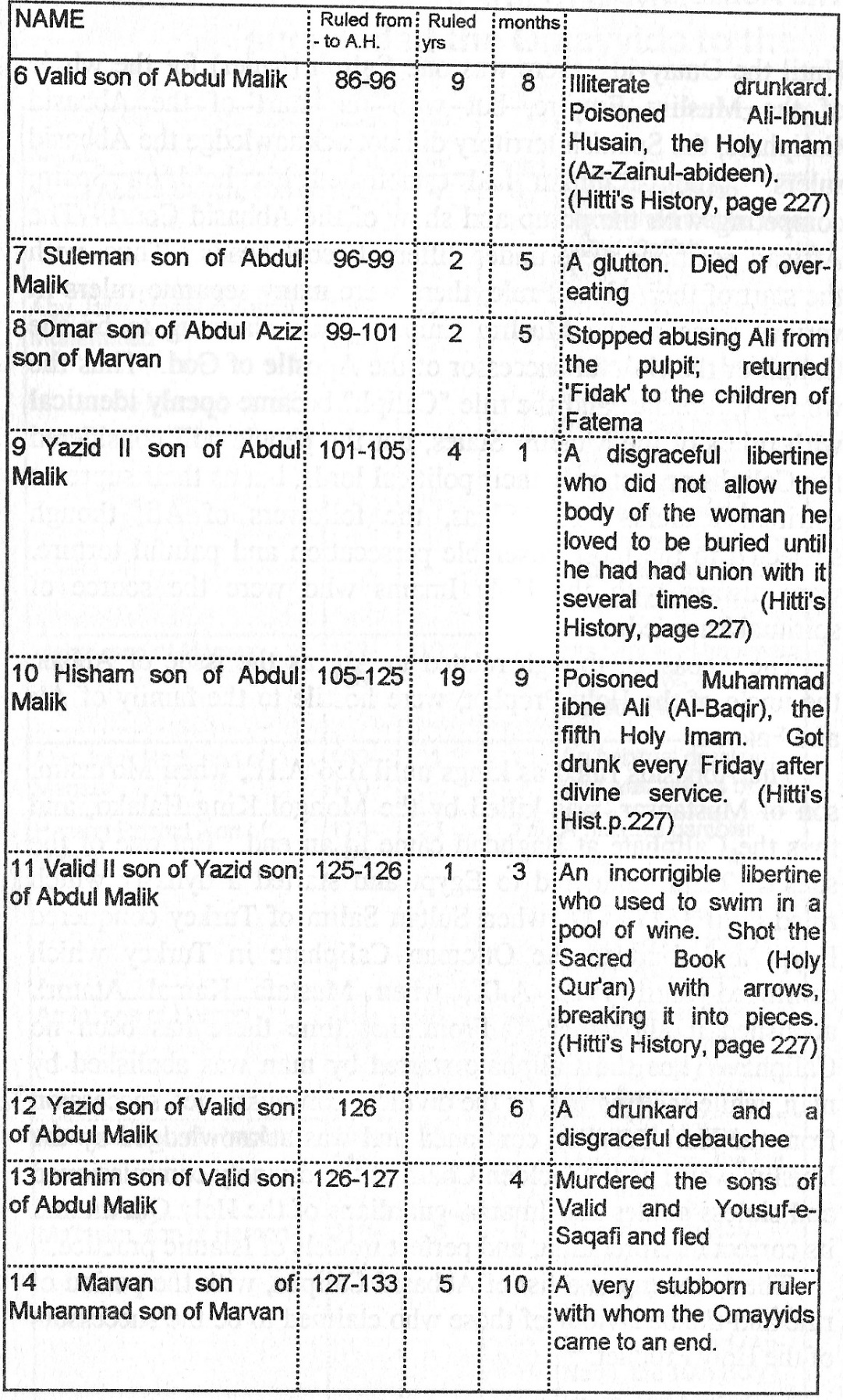
The Abbaside Caliphs
Until the Omayyids, there was one Caliph (or a ruler) for the whole of the Muslim Empire but with the start of the Abbaside Caliphate, the Spanish Territory did not acknowledge the Abbaside Rulers. Abdur Rahman had established his hold in Spain, competing with the pomp and show of the Abbaside Court. The African positions went under the different revolting heads. Thus, with the start of the Abbaside rule, there were many separate rulers in the different parts of the Muslim Empire, each claiming to be the Caliph or the rightful successor of the Apostle of God.
Thus, the word ‘Caliphate’ and the title ‘Caliph’ became openly identical with the rulership and the ruler of the Muslim States, but the masses still held the Caliphs (or the rulers) not only as their political Lords but also as their supreme spiritual leaders. The Shi’as or the followers of Ali, though subjected to the most miserable persecution and painful tortures, were always with the Holy Imams who were ever the fountainheads of godliness and every kind of virtue, spreading the wonderful light of the inestimable store of inspired knowledge.
The Abbasides though related to Ali, as the issues of Abbas the uncle of the Holy Prophet, were hostile to the family of Ali and Fatimah.
The Abbasides ruled as kings until 656 A.H. when Mo’tasim son of Mustansar was killed by the Mongol King Halako and thus the Caliphate at Baghdad came to an end. But one of the sons of Tahirbillah fled to Egypt and started a dynasty which ruled up to 1517 A.D. when Sultan Salim of Turkey conquered Egypt and founded the ‘Uthmani Caliphate at Turkey which continued up to 1922 A.D. when Mustafa Kamal Pasha the Ataturk abolished the Caliphate altogether and thereafter up till now there has been no Caliph either under the practice started at the Saqifa or under any other system. Thus, the Caliphate started by man has been abolished by man himself but the Imamah or the divinely commissioned succession to the Holy Prophet, continued, consistently acknowledged by the Muslim world, as the Golden Chain of the divinely commissioned, godly inspired, Infallible and the sinless guides or the Imams - the godly guardians of the Final Word of God, the Holy Qur’an, and its correct interpreters - and the perfect models of the correct practice of the Islamic faith.
The following statement will give the reader the kind of persons or the personalities the Abbasides were, who claimed to be the successors of the Holy Prophet.
Table 3: The Abbaside Caliphs who succeeded the Omayyids to the Caliphate


The reader will find how many of the Omayyids and the Abbasides were the assassins who martyred the Holy Imams of the Family of the Holy Prophet.
Imamah Conclusion
It is now for every intelligent reader to himself judge that whether anyone or everyone, irrespective of his personal qualities, who merely satisfies the choice of the majority of the masses, can ever be reasonably justified to succeed the Holy Prophet as the godly guide for mankind. It is an acknowledged truth that the Holy Prophet was All-Pure physically and spiritually, purified by God Himself, and no impure one can ever succeed an All-Pure personality. One can give an argument and not an understanding of the truth. God also having revealed the truth has declared
إِنَّا هَدَيْنَاهُ السَّبِيلَ إِمَّا شَاكِرًا وَإِمَّا كَفُورًا
“Verily have We shown him (man) the (Right) way, he be grateful or ungrateful” (76:3)
Man is left with a test to use his discretion correctly. The names of the successors to the Holy Prophet are not given in the Holy Qur’an but the infinite mercy of the Lord has not spared giving the guiding hints in the Final Word, the Holy Qur’an. 10:35 & 67:22. And besides these verbal notes of definite guidance towards the qualities essential in the Successor to the Holy Prophet, as a guide for mankind, the Holy Prophet was also commanded by the All-Merciful Lord to announce at ‘Ghadir Khumm’ at the eve of his departure from this world, before the mammoth assembly of the righteous ones, the Hajjes, as to who the people should follow, after him, and accordingly the Holy Prophet had declared Ali as the Lord, the Guardian, the Ameer in his place and had taken allegiance to him, during his very lifetime. As it becomes incumbent on every true Muslim to abide by the command of the Holy Prophet which was issued at the instance of the command of the Lord, the true Muslims have only to follow Ali as their leader in the place of the Holy Prophet. Since those who have deviated from this right course, also call themselves as Muslims, those who follow the command of the Holy Prophet identify themselves by calling themselves as the Shi’as of Ali to mean those who follow the course prescribed by the Holy Prophet, i.e., the Original Islam .
Any Intelligent reader will find, what has happened to the Caliphate instituted by man in the place of the Imamah declared by God through His Holy Prophet at Ghadir Khumm. Sometimes it was decided by a method which was called an election though it was not one even, and sometimes by nomination and sometimes by arbitration and later on, it becomes a hereditary kingship at one place, and sometimes divided into the various territories and ultimately it dies away. And till now the non-Shi’a world is uncertain about any universally accepted procedure. And today the Khilafat has been distributed by the masses among the innumerable who have started their own mystic school and appoint their own Khalifas or the deputies or successors.
Thus, the Shi’as of Ali or the followers of the Original Islam irrespective of what the non-Shi’a world believes and acts, are faithfully attached to the Command of God, received through the Holy Prophet and hold the Holy Prophet, His daughter Fatimah Zahra and the Twelve Imams as the godly ideals of their life and the Muslim World knows and unanimously acknowledges that these holy ones are those who have been purified by God Himself:
إِنَّمَا يُرِيدُ اللَّهُ لِيُذْهِبَ عَنْكُمُ الرِّجْسَ أَهْلَ الْبَيْتِ وَيُطَهِّرَكُمْ تَطْهِيرًا
“Verily, verily God intendeth but to keep off from you (every kind of) uncleanness O’ ye the People of the House and purify you (with) a thorough purification” (33:33).
The Holy Prophet on the memorable historic day of Mubahila showing Ali, Fatimah, Hasan, and Husayn, had declared saying “O Lord! these are my Ahl Al-Bayt”
Besides all the other similar announcements, the Holy Prophet had declared:
“The likeness of my Ahl Al-Bayt is that of the Ark of Noah. He who got into it is saved and he who turned away from it got himself drowned and lost”
Hadith
What else should God and the Holy Prophet, have done to guide mankind aright?
Shi’ism is following nothing but the Original Commands of the Lord and His Holy Prophet and those who do it, identify themselves as the Shi’as of Ali Ibn Abi Talib.
Thus, Shi’ism means only Original Islam and nothing else other than what preaches the Holy Qur’an and practiced the Holy Prophet, and his Ahl Al-Bayt.
It is therefore compulsory in Shi’ism to believe in the Twelve Holy Imams as the divinely Commissioned Guides in the place of the Holy Prophet, and none else.
The readers to themselves judge if this is the right course or otherwise.
The Twelve Holy Imams - The Divinely Commissioned Guides
About the Twelve Holy Imams or the Divinely Commissioned Guides succeeding the Holy Prophet Muhammad5.
It must be remembered that the prophethood or the apostleship of God has been concluded with the Holy Prophet Muhammad and these Imams are the divinely commissioned guardians of the Holy Qur’an, the Final Word of God, and the Qur’anic law the ‘Shariat’ and the guides to the right practice of the Qur’anic faith.
The Living Imam Of The Age
As Jesus in the seed of Abraham through Isaac and Moses, was rescued from the hands of the Jews, the Last Imam Muhammad Ibn al- Hasan al-Mahdi, also in the seed of the same Abraham through his first son Ishmael and the Holy Prophet Muhammad, was rescued from the plots of Mo’tamad and is kept alive by the will of the Lord, and will re-appear when the Lord wills, at whose appearance, will also return Jesus. Thus, the divinity bifurcated into the seeds of Ishmael and Isaac will come to meet and that will mark the end of the world.
The Holy Ahl Al-Bayt - Who Are They?
It is a universally acknowledged fact that truth can never be resisted or suppressed for all times. Even the enemy is forced to helplessly declare it. Here are given only a very few of the evidence which are decisive as to who actually are the Ahl Al-Bayt and what their actual position is in the Islamic World. The following references are from the greatest rather the original religious authorities of our Sunni brethren. The great works are full of such references but only a very few are given here, for these will be quite sufficient to those who are really earnest to know the truth, and nothing can help those who are adamant and who do not at all want to know it.
ذَٰلِكَ الَّذِي يُبَشِّرُ اللَّهُ عِبَادَهُ الَّذِينَ آمَنُوا وَعَمِلُوا الصَّالِحَاتِ قُلْ لَا أَسْأَلُكُمْ عَلَيْهِ أَجْرًا إِلَّا الْمَوَدَّةَ فِي الْقُرْبَىٰ وَمَنْ يَقْتَرِفْ حَسَنَةً نَزِدْ لَهُ فِيهَا حُسْنًا إِنَّ اللَّهَ غَفُورٌ شَكُورٌ
“That is of which giveth God the glad tidings unto His servants who believe and do good deeds; Say thou (O’ Our Apostle Muhammad!) ‘I demand not of you any recompense for it (the toils of the apostleship) save the love of (my) relatives; and whosoever earneth good. We increase for him good therein, verily God is Oft-Forgiving, the Most Grateful (One)” (42:23).
When asked as to who his relatives were referred to in the above verse, the Holy Prophet replied:
‘Ali, Fatimah and their issues.’6
It is reported that one day the Holy Prophet way lying under his Mantle, therein entered Ali, Hasan, Husayn and Fatimah, this verse was revealed:
إِنَّمَا يُرِيدُ اللَّهُ لِيُذْهِبَ عَنْكُمُ الرِّجْسَ أَهْلَ الْبَيْتِ وَيُطَهِّرَكُمْ تَطْهِيرًا
“Verily, verily God intendeth but to keep off from you (every kind of) uncleanness O’ ye the people of the House and purify you (with a thorough purification)” (33:33).7
Umm al-Mu’minin Ayesha says that the verse was revealed when the above five were under the mantle8.
When Hazrat Ayesha herself says that only the above Five Holy Ones were there under the mantle and she was out of it, some of our brethren not knowing her actual position unwarrantedly claim her inclusion in the ‘Ahl Al-Bayt’ interpreting the verse of the Holy Qur’an in their own way.
Hazrat Omme Salema reports that on the above occasion she was there and desired herself to join the Holy Five, but the Holy Prophet refused her entry saying, “Thou art of my wives and thou art righteous but this is not the place for thee, thou art not of my Ahl Al-Bayt”9.
The above event related by Ayesha and Umm Salema clears the position of the wives of the Holy Prophet in comparison to the Holy Ahl Al-Bayt all the authorities reporting the historic event, quoted above, are of our Sunni Brethren10
The historic event of Mubahila reported invariably by all the Historians, Traditionists and the other religious authorities, clears once for all the position of the Ahl Al-Bayt as to who they were. There is no loophole left for anyone else besides the declared personnel, to be counted among the Ahl Al-Bayt, i.e., besides the Holy Ones - The Holy Prophet, Ali, Fatimah, Hasan, Husayn and the nine Imams in the seed of Husayn.
When the Christians of Najran did not yield to any of the reasonable arguments proving Islam as the only religion prescribed by God, the following verse was revealed giving the directive to the Holy Prophet, about the course to be adopted to prove the truth:
فَمَنْ حَاجَّكَ فِيهِ مِنْ بَعْدِ مَا جَاءَكَ مِنَ الْعِلْمِ فَقُلْ تَعَالَوْا نَدْعُ أَبْنَاءَنَا وَأَبْنَاءَكُمْ وَنِسَاءَنَا وَنِسَاءَكُمْ وَأَنْفُسَنَا وَأَنْفُسَكُمْ ثُمَّ نَبْتَهِلْ فَنَجْعَلْ لَعْنَتَ اللَّهِ عَلَى الْكَاذِبِينَ
“And unto him who disputeth with thee therein after the knowledge hath come unto thee, Say! (O’ Our Apostle Muhammad!) (Unto them) “come ye, let us summon our sons, and (ye summon) your sons, and (we summon) our women and (ye) your women, and (we summon) ourselves and (ye) yourselves and then let us invoke and lay the curse of God on the liars!” (3:61).
The great Sunni commentators on the Holy Qur’an say that on the occasion the Holy Prophet took along with him only Hasan, Husayn, Fatimah, and Ali.
Besides the above great authorities - Imam Ahmad Ibn Hambal Muslim - Tirmizi and Nisayi have related of Sa’d Ibn Waqqas and Hakim of Jabir Ibn Abdullah that by the term sons are meant Hasan and Husayn and by women is meant Fatimah Zahra and by selves, is meant Ali Al-Murtaza.
As regards the position of Ali with the Holy Prophet, it has been reported that the Holy Prophet declared:
“Ali is myself”
This has been related by Hazrat Ayesha and Hazrat Umm Salama, and ‘Umar Ibn Aas11.
‘Qiyamah’ - The Last Day Or Date Of The Final Judgment
‘Qiyamah’ or the Last Day of Final Judgment
Islam demands a Muslim to essentially believe in the return of everything to the Lord for the Final Judgment of every soul with regard to its faith and actions. There are repeated declarations in the Holy Qur’an, informing man of this day and warning him to be guarded in his life on earth, against the Requital which is sure and certain to take place. It is the conviction about this fact that would keep man, on the right track, duly guarded against his accountability. It is natural that when an individual is not mindful of his or her accountability, nothing would hinder him or her, to commit any sin or crime, and with the sense of one’s accountability one would never dare to transgress the limits and would always remain guarded.
A Muslim should and must believe in ‘Ma’ad’ or ‘Qiyamah’, i.e., the Last Day of the Final Judgment and live such a clean life which would help him to pass through the divine judgment easily and earn the life eternal of the heavenly bliss.
‘Ma’ad’ - ‘Qiyamah’ - The Last Day Of Final Judgment
The fifth principle of the faith ‘Islam-Original’ or ‘Shi’ism’ i.e., the belief in ‘Ala ad’ or ‘Qiyamah’, i.e., the Last Day of Final Judgment. The faith in this principle is essential, i.e., compulsory.
Every human being is individually accountable for each one’s faith and deeds.
وَلِكُلٍّ دَرَجَاتٌ مِمَّا عَمِلُوا وَلِيُوَفِّيَهُمْ أَعْمَالَهُمْ وَهُمْ لَا يُظْلَمُونَ
“And for all (are ranks assigned) according to what they did; that (God) may (fully) recompense their deeds, an.’ they shall not be done any injustice” (46:19).
After death, all human beings will be resurrected to be rewarded and punished according to each individual’s earnings of virtue and vice in this life. The present life is only a season for cultivation or effort, and the life after death will be the period of harvest or the result. This life is a respite for creating causes for the effects in the hereafter. As one sows now so then shall he reap.
It is needless to repeat here the well-known fact that there was a time when there was no human life on earth, and it started with one single pair called Adam and Eve and got multiplied during the immeasurable passage of time. Simple logic ensures that that which had a beginning shall also have an end.
Death can never reasonably be the extinction of life, for if it be so, the end of the good and the bad, will be one and the same. The good and the evil can never be equalised:
قُلْ لَا يَسْتَوِي الْخَبِيثُ وَالطَّيِّبُ وَلَوْ أَعْجَبَكَ كَثْرَةُ الْخَبِيثِ فَاتَّقُوا اللَّهَ يَا أُولِي الْأَلْبَابِ لَعَلَّكُمْ تُفْلِحُونَ
“Say! (O’ Our Apostle Muhammad!) equal are not the bad and the good though the abundance of the bad may enchant thee; so then fear ye God, O’ ye of understanding that ye may be successful” (5:100)
Mere common sense is sufficient to know that goodness should be rewarded and evil should be punished.
When we are enjoined to do only good and to abstain from every evil, the question arises why? the only natural or reasonable answer can be that if good is done good will be the return and if evil is done evil will be the return. It is with this assurance one will incline to goodness and remain away from evil. Note the Qur’anic declarations.
يَوْمَئِذٍ يَصْدُرُ النَّاسُ أَشْتَاتًا لِيُرَوْا أَعْمَالَهُمْ
“On that day shall come out people (from their graves) in (scattered) groups, to be shown their own deeds” (99:6).
فَمَنْ يَعْمَلْ مِثْقَالَ ذَرَّةٍ خَيْرًا يَرَهُ
“Then he who hath done an atom-weight of good shall see it” (99:7).
وَمَنْ يَعْمَلْ مِثْقَالَ ذَرَّةٍ شَرًّا يَرَهُ
“And he who has done an atom-weight of evil shall see it” (99:8).
It is worthy of note how the following verses encourage doing good, promising the return for good more than what it actually would be:
مَنْ جَاءَ بِالْحَسَنَةِ فَلَهُ خَيْرٌ مِنْهَا وَمَنْ جَاءَ بِالسَّيِّئَةِ فَلَا يُجْزَى الَّذِينَ عَمِلُوا السَّيِّئَاتِ إِلَّا مَا كَانُوا يَعْمَلُونَ
“Whosoever bringeth good, for him shall be better than it, and whosoever bringeth evil, then shall not be recompensed those who wrought evil, (with) aught save what they had been working” (28:84).
Besides, it will be opposed to the divine justice to allow good and a bad life, both to equally end in mere extinction. To imagine the one who suffered miseries, tortures and painful death for the sake of goodness under the divine command, to please the Lord and the one who lived in vice and all sorts of sinful luxuries and criminal enjoyments prohibited by the Lord, to be levelled together, is opposed to reasoning and justice.
Moses and Pharaoh, Jesus and his persecutors, Muhammad the Holy Prophet and Abu Jehl, Ali and Ibn Muljim and Husayn and Yazid can never be equalised. The merits and the demerits naturally and necessarily need, rather imperatively demand, recognition and appreciation. The ‘Ma’ad’ or the ‘Qiyamah’ is only for this.
Death is only a turning point of life, a transit from this life of causes to the state of effects.
The period between death and the Day of the Final Judgment is called ‘Barzakh’ or what is called in English the Purgatory stage.
The Last Day will be the Day of the Final Judgment when every soul shall account for its individual good or evil in its life on earth.
On this day the people will be divided into three groups:
-
Those who did only good and never polluted themselves with any evil and did good to others.
-
Those who lived their whole life in evil and did evil to the others.
-
Those who have a mixed record of good and evil in their lives.
It is also a known fact that a good deed may seem to be a minor goodness, but it may have an abiding major effect and similarly an evil may seem to be minor, but it may have far reaching major consequences. Hence every good deed, minor or major, and every evil, simple or grave, in our own opinion, will be judged according to the actual merit or the demerit of its consequent effect.
Thus, he who did only good, will enjoy the eternal bliss, those who did evil shall have the consequent punishment and those with mixed records of goodness and badness together, their actions will be balanced against each other. If their good deeds outweigh their evils, they may draw the proportionate return and if the evils outweigh the good deeds, accordingly, will be the award.
There is room for intercession, but it is conditional, and it will not be for those who have intentionally rebelled against the authorities set up by God, and who have tortured and killed God’s vicegerents on earth viz. the Apostle and the Holy Imams.
The Holy Qur’an says that killing one man is equal to killing the whole human race and saving one man’s life is saving the life of the human race as a whole. If this be so, in the case of killing a single ordinary man, what will be gravity of the killing of an apostle of God or an Imam, and what will be the case with those who have killed Husayn along with his whole godly band of faithful supporters of the truth:
مِنْ أَجْلِ ذَٰلِكَ كَتَبْنَا عَلَىٰ بَنِي إِسْرَائِيلَ أَنَّهُ مَنْ قَتَلَ نَفْسًا بِغَيْرِ نَفْسٍ أَوْ فَسَادٍ فِي الْأَرْضِ فَكَأَنَّمَا قَتَلَ النَّاسَ جَمِيعًا وَمَنْ أَحْيَاهَا فَكَأَنَّمَا أَحْيَا النَّاسَ جَمِيعًا وَلَقَدْ جَاءَتْهُمْ رُسُلُنَا بِالْبَيِّنَاتِ ثُمَّ إِنَّ كَثِيرًا مِنْهُمْ بَعْدَ ذَٰلِكَ فِي الْأَرْضِ لَمُسْرِفُونَ
“For this reason did We prescribe unto the Children of Israel that he who slayeth anyone (man), without (that being for) murder, or for mischief in the land, (It is shall be) as though he hath slain mankind as a whole; and he who saveth it (a human life), shall be as though he hath saved mankind as a whole; and certainly our Apostles came unto them with clear evidences and yet verily, many of them even after that certainly commit excesses in the land” (5:32).
The return of everything to its Creator Lord, in the life hereafter - the Judgment has been repeatedly declared by the Holy Qur’an:
وَهُوَ اللَّهُ لَا إِلَٰهَ إِلَّا هُوَ لَهُ الْحَمْدُ فِي الْأُولَىٰ وَالْآخِرَةِ وَلَهُ الْحُكْمُ وَإِلَيْهِ تُرْجَعُونَ
“And He is God, there is no god hut He! His is all praise, in first and (in) the last, and His is the authority, and unto Him (only) ye shall he returned” (28:70).
The Day of a Total gathering is announced:
وَيَوْمَ نَحْشُرُهُمْ جَمِيعًا ثُمَّ نَقُولُ لِلَّذِينَ أَشْرَكُوا مَكَانَكُمْ أَنْتُمْ وَشُرَكَاؤُكُمْ فَزَيَّلْنَا بَيْنَهُمْ وَقَالَ شُرَكَاؤُهُمْ مَا كُنْتُمْ إِيَّانَا تَعْبُدُونَ
“On the day (of resurrection) when We will gather them all together, then will We say unto those who associated others (with Us) ‘Keep ye where ye are, ye and your associated gods;’ then We shall separate them, the one from the other, and shall say (unto them) their associate gods ‘It was not us that ye worshipped’” (10:28).
Regarding the return of all men to their True Lord and how quickly the accounting will be affected it is declared:
ثُمَّ رُدُّوا إِلَى اللَّهِ مَوْلَاهُمُ الْحَقِّ أَلَا لَهُ الْحُكْمُ وَهُوَ أَسْرَعُ الْحَاسِبِينَ
“Then they are returned unto God, their ‘Mania’ (Master), the (only) Real One; Beware! (Now surely), His (alone) (as the Master) is the Judgment, and He is the Swiftest or reckoners” (6:62).12
The following verse gives out that the deeds will be judged according to their merits and demerits and accordingly will be rewarding and the punishment:
وَلِكُلٍّ دَرَجَاتٌ مِمَّا عَمِلُوا وَلِيُوَفِّيَهُمْ أَعْمَالَهُمْ وَهُمْ لَا يُظْلَمُونَ
“And for all (are ranks) (assigned) according to what they did; that (God) may (fully) recompense their deeds, and they shall not be done any injustice” (46:19).
God the Best of the judges:
أَلَيْسَ اللَّهُ بِأَحْكَمِ الْحَاكِمِينَ
“What! Is not God the Judge of the judges?” (95:8).
The following verses of ‘Sura al-Tatwif’ (the Defaulters) will be sufficient to give a brief picture of the Day of Judgment:
The verses clearly declare the following points about the Last Day of Judgment:
Sura 83 Verses
أَلَا يَظُنُّ أُولَٰئِكَ أَنَّهُمْ مَبْعُوثُونَ
“What! Think they not that they shall be raised” (83:4).
لِيَوْمٍ عَظِيمٍ
“For a mighty day” (83:5).
يَوْمَ يَقُومُ النَّاسُ لِرَبِّ الْعَالَمِينَ
“On the day when mankind shall stand before the Lord of the worlds?” (83:6).
وَيْلٌ يَوْمَئِذٍ لِلْمُكَذِّبِينَ
“Woe on that day unto the beliers” (83:10).
الَّذِينَ يُكَذِّبُونَ بِيَوْمِ الدِّينِ
“Those who belie the Day of Judgment” (83:11).
وَمَا يُكَذِّبُ بِهِ إِلَّا كُلُّ مُعْتَدٍ أَثِيمٍ
“And belieth it not (anyone) saves a every transgressor, a sinner” (83:12).
ثُمَّ إِنَّهُمْ لَصَالُو الْجَحِيمِ
“Verily, they shall be committed to the flaming fire” (83:16).
ثُمَّ يُقَالُ هَٰذَا الَّذِي كُنْتُمْ بِهِ تُكَذِّبُونَ
“Then shall it be said (unto them): ‘This is that which ye belied” (83:17).
إِنَّ الْأَبْرَارَ لَفِي نَعِيمٍ
“Verily the righteous ones shall be in bounteous bliss” (83:22).
تَعْرِفُ فِي وُجُوهِهِمْ نَضْرَةَ النَّعِيمِ
“Thou (O’ Our Apostle Muhammad!) wilt recognise in their face -the (delightful) radiance of the bliss” (83:24).
إِنَّ الَّذِينَ أَجْرَمُوا كَانُوا مِنَ الَّذِينَ آمَنُوا يَضْحَكُونَ
“And verily they who are the guilty ones, used to laugh at those who believe” (83:29).
وَإِذَا مَرُّوا بِهِمْ يَتَغَامَزُونَ
“And when they pass by them, wink they at one another” (83:30).
وَإِذَا انْقَلَبُوا إِلَىٰ أَهْلِهِمُ انْقَلَبُوا فَكِهِينَ
“And when return they unto their people, return they jesting” (83:31).
وَإِذَا رَأَوْهُمْ قَالُوا إِنَّ هَٰؤُلَاءِ لَضَالُّونَ
“And when they see them, say they: ‘These are the ones astrayed one” (83:32).
وَمَا أُرْسِلُوا عَلَيْهِمْ حَافِظِينَ
“While they are sent not over them to be the watchers” (83:33).
فَالْيَوْمَ الَّذِينَ آمَنُوا مِنَ الْكُفَّارِ يَضْحَكُونَ
“So, today, those who believe shall be at the disbelievers laugh;” (83:34).
عَلَى الْأَرَائِكِ يَنْظُرُونَ
“On couches (exalted they shall be) seeing (the delightful sights)” (83:35).
هَلْ ثُوِّبَ الْكُفَّارُ مَا كَانُوا يَفْعَلُونَ
“Shall not the disbelievers be (also) recompensed for what they used to do?” (83:36).
The above Verses clearly declare:
-
That there is a Day of Final Judgment,
-
When every soul shall return to the Lord of the worlds.
-
The evil shall be punished and the good shall be rewarded.
-
There is a place of suffering for the evil ones which is called Hell and there is a place of eternal bliss for the good ones which is called Heaven or Paradise.
-
The reward or punishment to each individual soul shall be according to the individual merit or demerit.
The Holy Qur’an is full of warnings to mankind against the life after death and the Last Day of the Final Judgment.
-
‘Jannah’ Paradise or Heaven
-
‘Naar’ Hellfire.
-
‘Akhirat’ The Hereafter.
-
‘Mahshar’ The Place of the gathering of the souls.
-
‘Qiyamah’ The Resurrection.
-
‘Mizaan’ The Balance - The means of discrimination or balancing two things against each other. This will not be any material scale which can measure or weigh only material commodities and not the abstract ones like the merits of intention and actions.
-
‘Siraat’ The Path absolutely corrects in every meaning and sense of it. Every soul shall pass through it. The righteous ones will not find any difficulty to pass through, whereas it will be very difficult rather impossible for the wicked ones to traverse it successfully. Every soul will find it easy or difficult according to the individual merit or demerit earned in this life.
-
‘Sawale-Munkir wa Nakir’ - Every human soul at its leaving the corporeal body shall be questioned about its faith and deeds which it earns in the present life and will be admitted to the transitory state ‘Barzakh’ or the Purgatory, according to the degree of the success in the response to the questioning.
-
‘Nama al-Aamaal’ or the Record of deeds - Every one’s deeds are getting then and there recorded and the records are preserved.
Sura 83 Verses
كَلَّا إِنَّ كِتَابَ الْفُجَّارِ لَفِي سِجِّينٍ
“Nay! the record of the wicked hast been preserved in the ‘Sijjin’” (83:7).
وَمَا أَدْرَاكَ مَا سِجِّينٌ
“And what will make thee know what ‘‘Sijjin’ is?” (83:8).
كِتَابٌ مَرْقُومٌ
“It is a book Written” (83:9).
كَلَّا إِنَّ كِتَابَ الْأَبْرَارِ لَفِي عِلِّيِّينَ
“Nay! The record of the righteous shall be in the ‘‘Illiyin” (83:18).
وَمَا أَدْرَاكَ مَا عِلِّيُّونَ
“And what will make thee know what the ‘Illiyun’ is?” (83:19).
كِتَابٌ مَرْقُومٌ
“(It is) a book Written” (83:20).
The Book referred to here, does not mean the book of paper or any material stuff but the means of natural evidence.
The Day of Judgment shall be a horrible day of the revelation of the truth both hidden and manifest. Every Organ of man itself will automatically bear witness to the deeds of the individual:
الْيَوْمَ نَخْتِمُ عَلَىٰ أَفْوَاهِهِمْ وَتُكَلِّمُنَا أَيْدِيهِمْ وَتَشْهَدُ أَرْجُلُهُمْ بِمَا كَانُوا يَكْسِبُونَ
“On that day will We set a seal upon their mouths and shall speak unto Us their hands and shall bear witness their feet, of what they were earning” (36:65).
يَوْمَ تَشْهَدُ عَلَيْهِمْ أَلْسِنَتُهُمْ وَأَيْدِيهِمْ وَأَرْجُلُهُمْ بِمَا كَانُوا يَعْمَلُونَ
“On that day will bear witness against them, their tongues and their hands and their feet, as to what they did” (24:24).
يَوْمَ يَقُومُ الرُّوحُ وَالْمَلَائِكَةُ صَفًّا لَا يَتَكَلَّمُونَ إِلَّا مَنْ أَذِنَ لَهُ الرَّحْمَٰنُ وَقَالَ صَوَابًا
“On the day whereon shall stand the spirit and the angels arrayed they shall speak not save he whom the Beneficent God giveth leave, who spoke not (only) the truth” (78:38).
ذَٰلِكَ الْيَوْمُ الْحَقُّ فَمَنْ شَاءَ اتَّخَذَ إِلَىٰ رَبِّهِ مَآبًا
“That is the day certain, whoso then desireth, may take refuge unto his Lord” (78:39).
There are many more verses in the Qur’an dealing with the other details of the Last day of the Final Judgment. Only a very few verses have been quoted here, just to give the idea as to how sure is the coming of the Day of Requital when every soul shall render the account of its deeds and get rewarded or punished according to the merits and demerits earned in this life. Thus, every true Muslim should believe in the Last Day of Judgment as a compulsory article of the faith Aslam’ or ‘Shi’asm.’
‘Jannah’ - Paradise
‘Jannah’ is a place which is generally called in English ‘Heaven.’ It is a place of eternal bliss, an abode granted to those who do good in this world. On the day of the Final Requital or Judgment, every one’s actions will be weighed and those whose goodness in this life exceeds their evils will be granted this abode to live therein for ever in the degree of bliss according to one’s own rank in goodness earned by the individual. The belief in the existence of this abode and its award to the good ones by the Lord, is incumbent on every Muslim. The following are a few of the verses of the Holy Qur’an referring to ‘Jannah’ and its award:
زُيِّنَ لِلنَّاسِ حُبُّ الشَّهَوَاتِ مِنَ النِّسَاءِ وَالْبَنِينَ وَالْقَنَاطِيرِ الْمُقَنْطَرَةِ مِنَ الذَّهَبِ وَالْفِضَّةِ وَالْخَيْلِ الْمُسَوَّمَةِ وَالْأَنْعَامِ وَالْحَرْثِ ذَٰلِكَ مَتَاعُ الْحَيَاةِ الدُّنْيَا وَاللَّهُ عِنْدَهُ حُسْنُ الْمَآبِ
“(It has been) made to seem attractively fair unto men, the love of the lusts for women and sons and pile hoarded treasures of gold and silver and well-bred horses and cattle and tilth; this is the provision of the life of this world, while God! Verily with Him is the best destination.’’ (3:14).
قُلْ أَؤُنَبِّئُكُمْ بِخَيْرٍ مِنْ ذَٰلِكُمْ لِلَّذِينَ اتَّقَوْا عِنْدَ رَبِّهِمْ جَنَّاتٌ تَجْرِي مِنْ تَحْتِهَا الْأَنْهَارُ خَالِدِينَ فِيهَا وَأَزْوَاجٌ مُطَهَّرَةٌ وَرِضْوَانٌ مِنَ اللَّهِ وَاللَّهُ بَصِيرٌ بِالْعِبَادِ
“Say (O’ Our Apostle Muhammad!) ‘Shall I tell you of what is better than these? for those who take shelter in God are gardens with their Lord, beneath which flow rivers, to abide in them and mates pure, and God’s pleasure; and verily God is well aware of the servants” (3:15).
إِنَّ الَّذِينَ آمَنُوا وَعَمِلُوا الصَّالِحَاتِ يَهْدِيهِمْ رَبُّهُمْ بِإِيمَانِهِمْ تَجْرِي مِنْ تَحْتِهِمُ الْأَنْهَارُ فِي جَنَّاتِ النَّعِيمِ
“Verily (for) those who believe and do good, guideth them their Lord by their faith, beneath them will flow rivers in gardens of bliss” (10:9).
دَعْوَاهُمْ فِيهَا سُبْحَانَكَ اللَّهُمَّ وَتَحِيَّتُهُمْ فِيهَا سَلَامٌ وَآخِرُ دَعْوَاهُمْ أَنِ الْحَمْدُ لِلَّهِ رَبِّ الْعَالَمِينَ
“Their cry therein (will be), ‘Glory be to Thee O’ God!’ and their greetings in it (will be), ‘Peace’ and the last of their cry (will be), that God’s is the praise, the Lord of the worlds” (10:10).
The following will be the announcement to the good servants of the Lord on the Day of Judgment:
يَا عِبَادِ لَا خَوْفٌ عَلَيْكُمُ الْيَوْمَ وَلَا أَنْتُمْ تَحْزَنُونَ
“O’ My servants! No fear shall be on you this day, nor shall ye grieve” (43:68).
الَّذِينَ آمَنُوا بِآيَاتِنَا وَكَانُوا مُسْلِمِينَ
“Those who believed in Our signs and were Muslims (those submitting themselves unto God)” (43:69).
ادْخُلُوا الْجَنَّةَ أَنْتُمْ وَأَزْوَاجُكُمْ تُحْبَرُونَ
“Enter ye the Garden, ye and your mates; ye shall be made to be delighted” (43:70).
يُطَافُ عَلَيْهِمْ بِصِحَافٍ مِنْ ذَهَبٍ وَأَكْوَابٍ وَفِيهَا مَا تَشْتَهِيهِ الْأَنْفُسُ وَتَلَذُّ الْأَعْيُنُ وَأَنْتُمْ فِيهَا خَالِدُونَ
“Shall be passed round unto them dishes of gold and cups (of drinks); and therein shall be whatever desire their souls, and (wherein) could delight the eyes; and ye shall abide therein” (43:71).
وَتِلْكَ الْجَنَّةُ الَّتِي أُورِثْتُمُوهَا بِمَا كُنْتُمْ تَعْمَلُونَ
“This is the Garden (Paradise) ye are made to receive as a heritage (in recompense) for what ye have been doing” (43:72).
The Faith In The Angels
Angels are pure spiritual beings created to glorify the Lord and to execute His will. They can appear in any form but not of any base animals. Their number, none knows. Only a few important ones whose services are directly connected with the life known to mankind, arc mentioned. Faith in the existence of these celestial beings, is incumbent on every Muslim. A few’ of the verses of the Holy Qur’an concerning the angels are given below:
لَيْسَ الْبِرَّ أَنْ تُوَلُّوا وُجُوهَكُمْ قِبَلَ الْمَشْرِقِ وَالْمَغْرِبِ وَلَٰكِنَّ الْبِرَّ مَنْ آمَنَ بِاللَّهِ وَالْيَوْمِ الْآخِرِ وَالْمَلَائِكَةِ وَالْكِتَابِ وَالنَّبِيِّينَ وَآتَى الْمَالَ عَلَىٰ حُبِّهِ ذَوِي الْقُرْبَىٰ وَالْيَتَامَىٰ وَالْمَسَاكِينَ وَابْنَ السَّبِيلِ وَالسَّائِلِينَ وَفِي الرِّقَابِ وَأَقَامَ الصَّلَاةَ وَآتَى الزَّكَاةَ وَالْمُوفُونَ بِعَهْدِهِمْ إِذَا عَاهَدُوا وَالصَّابِرِينَ فِي الْبَأْسَاءِ وَالضَّرَّاءِ وَحِينَ الْبَأْسِ أُولَٰئِكَ الَّذِينَ صَدَقُوا وَأُولَٰئِكَ هُمُ الْمُتَّقُونَ
“It is not righteousness that ye turn your faces towards the East and the West, righteousness is rather one who believeth in God and the Last Day and the angels and the Book, the apostles, and giveth his wealth out of love for Him to the kindred and the orphans and the poor and the wayfarer and the needy and for those in bondage; And established prayer and payeth the poor-rate; And those who fulfil their promise and the patient ones in distress and affliction and in the time of war these are they who are Truthful and these are they who are the pious” (2:177).
يُنَزِّلُ الْمَلَائِكَةَ بِالرُّوحِ مِنْ أَمْرِهِ عَلَىٰ مَنْ يَشَاءُ مِنْ عِبَادِهِ أَنْ أَنْذِرُوا أَنَّهُ لَا إِلَٰهَ إِلَّا أَنَا فَاتَّقُونِ
“He sendeth down the angels with the spirit (revelation) by His own decree on whomsoever He willeth of His servants saying: “Warn ye (the mankind) that there is no God, but I therefore fear Me” (16:2).
وَلَهُ مَنْ فِي السَّمَاوَاتِ وَالْأَرْضِ وَمَنْ عِنْدَهُ لَا يَسْتَكْبِرُونَ عَنْ عِبَادَتِهِ وَلَا يَسْتَحْسِرُونَ
“And His is whosoever is in the heavens and the earth; and those who are with Him are not proud to worship Him, nor do they get weary” (21:19).
الَّذِينَ يَحْمِلُونَ الْعَرْشَ وَمَنْ حَوْلَهُ يُسَبِّحُونَ بِحَمْدِ رَبِّهِمْ وَيُؤْمِنُونَ بِهِ وَيَسْتَغْفِرُونَ لِلَّذِينَ آمَنُوا رَبَّنَا وَسِعْتَ كُلَّ شَيْءٍ رَحْمَةً وَعِلْمًا فَاغْفِرْ لِلَّذِينَ تَابُوا وَاتَّبَعُوا سَبِيلَكَ وَقِهِمْ عَذَابَ الْجَحِيمِ
“Those who bear the ‘Arsh’ and those around it celebrate the praise of their Lord and believe in Him and seek forgiveness for those who believe in Him (saying): ‘O’ Our Lord! Thou comprehendeth all things in (Thy) Mercy and Knowledge, therefore, forgive Thou those who turn (unto Thee) and follow thy way, and save them from the torment of the Hell” (40:7).
وَنُفِخَ فِي الصُّورِ ذَٰلِكَ يَوْمُ الْوَعِيدِ
“And there shall be a blast on the trumpet, It is the Day Promised (warned against)” (50:20).
وَجَاءَتْ كُلُّ نَفْسٍ مَعَهَا سَائِقٌ وَشَهِيدٌ
“And shall come every soul, along with it a driver and a witness” (50:21).
وَالنَّازِعَاتِ غَرْقًا
“By those who drag forth violently” (79:1).
وَالنَّاشِطَاتِ نَشْطًا
“And by those who untie (the knot) briskly” (79:2).
وَالسَّابِحَاتِ سَبْحًا
“And by those (angels) who glide on (swiftly)” (79:3).
فَالسَّابِقَاتِ سَبْقًا
“Then those (angels) who go ahead with a foremost speed” (79:4).
فَالْمُدَبِّرَاتِ أَمْرًا
“Then those (angels) who (submissively) manage the affairs” (79:5).
يَوْمَ يَقُومُ الرُّوحُ وَالْمَلَائِكَةُ صَفًّا لَا يَتَكَلَّمُونَ إِلَّا مَنْ أَذِنَ لَهُ الرَّحْمَٰنُ وَقَالَ صَوَابًا
“On the day whereon shall stand the spirit and the angels arrayed they shall speak not save he whom the Beneficient God giveth leave, who spoke not (only) the truth” (78:38).
The following angels are those with the definite duties mentioned against them:
Gabriel - The appellation of this angel is the ‘Ameen’ (i.e., the Trusted). He is the foremost of all the angels and he is the one who communicated God’s commandments to the Prophets, and he is the one who conveyed the Holy Qur’an to the Holy Prophet.
Israel - The messenger of Death, who separates the soul from the body.
Israfeel - The one -who will blow’ the Trumpet announcing the Day of the Final Judgment.
- 1. See the note on ‘Tahrif’ by A.P.
- 2. Vide ‘Tafsir-Kabir, Tafsir-Durr al-Manthur and the others
- 3. Hadith Ghadir Khumm.
- 4. Al-Hakim al-Naysaburi, al-Mustadrak ‘ala as-Sahihayn, Vol.3, p. 126; Ibn ‘Abd al-Barr, al-Isti’ab, Vol.3, p. 1102.
- 5. See Table 1: A Historical Chart Of The Holy Fourteen.
- 6. Vide Tafsir al-Kabir of Fakhruddine Fazi Zamakhshari-Tafsir-Kashashaf-Sawaiqe Mohriqa al- Ibn Hajjre-Makki.
- 7. See: Tafsir Kabir; Kanz al-’Ummal; Tirmizi; Sawaiqe Mohriqa; Musnad Imam Ahmad Ibn Hambal; Aqdul Farid; Sharh Fiqh Akbar; Durr al-Manthur.
- 8. Sahih Muslim-Baidhavi.
- 9. Tabari Vol. II p. 17.
- 10. See the notes on Verse 33:33.
- 11. Kanz al-’Ummal. Musnad Khawarzami. Sawaique Mohriqa.
- 12. See also Chapter ‘Yasin’, particularly verses 36:51-54 & 36:65.
