Raising a Godly Child 1/4
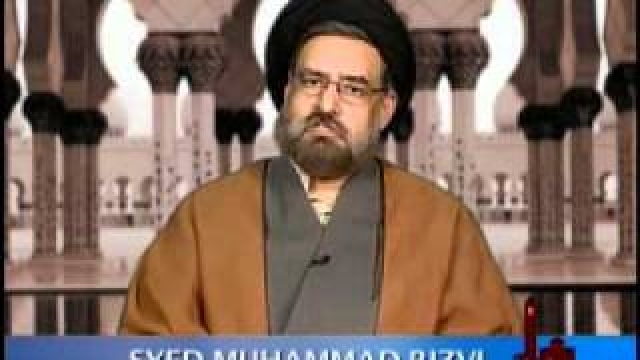
Hujjatul Islam Maulana Sayyid Muhammad Rizvi talks about how to raise God-conscious children (Tarbiyat-e-Aulad), based on the teachings of the Qur'an, the Holy Prophet [saww], and the Holy Household [as].

'A'udhu billahi min al-Shaytan, al-la'in, al-rajim. Bismillah Al-Rahman Al-Rahim. Al-hamdulil-Lahi Rabbi 'l-Alameen, wa as-salat Wa as-salam 'ala Sayyid Al-Anbiya'i, wa Khatim al-Mursaleen, Sayyidina, wa Nabiyyina, Abil Qasim Muhammad, wa 'ala ahlih, at-tayyibin, at-taharin, al-masoomeen.
I begin in the name of God the Kind and Merciful, and would like to start with the Islamic greeting of "salamun alaykum", peace be upon all of you. In today's program we are going to talk about the concept of raising godly children from the Islamic point of view. Basically, we are dealing with an issue which is part of all families, whether Muslims or non Muslims alike. And that is the issue of how should we raise our children so that they are better human beings and good Muslims? This program actually will take us for about three to four segments of the weekly programs. In today's event, we are going to basically talk about the introduction to this theme of how to raise a Godly child.
Let me begin by talking about the process of parenting itself. What is the Islamic perspective about it? It's very interesting to see that in Islam the process of parenting is considered to be a noble task by itself. Almighty God in the Qur'an has taught us a prayer for our parents, which is in a very beautiful wordings where we are told in chapter 17, verse 24 "Qul Rabbi arhahuma kama rabbayani sagheera" (17:24), which means: 'O my Lord, O my provider, have mercy on both of my parents just as they both nourished me when I was a child'.
It's interesting to see that Almighty God is being described in the Holy Qur'an and this verse in a known form as the Provider and the Nourisher. While the act of providing and nourishing is being attributed to the parents. In other words, according to this verse, Allah, the Almighty God is our Lord, He is the Provider and the Nourisher and our parents are also our providers. Both are nourishers. But of course there is a big difference between the levels and the status of God compared to the parents.
God is the ultimate Provider, while our parents are the means of God's grace to us. So parenting is a divine tradition of nourishing and providing and the parents are the means of the divine grace for the children. And this is why Almighty God has made it mandatory in the Qur'an in chapter 31 verse 14, he has made it mandatory on us to thank Him as well as to thank our parents. The words are "ashkurli wa al-walidaik" (31:14), thank me and also thank your parents.
In a sense, God is saying that although I'm the one who provides for you at all stages of your existence, when you are in the womb of your mother, you were being nourished when you came out and when you were born, the mother breastfed you and then you came out of that wheening period, and your parents were there to support you and nourish you and provide for you.
And then you grow up as an adult and you are responsible for yourself. At all stages, Almighty God is the Provider. But we had to realize that during the early stages of our life, God used the parents as the means of His nourishment and provision. And therefore God says, do not only thank me, you also have to thank your parents who are the means of my grace and my provision. And so when we look at this, we see that you know, parenting is considered to be in a way tradition of the divine.
Now let us look at the duty of the parents from the Qur'anic point of view. We need to realize that although parenting is a noble task, but at the same time, it is a very heavy duty which Almighty God has put on us as parents. In verse 28 of chapter 8 of the Holy Qur'an, Almighty God says to us that: "know that your wealth and your children are a Fitna for you" (8:28). Now what does the word Fitna mean? Fitna means the means of test and trial.
In this verse, Almighty God is saying that I bless you with wealth as well I have blessed you with children. And children are also the means of test and trial for the parents, and we will be judged as parents on the Day of Judgment by Almighty God on how we fulfill the task of raising our children. So what are we supposed to do? The Qur'an is very clear about our responsibility, as far as raising the children is concerned. There is a verse in chapter 66 verse number 6, where Almighty God says, "Oh you who believe! Save yourselves and your families from a fire whose fuel is man and stones. Over it our Angels are stern and strong. They do not disobey Almighty God in what He commands them and do as they are commanded" (66:6).
So this verse is actually commanding the believers that you have a responsibility to rescue yourselves as well as your families from the Hellfire. And so how do we do this? As far as our children are concerned, the proper Islamic upbringing of a child is an essential part in rescuing our children from the Hellfire. Now let us look at the relationship between parents and religious institutions in this task of raising our children.
Raising children is primarily the duty of the parents. Nobody can deny that, or other institutions, whether they are educational, secular, educational institutions or religious institutions, they cannot take the place of the parents. They are just there to support the parents efforts. You know, from the religious point of view, there are three institutions and we may call them three M's because all three starts with M. One is Masjid, the other is Madrasa, and the third one is Mimbar.
Masjid is the mosque. The place of worship where Muslims gather for religious events. Madrasa is like the Sunday school, where the children go at evenings or during weekends for their religious instructions. And Mimbar is the pulpit where the Imam of the Center or the religious scholars basically impart the Islamic knowledge to the community. So when we look at these three institutions, three M'S, the Masjid, the Madrasa, and the Mimbar. We do realize that there has to be a partnership between the parents and the three Ms. But the parents have to realize that the primary duty of raising the children is upon them and not upon the institutions.
There is a very interesting survey done by an educationist in the United States of America regarding the Muslim communities, and he basically looked at the issue of, you know, the role of parents and the three M's in the Islamic society. And his conclusion is very interesting when he says that 10% of Muslim children will be raised properly with or without the support of the three M'S. So there are some parents who are so concerned about their own fulfilment of their duty that whether they have support or not, they are going to raise their children in the Islamic manner, then other 10% of the Muslim children will be lost with or without the support of the three M's, since the parents don't really care about their religious upbringing and the responsibility that they have in the eyes of God.
Then 80% of the Muslim children are those who can be raised properly from the Islamic point of view, if their parents have the support of the three M'S. And so when we talk about the majority of the Muslim community, 80% of the Muslim children, you know, they can be raised properly provided the parents get the support of the religious institutions. So we realise that religious institutions play an important part in helping the parents in their children's Islamic upbringing.
But we have to keep in mind that these institutions cannot take the place of the parents themselves. If we totally leave our children's upbringing to the institutions, whether they are secular or religious, then we are all losers. The institutions, the parents as well as the children. There has to be a partnership between the parents and the Educational Institutions. And always, as I emphasize, we have to keep in mind that the Masjid, the Madrasa, and the Mimbar can only teach Islam to your children, but they cannot raise them.
Children can learn Islam from the institution, but they can only live by Islam through the guidance and support of their parents. So keep that distinction in mind that the institutions can teach Islam to their children, but how the children will live by Islamic principles, that is the task of the parents only.
Let me now talk about the child. Because we have to understand when we talk about this issue of, you know, raising a Godly child, we have to understand our subject. You know from the Islamic perspective, we can say that a child is a human being, and as a human being, he or she is composed of two dimensions. There is a physical dimension, and then there is a spiritual dimension. When it comes to the physical dimension of a child, we know that for the normal development of the child's physical wellbeing, we have to ensure two things. Number one, we have to provide the necessities for the child's physical development, for example, food, clothing and shelter. And Secondly, we have to protect the children from the factories which are detrimental to their physical wellbeing, for example, malnutrition, disease and extreme climate.
Now, we as parents we do this quite well. We don't have to be told by anyone that we have to take care of the physical wellbeing of our children, especially when you look at the immigrant Muslim parents in North America. It is becoming almost imperative for them to provide their children with designer clothes and shoes, brand names school supplies. And this is how the immigrant parents actually work so hard so that their children will have the best that they can provide for them. However, we should realize that by providing what is good for the child's physical wellbeing only, the most that we are doing is raising a strong and healthy animal.
Yes, I have mentioned the term animal, because remember, we are not breathing and raising a horse for winning at the race tracks. We are dealing with human beings, with Insan, who is actually, who has been selected by Almighty God to represent him on the Earth. We actually have been appointed as the custodian of this Earth, and we are in a way representing Almighty God on this Earth. So I'm not against designer lines and brand names. If you can afford it, then why not? But don't make that measure of your child's self-esteem and identity. Don't make your child a slave of designer lines and brand names.
So let us now move to the second dimension of the child and that is the spiritual dimension. And we realize that from the Qur'anic point of view, the essence of a human being is the soul and the spirit of the person. As Muslims, we have to pay attention to our child's spiritual dimension. And in order to ensure its development, we have to do the same things, same two aspects that we talked about physical development.
Number one, we have to provide the necessities for spiritual development, such as sound belief, sense of fulfilment of the obligations and building a good character. And Secondly, we have to protect our children from the factories which will impede their spiritual wellbeing, such as sins, bad habits and bad friends and companions, because they can have, you know, the peer pressure is there. And so we have to make sure that in order to develop them spiritually in the right way, they have to be protected from all negative elements. And we now move on to the third stage of my talk.
And that is about , if Islam has made this issue a very serious duty on the parents that we have to raise our children from the Islamic perspective, then is there any specific guidance that Islam has given to us? It's becoming very trendy these days to buy and read the books by modern child psychologists. There's nothing wrong with it, but we, as Muslims should not forget the rich treasure of knowledge and wisdom that the Prophet Muhammad, peace be upon him, has left for us in the form of the Qur'an and his own example, the Sunnah and the example of the Imams of Ahlul Bayt from his family.
What I would like to do today is basically present to you a very famous saying of Prophet Muhammad, which describes the process of raising a child. In that saying, the Prophet says that the child has to be raised in three stages, from birth to 7, then from age 8 to 14, and then from age 15 to 21. Speaking to the people who have no clue at all about child psychology, Prophet Muhammad used three very simple terms to explain the role of parents towards the child in these three different stages of upbringing. The saying of the Prophet in Arabic, he says "Al waladu sayyidun saba' sineen, wa 'abdun saba' sineen, wa wazeerun saba' sineen". What the Prophet said, that the child is a master, sayyid for seven years, a slave for seven years and a minister for seven years.
The Prophet's hadith is actually a miracle by itself that he was able to convey very complex psychological concepts in very simple terms, understood by all people, literate as well as illiterate ones. It is obvious that the Prophet has used these three terms as the master, the slave, and the minister, in their figurative sense and not in their literal meanings. This terms beautifully describe how the parents should be here with their children during the three stages of upbringing them.Let me now talk about the first stage from birth to age seven, and we'll deal with the other stages in other segments of our talk in the following weeks.
When it comes to the first stage, Prophet Muhammad says that the child is master for the seven years. It implies that let the child be a child. Don't overburden your child with formal means of education. It does not mean that you should not instruct your child at that stage, but the instruction should not be in a formal academic form. It should be more or less by your own example. The concept presented by Prophet Muhammad has been proven true by recent findings on education. An article was published almost a year ago by Wall Street Journal, which was talking about the children of Finland. And let me give you the quotation. It's very interesting because it actually ties in with the sayings of Prophet Muhammad.
The report says Finnish teenagers are among the smartest in the world. They earned some of the top scores by 15 year old students who were tested in 57 countries. American teens finished among the world's C students, not A or B, but C students. Now what was very interesting for me was the first paragraph of the article, and I'll quote to you word to word where it says: "high school students here readily get more than half an hour of homework at night. There are no school uniforms, no honour societies, no valedictorians, no tidy belts, no classes for the gifted. There is little standardized testing. Few parents agonize our College and kids don't start school until age seven. End of the quotation from the article.
The writer of the article, Mr. Gehmermann, he continues by saying that in all these Scandinavian countries, students began formal schooling only at age seven, two years after most American children begin school. And yet they are smarter than the North American kids. This experiment of Finland proves that we might not always have evidence to support the rationale for the Qur'anic verses or the ahadith of our Holy Prophet or the narrations of the Imams of Ahlul Bayt. But we have to trust them. And eventually the world would come around to what they said 1400 years ago.
Now what was the most important part of this report was the issue that the children start their school at age seven. And Prophet Muhammad says for the first seven years, the child is a master. Do not burden the child with formal means of education. So now let us reflect more on this issue, that when the Prophet says that the child is a master for seven years, it doesn't mean that you should not teach or instruct your child.
Now, the issue is that you're not building the child with academic programs instead concentrate on their character building. Character building starts from day one of their life. Again, it is very interesting to see that even the finnish model in Finland has a preschool program. But if you study the report, you will see that they do not focus on academics at that stage. Rather, they actually focus more on self reflection to quote the report itself, it says, as opposed to the focus on getting a jump academically, these early childhood programs focus on self reflection and social behavior. When you look at this report and then compare that with the saying of Prophet Muhammad, we really come to realize that Prophet Muhammad has given us a guidance for all times.
In Arabic language, moral upbringing and character building is known as Tarbiyat and formal education is known as Ta'leem. In Islam, Tarbiyat comes before Taaleem. Character building comes before formal education. If you look at the mission of Prophet Muhammad himself, Almighty God. In chapter 62, verse two, he talks about Prophet Muhammad. That is why he sent him. And then he describes he says that Muhammad was sent: "Wa yuzakkihim wa yu'allimuhum" (62:2). Basically, "Wa yuzakkihim wa yu'allimuhum" he came to purify their souls and to teach them. We see their purification of the soul comes before the formal educational program. There is a very big difference between what is known as Tarbiyat and what is known as Ta'leem. Tarbiyat means building the character, and Ta'leem means formal education.
When it comes to the issue of Ta'leem, when we talk about seeking knowledge from the Islamic perspective, the character of the teacher is not that much crucial. It doesn't matter whether the teacher is a Muslim or a Non Muslim. It doesn't matter whether the teacher is a pious person or an irreligious person. It doesn't affect the process of imparting the knowledge. As long as the teacher has the expertise, they will be able to impart their knowledge to your child. And therefore, we see even the sayings of Prophet Muhammad are very clear on this issue, and the sayings basically emphasize that seek knowledge from whatever source that you get, even if it is from Non Muslims.
For example, one of the sayings of the Prophet says, "Al-Hikmatu dhaallat ul-Mu'min, fa khudhuho, wa law min fam il-Mushrik", 'Wisdom is actually the lost property of a believer, so go and seek that even if you get it from the mouth of an idol worshipper'. Another hadith where the Prophet says, 'Go and seek knowledge, even if you had to go to China'. China was a very far away place during the days of the Prophet. From Arabia to China, it was not that easy to travel, and they were not even Muslims. And so we see when it comes to the process of seeking knowledge, there are no limitations in this source.
But when it comes to the issue of character building, the issue of Tarbiyat, this is where we have to realize that the mentor has to be a good role model. Otherwise, the process of character building is not going to work at all. And who is the first Murabbi or a Murabbiya? Who is the first mentor for a child in their upbringing and character building? Of course, it is the parents, and therefore the parents held this very heavy burden on their shoulders that they have to provide themselves as a good role model for character building and raising them as good Muslims and good human beings.
Especially when we talk about this issue of the early childhood education, it's important, especially in this part of the world, for the Muslim parents to choose an Islamic school. When we talk about this issue of the impact of the mentor on the character of the students, let me narrate you one story from the life of the Prophet.
There was a mother who had a child and the child was addicted to dates. Very easily available fruit in Arabian desert. But although dates a very nutritious food, it's a very good thing for our health, but this child seemed to have become very addictive and eating more than what was good for him. And the doctor basically advised the child not to eat that much of the dates. The mother advised the child, but the child didn't listen to the mother. And so the mother decided to take the child to the Prophet, that if the Prophet would advise that to the child, he might listen to the Prophet. So she went to the Prophet, presented her problem and the Prophet asked her to bring the child next day.
So she came back again next day, brought the child, and the Prophet sat down and talked with the child and advised him to refrain from eating dates excessively. The mother at the end asked the Prophet why didn't he advise the child yesterday, why she had to come next day? And the Prophet replied that he himself had eaten dates on that day. And it would not have been right for him to advise somebody else to refrain from dates while he himself had eaten dates on that same day.
And so we see this example that when we talk about mentoring a child or a student, the teacher has to be a good role model, otherwise, this issue of character building is not going to work at all. For example, if we have a sheikh or a speaker coming to the Islamic Center and right at the entrance of the mosque, he is smoking. And then after he smoked, he comes inside, goes on to the podium or the stage, sits on the pulpit. And then he talks to the youth about the harms of smoking or shisha. His words will have no impact on the youths at all. Always remember this advice from me, children don't hear what you say, they see what you do. And so our actions as parents and mentors and teachers really has a very strong impact on the character building of our children and our students. We'll conclude the segment at this stage and we'll continue with this discussion in the following program next week, inshallah God willing. May he bless all of you and keep all of us safe in this time and in this age.
Wassalama Alaikum Wa Rahmatullahi Wabarakatuh.