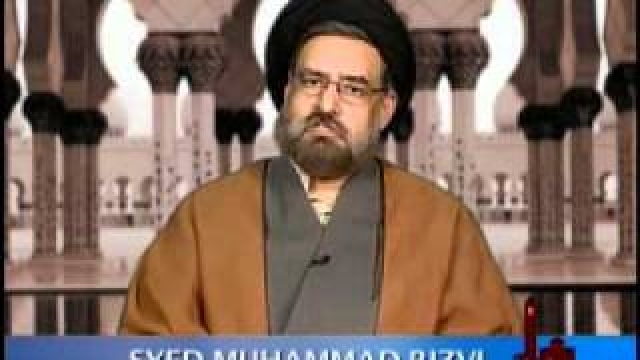
Raising A Godly Child 4/4

'A'udhu billahi min al-Shaytan, al-la'in, al-rajim. Bismillah Al-Rahman Al-Rahim. Al-hamdulil-Lahi Rabbi 'l-Alameen, wa as-salat Wa as-salam 'ala Sayyid Al-Anbiya'i, wa Khatim al-Mursaleen, Sayyidina, wa Nabiyyina, Abil Qasim Muhammad, wa 'ala ahlih, at-tayyibin, at-taharin, al-masoomeen.
I begin in the name of God, the Kind and Merciful, and I ask for the special blessings of Almighty God upon Prophet Muhammad and his Holy Progeny. Dear viewers, salamun alaykum, Peace be upon all of you. This is the fourth and the final segment of our talk on raising a Godly Child from the Islamic perspective. Our entire discussion was based on the saying of Prophet Muhammad, where he says 'Al waladu sayyidun saba' sineen, wa 'abdun saba' sineen, wa wazeerun saba' sineen,' which means that a child is the Master for the first 7 years and then the child is a slave for the next 7 years. And finally, in the last segment of the upraising of the child, the child is the minister.
When we look at this famous saying of the Prophet, we come to realize that the Prophet Muhammad was able to convey very complex psychological ideas and concepts to the people who were illiterate and many of them who lived as bedouins in the Arabian desert. Let me summarize our previous discussion before we move on to the final segment of our talk. In the first stage of upraising the child, the child has been described by the Prophet Muhammad as the master, and this is the pre-school era, where the Prophet is saying that let your child be a child. At this first stage of raising a child from birth to age 7, the emphasis was on Tarbiyat, which means on character building, providing a positive role model because we have to realize that children see and hear from the parents, siblings and elders and whatever they see and hear, that actually forms their character.
In the second stage of raising a child, the Prophet Muhammad said that the child is the slave. The term slave here used in a figurative sense, is emphasizing that now that the child has started and gone into the elementary school years, you know you have to be more vigilant. The Tarbiyat, the character building process has to continue in the second stage of the raising of the child, but now you also have to include the formal education, whether it's in secular issues or religious issues.
The most important point that I would like to mention here before we talk about the final and the third stage of raising a child is the issue of, you know, interdependency of these stages. You know, no parents should ever expect that they will be able to raise their children in the third stage from age 15 to 21 in a perfect way if they have not done their homework in the first and the second stages of raising a child. If you as a parent have not done your work in the first two stages, then don't expect a miracle when things go wrong in the third stage. You know there is no magic wand or a pill or a lucky charm with any 'Alim or Mulla or Aamil or Jotshi or a Holy man for curing the ills of the third stage if the parents did not do their own homework in the first and the second stage of raising a child.
And so let us now you know go to the third stage of raising a child, when the child is from age 15 to 21, when the child is in the high school and the early years of college and university. Prophet Muhammad described the final stage of raising a child as the stage in which your child is the minister. He uses the term wazeer. This description of a child as a wazeer, a minister, in the third stage of raising the child is very beautiful in a sense, it shows the relationship between the parents and their children. You know, the parents are basically like the king and the queen, and the child is like the minister. And this description used by the Prophet highlights two issues.
Number one, it clarifies the hierarchy that even though the child is now in high school or early years of college and university, the hierarchy is still very clear, the parents are still in charge. And the second point, which this term minister highlights is that the parents should realize that their child is no more a minor. You know, he is now going into the third phase of his life as your child. And in that third phase you have to treat your child like a king or a queen would treat their minister. You know a minister is not just a low status clerk to be ordered around for errands only. No, the parents now as king and queen for example, when they want to talk with their children, they have to basically sit down, talk and discuss the issues and guide the child to make the right decision under your guidance and under your wisdom.
This is how the child basically will be trained to make their own wise decisions in their adulthood when they reach into the age of 21 plus. And so remember that when we talk about the third stage, the issue of upbringing and Tarbiyat is concerned with, realize that from the Islamic perspective, the child is now entering adulthood.
In the secular system, the age 15 to 21 is described as the age of you know youth age or adolescence. Islam actually considers this age to be the age of responsibility and being accountable in the eyes of God. Actually, from the Islamic perspective, a child in that stage from 15 onwards is an adult and a responsible person in the eyes of God and society. The most fundamental issue in this third stage of raising a child is the issue of the mindset that you have formed for your child.
Almighty God has created in our body four levels and this is just a very simplistic way of looking at things but my purpose is to make things as simple as possible. You know there are four levels when we look at ourselves. There is the first level, the level of the mind. Then there is a second level, the level of the heart. Then there is a third level, the level of the belly, and then comes the fourth level of the private parts. And you know as parents and as a community, many times we look at the needs of the third and the fourth levels of our children and then we think of fulfilling those needs on their own. Whereas we do not realize that there has to be a very strong connection between the third and the fourth levels of our being with the first level and that is our mind and our attitude and our perspective about life.
For example, look at the needs of the third level, which is the belly. You know, when we look at that, and we say 'Ok, what is the need of the belly?' You know, a child for example, is hungry and thirsty, and so immediately we say 'Ok, provide food and drink.' And if you provide food and drink, you know it would take care of the third level of the human being. But you have realize you know that not just any food or drink would be the right answer to take care of the needs of the third level of a person. o, there are other issues that you have to you know, you have to consider also. For example, what kind of food are you going to provide to your child? You know is the food going to be healthy or unhealthy? Is it going to be you know halal or haram? You know which is religiously acceptable or forbidden? Is it going to be a food which is considered to be pure from the Islamic perspective, or is it an impure substance? Or is the food itself legitimate or not? It has been acquired from the means which are acceptable in our faith as well as in you know our society or not.
So these are the questions which can only be dealt, dealt with if we look at the needs of the third level, you know in coordination with the first level, and that is the wisdom of the mind of a person. So my point is that you know we cannot take care of the, for example, the problems of the belly, or the problems of the private part, of other needs of other children at that stage, just in isolation. We have to link that with the mindset that our children have at that time.
For example, when we talk about, another example, when we talk about the issue of marriage. You know the marriage cannot be simply solved by saying 'Ok you know, the first boy or girl that our children would see in the college or the campus, and they like them and that is the solution to the problem.' No, there are many many other issues which have to be taken into consideration. It's not just the physical looks, or the you know the girl is beautiful or the boy is handsome. No, there are other issues which play a very important role in selection of a spouse for our child. For example, the faith and religion will come up. There will be a lot of tension if the husband and wife are not on the same page as far as their perspective for life, the purpose of life, and faith and religion is concerned. And so when we have to look at the character of the person, the background of the person and not just the looks and the physical beauty would be the right answer.
And this is where there has to be a coordination between all parts of our body and the needs that a person has with the first level, and that is the level of the mind. And so, for example, when we talk about the problems of our youths in the third stage of you know upbringing from 15 to 21. We hear about many many issues discussed in Muslim communities, from the issues of you know hijab or lack of hijab or pointless hijab or the issue of immodest and revealing clothes. Sometimes we hear about the issues of you know friendship between boys and girls, and you know they're going to the dance parties or even the issue of alcohol and drug addiction to things which are haram, forbidden and doubtful from the Islamic perspective, even from the perspective of the laws of the land.
And so when we look at all these issues, we have to realize that many times the parents as well as the community, you know they look at the problems singularly and separately. We do not realize that we have to take a holistic approach and only then we will realize that the actual key to all the problems that the young person has is the mind and the mental outlook of the person.
If you are able to raise your child with a proper mindset, a mind which is anchored to the values of Almighty God, Prophet Muhammad and the Imams from his family, then all other problems will be taken care of in the right way. The desires of the heart, the desires and the needs of the belly and the private parts will be resolved in the right way automatically.
And so the key to solutions, especially when we are talking about you know helping our young boys and girls you know to enter into adulthood and make right decisions for themselves, is to make sure that their mindset is anchored with our spiritual values. Amir ul-Mu'minin, Ali Ibn Abi Talib, our first Imam, in advice to his son, he emphasized this point of Dhikr and Taqwa. Taqwa means the Consciousness of Allah's presence in our life. For example, he says, he says to his son 'I advise you to have the Consciousness of Allah O my child, to abide by His commands, to fill your heart with the Remembrance of Him and to clinch to Hope from Him. No connection is more reliable than the connection between you and Almighty God, provided you hold on to that connection.'
And so you know, when you are talking about age 15, remember that your child has already started high school and then they will go on to the college or the university. You know at that stage, most of us as parents, we worry about the clothes and the supplies that they will need at the new school. We also worry about how they will fit in in that new environment, especially when we know that the teachers in high school are no more in control. They are not that much strict as they were in the elementary school. And so they are going into a new environment. And so we actually worry about many things. We worry about their supplies, their clothes, their shoes but besides all these mundane items, the most fundamental school supply for our children in high school and college years is Taqwa and the connection to Almighty God.
As Imam Ali says that, no connection is more reliable than the connection between you and Allah, provided you hold on to it. And so we have to realize that you know Taqwa, this Consciousness of Allah's presence in our life, that is the main mindset which is going to you know guide our youths and our children in the right way. And that is the key to all other problems. You know we cannot look at issues in isolation and separately and individually. The key to all these problems that the youth face in their life in that stage from 15 to 21 is this issue of the mindset. What is their mindset? Is their mind you know anchored in this element of Taqwa or not?
Almighty God for example, in chapter 8 of the Quran, verse 29, He says "Yaa aiyuha al-ladheena amanoo in tattaqu Allaha yaj'allakum furqanana"(8:29). Almighty God says that if you acquire the Taqwa, the Consciousness of God, He will grant you the insight, the furqaan, the ability to distinguish between what is right and what is wrong, what is you know proper and what is improper. There is another verse also, if you go to chapter 65 verse 2 and 3, there God says that 'If you really acquire this Consciousness of My Presence in your life, I will find a way for you in your difficulties.'(65:2-3).
And so as Amir ul-Mu'minin emphasizes this point of Taqwa, Allah has guaranteed to us in the Qur'an that with Taqwa, you get the insight to know what is right and what is wrong. With Taqwa, God will find ways to take you out of the difficulties and the problems that you see in your own life.
So you know when we talk about a young person's mind, if it is connected to Almighty God, you know he will be helped in the best of ways. And for example you know, if you look at the life of Zaynab salawatu Allahi 'alayha, the daughter of Amir ul-Mu'minin, you know it was this element of Taqwa which stayed with her till the last moment. You know especially when we look at her sermon that given in the darbaar of Yazid, the way she talks about, you know the long term effects of Taqwa. She was married to a very affluent person, but when the time came for her to give the sacrifice for the sake of the Imam of her time, for the sake of her faith and her religion, she was very easily willing to sacrifice whatever she had. And that is where you know the issue of Taqwa comes up. You can be surrounded with luxuries. You can be surrounded with immoral environment but if you have Taqwa, you know what is the right decision that you should take.
Let me talk about two or three issues related on a practical level about our youths. Number one is the issue of attendance at the mosque. You know I hear from many, many parents, they complain that you know while my child now goes to the high school and because they have you know lots of homework, therefore you know they cannot attend the weekly Thursday night programmes or Friday prayers or other religious functions. And homework becomes the main issue that 'Oh they get so much homework in high school and college and university.' We have to realize that as parents, we actually have to help our children, the young children, the youths, how to manage their time in such a way that they do their homework and their assignments as well as they are able to participate in religious programmes. You know we are very fond of talking about time management. Why don't we do that in our own personal life?
You know, if I as a parent know that tonight, let's say, is a Thursday night programme, for example, or there is a special programme today, you know I can actually prepare my children from day before that you know 'Ok, tomorrow there is a special programme. We have to go there, so you know change your schedule and make sure that you have done your assignments and homework before it.' Or arrange it in such a way that they can come later on and complete that. And this is an important issue. And I'm talking from my own experience. I have seen how my wife you know has guided my children. All my children were born in Canada and we were able to balance you know the demands of the high school level or even university level and the issue of participation in religious events.
So this is something which can be done. It's actually the issue of the mindset. If you really think about it, you will be able to find the solution to the problems. Many times you know we talk about the issues, for example, the children also go to early morning or after school extracurricular activities. We can do that. Why can't then we find extra time and effort to bring our children for the weekly religious programme? And this is where I'm saying that if we have do the will, we will be able to find the way.
Another excuse which I hear quite a lot on this issue, is that you know kids don't like the speaker for example. Say the programme at the mosque or the religious centre is boring. And you know, when they say 'Oh because of that, I do not want to come.' The parents say 'Ok, then you stay home.' My question to parents and the children both, is that do you like all your teachers in the school or the college and the university? No. You cannot tell me that all your teachers for all the subjects in high school or at the college and the university, you know you like them? No. There would be some professors and lecturers and teachers who are boring in your view. You don't like it, but still you go. Why do you go? You go because you have given this priority in your mind to seeking of education. You know that if you don't have good education, you will not get the degree. If you don't have the degree, you will not be able to find good jobs.
So you have set up a priority in your own mind. It is the mindset which is forcing you to attend the high school or the college or the university, even if you don't like the teacher. And this is where we have to you know basically make sure that the children realize that, for us it's not only this dunya. You know I remember once I'd given, I had attended a Financial Planning Seminar in our Centre and there was a financial expert who talked about the importance of you know saving money and investing for the retirement. So he had made a PowerPoint where he says the childhood, the working age and then the retirement. He said in order to have a good retirement life, you need to save and invest during the time when you are working.
When I looked at that chart, in my mind you know I extended that. It's not only the issue of retirement for us as Muslims. You know for us, we have this, the Hereafter, the Akhirah, and we have to prepare for that also, not only for our retirement. So when we look at our life and if we can help our children to realize that the ultimate goal for a Muslim is to have a blissful life in the Hereafter, not only in this world, not only the job in this dunya and the retirement in this dunya, rather we also have to prepare for the Hereafter, that is where we will see that the priorities in the mind of our children will change. And then you will see that they will be able to balance their you know schedule as far as their homework and assignment and education as well as the religious activities in the community. Then you will see that the balance would be there and your vision will broaden and you will see that they will gain the good of this world as well as the Hereafter.
You know let me end with a discussion about what I had read last year in a special issue, in the Winter's issue of this Sociological Quarterly of the United States of America. And there was a survey which is very interesting about students attending the Church. And according to that survey, let me read the exact word, it says researchers found that Church attendance has as much effect on a teen's GPA as whether the parents earned a college degree. So they're saying that you know the parents have a college degree, then the chances of the child's GPA increasing will increase. But they say also, if they attend the Church, their chances also will go up for raising their grades. Students in grades 7 to 12, who went to the Church weekly also had lower dropout rates and felt more a part of their schools. So we have to realize that you know attending the Church or attending the Mosque is not going to take your child away from the progress in Secular Education. I think they will grow and become stronger you know in their faith, in their values as well as in their education.
And so remember, the main message that I have for the third stage of raising a child, is to raise the child in such a way that in their mindset, the priorities they are anchored according to the values of our faith. If that is there, they will achieve the highest levels of education as well as higher levels of spirituality. They will have the good of this world as well as the Hereafter. And that is the ultimate success that each one of us is striving for.
May Almighty God bless all of us and to us who are parents, may He give us the courage, the wisdom and the insight to raise our children as good Muslims and good citizens of the society. Wa as-salamu alaykum wa rahmatullahi wa barakatuh .