
Chapter 25: All Liquids That Cause Intoxication Are Considered Impure
The verb ‘intoxicate’ is borrowed from the Latin word for poisoned - intoxicatus - from the noun for poison - toxicum. Its meaning of drunkenness is borrowed from the Medieval Latin for poisoning - intoxicationem - derived from intoxicare ‘to poison’. The word ‘drunk’ implies that someone is at present the worse for drink - to have lost control over behaviour, movement or speech as the result of having been poisoned by alcohol.
In its figurative sense, the word ‘intoxication’ derives from an earlier adjectival sense of being stupefied or exhilarated. Thus, in its metaphoric sense, ‘drunk’ may describe the state of irrationality that results from intense fear or excitement, or the euphoria that is stimulated by poetry, music or success.
In the Qur'an the word ‘drunkenness’ is used in both its literal and its metaphorical sense.
In its literal sense:
"O' you who have Faith! do not approach prayer when you are intoxicated, until you know what you say, nor when you are polluted - unless you be passing through - until you wash yourselves. And if you are ill or on a journey, or one of you come from privy or you have touched the women and you cannot find water, then betake yourselves to pure earth then wipe your faces and your hands; verily Allah is Pardoning, Forgiving." (Surah An-Nisa’, 4:43).
In its metaphorical sense - while describing the Day of Resurrection:
“On the Day you shall behold it, every suckling mother shall forsake her suckling babe, and every pregnant woman shall lay down her burden, and you shall see the people (‘a) intoxicated, yet they are not intoxicated, but the chastisement of Allah is severe.” (Surah Al-Hajj, 22:2).
The metaphorical sense of the word is also found in the ahadith:
-
Intoxication may be the result of three things: being drunk on wine, being drunk on riches or being drunk with power.1
-
Beware of being intoxicated by your sins because that is far worse than being intoxicated by wine.2
Have you not read that Allah Almighty said:
"(They are) deaf, dumb, blind - so they shall not return (to the right path)." (Surah Al-Baqarah, 2:18).
-
The return to sobriety after the intoxication of heedlessness or conceit is far more of a problem than the return to sobriety after being drunk on wine.3
With regard to 'impurity', most Islamic jurists acknowledge the difference between liquids and solids. Liquid intoxicants are considered impure, while solids, such as opium, cannabis, etc., whilst being Haram, are considered to be pure.
Gradual Introduction To The Prohibition Of Intoxicants
After their acceptance of Islam, many Arabs continued to drink wine and question the Prophet (S) about it until the following ayah was revealed:
"They ask you (O Prophet) concerning wine and gambling. Say: 'There is a great sin in both of them and (some) profits for people; but their sin are greater than their profit'…" (Surah Al-Baqarah, 2:219).
It is clear from the above ayah that in the early years of Muhammad's (S) prophethood, drinking wine was not completely prohibited despite the evil of drinking being signalled. Later Divine Revelation to some extent forbade the use of wine by telling Muslims not to pray while intoxicated:
"O' you who have Faith! do not approach prayer when you are intoxicated, until you know what you say" (Surah An-Nisa’, 4:43).
At the last stage, prohibition was made absolute:
"O' you who have Faith! Verily wine, gambling, idols, and (dividing by) arrows are an abomination of the Satan's work, so avoid it, that you may be prosperous." (Surah Al-Ma’idah, 5:90).
"Certainly Satan desires to cast enmity and hatred among you by wine and gambling, and to hinder you from the remembrance of Allah, and from prayer. So will you stop?" (Surah Al-Ma’idah, 5:91).
The Basis For This Principle
From The Qur'an
"O' you who have Faith! Verily wine, gambling, idols, and (dividing by) arrows are an abomination of the Satan's work, so avoid it, that you may be prosperous." (Surah Al-Ma’idah, 5:90).
In this ayah, the drinkingof wine is described as an abomination. In customary understanding – ‘urf - this equates to it being impure. Although some jurists have questioned the clarity that this ayah contributes to the Islamic legal definition of impurity, its interpretation is made clear in the following ahadith.
From Ahadith
Two groups of ahadith may be cited. The first communicates that wine and beer are prohibited, and the second that they are impure.
Examples regarding prohibition:
-
Al-Kulayni narrates on the authority of Imam al-Baqir (‘a) that the Prophet (S) said, 'All intoxicants are prohibited and all are to be treated in the same manner as wine.'4
-
In a letter to the Abbasid Caliph Al-Ma'mun, Imam al-Rida (‘a) wrote, 'Even the tiniest droplet of a liquid that may cause intoxication, is prohibited.'5
-
Imam al-Baqir (‘a) said, 'The prayers of those who have consumed wine or other intoxicating beverages are not accepted for 40 days.'6
-
Al-Kulayni narrates that when Al-Washa wrote to Imam al-Rida (‘a) for a ruling regarding beer, his reply clearly stated that beer is Haram.7
Examples Regarding Impurity
-
Al-Kulayni records that when ‘Abdullah Ibn Sinan asked Imam al-Sadiq (‘a) if he needed to launder a garment he had lent to a person who drank wine, he was told not to wear it for prayer until that had been done.8
-
Al-Kulayni records that Imam al-Sadiq (‘a) said, 'When clothes are polluted by wine or other intoxicants the polluted areas need to be washed; if the full extent of the pollution is unclear, the whole garment needs to be laundered. Any prayers offered in polluted clothes need to be repeated.'9
-
Shaykh Al-Tusi records that Imam al-Sadiq (‘a) said, 'Do not offer prayer in places where wine is served because the Angels avoid them - and do not offer prayer in clothes polluted by wine or other intoxicants until they have been cleaned.'10
-
Shaykh Al-Tusi records that when Imam al-Sadiq (‘a) was asked what should be done if a droplet of wine or other intoxicating liquid fell into a dish of meat in sauce or gravy, he was told that the meat should be washed before being eaten but that the sauce or gravy was no longer suitable for Muslim consumption.11
-
Al-Kulayni records that when Imam al-Sadiq (‘a) was asked about beer, his response was that it should not be drunk as it falls into the same category as wine and for that reason, clothes contaminated by beer need to be cleaned.12
Alcohol
In English, the word 'alcohol' is commonly used to describe any intoxicant even though, chemically, several types of alcohol do exist, e.g.
Methanol CH3OH
Ethanol CH3CH2OH
1-propanol CH3CH2CH2OH
1-butanol CH3(CH2)2CH2OH
1-hexanol CH3(CH2)4CH2OH and
1-octanol CH3(CH2)6CH2OH
Although all alcohols are toxic when ingested, human beings are able to tolerate low levels of ethanol - which is the reason why the alcohol ethanol is used as the basis for all alcoholic beverages.
Ethanol CH3CH2OH
Synonyms Ethyl alcohol, grain alcohol
Properties
Toxicity Can be ingested at low levels
Other Colourless, odourless, liquid
Uses
-
In the manufacture of alcoholic beverages - the 'alcohol' in alcoholic drinks.
-
To dissolve organic compounds insoluble in water - for example in the production of perfumes and cosmetics.
-
As an industrial feedstock.
-
As a fuel - ethanol can be used as a fuel in its own right, or in mixture with petrol (gasoline). 'Gasohol' is a petrol/ethanol mixture that contains 10% - 20% ethanol.
Note: Industrial methylated spirits (meths) is ethanol, with a small addition of methanol and colour. It is because methanol is toxic that industrial methylated spirits are unfit to drink.
Thus, all Islamic religious reference to 'alcohol' refers to ethanol - and not to the alcohols that are too toxic to be drunk. It follows that, as these are not in the same category as wine and other intoxicating beverages, they are not considered by Islamic jurists as being impure.
It should be noted that Islamic jurists are in agreement that small percentages of alcohol found in fresh apple juice and bananas, citrus-flavoured boiled sweets made from citric essences preserved in alcoholic solvents and the alcoholic additives used in the manufacture of cough syrup and cosmetic products such as aftershave and eau de cologne are all legally considered to be pure.
Liquor
The word 'liquor' is derived from the Latin word liquor - liquid. Prior to 1300 CE it had the sense of being any drink, especially wine. Today it refers primarily to distilled alcoholic drinks such as whisky, rum, brandy, gin, etc., also referred to as spirits or 'hard liquor'.
However, the word liquor may also refer to the reduced liquid or juice from the cooking of food or, when prefaced by the noun of a specific substance, e.g. chocolate, refer to the liquid or paste (liquor) that is produced when cocoa beans are roasted and ground. However, 'chocolate liquor' is not to be confused with 'chocolate liqueur', for the word 'liqueur' is a French word, itself from the Latin liquor. Liqueurs are sweet alcoholic beverages flavoured by herbs, spices, flowers, roots, bark, chocolate or cream being dissolved in the alcohol.
Spirit Vinegar / Wine Vinegar
When the chemical formulation of the elements oxygen and hydrogen - which as H2O constitute water - are no longer bonded together as H2O, they cease to constitute water and are transformed back into the gases hydrogen and oxygen. As changes to chemical structures transform their properties - referred to in Islamic jurisprudence (fiqh) as istihalah - such transformations are acknowledged by jurists to be 'purifying agents'. Once the structure of wine or spirits is transformed into vinegar, all jurists accept it as pure. Even supermarkets understand that vinegars have no place in alcoholic drink displays.
Alcohol Used In Cooking
It might be assumed that alcohols added to food before or during cooking would be dissipated. However, the table below shows that this is not the case. The results of a US Department of Agriculture 'Nutrient Data Laboratory' study show the percentages of alcohol retained after a variety of methods of cooking:
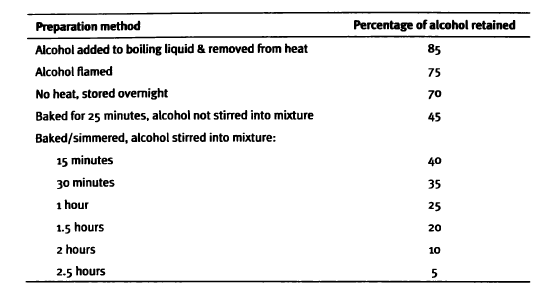
The above table is included on the following URLs:
http://chefshane.com/alcohol_burn_off.php
http://www.diabetic-lifestyle.com/articles/febo4_cooki_1.htm
http://homecooking.about.com/library/archive/blalcohol12.htm
http://www.ucook.com/news2.cfm?item_no=2074
http://whatscookingamerica.net/Q A/AlcoholCooking.htm
- 1. Bihar al-Anwar Vol. 10, p. 114.
- 2. Bihar al-Anwar Vol. 77, p. 102.
- 3. Ghurar al-Hikam.
- 4. Wasa'il al-Shi’ah, Vol. 25, p. 326.
- 5. Wasa'il al-Shi’ah, Vol. 25, p. 330.
- 6. Wasa'il al-Shi’ah, Vol. 25, p. 330.
- 7. Wasa'il al-Shi’ah, Vol. 25, p. 360.
- 8. Wasa'il al-Shi’ah, Vol. 3, p. 468.
- 9. Wasa'il al-Shi’ah, Vol. 3, p. 469.
- 10. Wasa'il al-Shi’ah, Vol. 3, p. 470.
- 11. Wasa'il al-Shi’ah, Vol. 3, p. 470.
- 12. Wasa'il al-Shi’ah, Vol. 25, p. 361.
