
Chapter 8: When A Text Is Clear, Interpretations Are Unacceptable
There are wide variances in the texts of the Qur'an and ahadith. The meaning of a text may be apparent, but when words are used in their metaphorical, rather than their literal sense, the text may at first appear to be unclear. Instances of ambiguity may also exist concerning words used in the Qur'an and elaborated upon in a hadith.
So, if a word is equivocal, that is to say it can be understood in more than one way, what does the faqih do?
For example, in Qur'an 2:228 we read, 'Divorced women must wait for three quru' . . .' Two meanings may be conveyed by the word quru';1 one refers to the period during menstruation – Hayd - the other to the time between two monthly periods of menstruation - tuhr.
Classification
Fuqaha classify multiplicity of meanings in the following ways:
1. That Which Is 'Manifest' - Zahir
Any practices and procedures that were not disapproved of and abolished by the Prophet (S) are believed to have his approval - hence the statement employed by fuqaha, 'Absence of rejection indicates approval'.
While signs, body language and telepathy are not adequate means by which to communicate precise information, words are an extremely effective means by which to accurately communicate sophisticated nonmathematical information. Like all other peoples, pre-Islamic Arabs depended on words to express ideas, and as there is not a single report of the Prophet (S) rejecting this method, it is clear that under Islamic law it is the only approved means of communication.
When what is meant is clear, a word is classified as being 'manifest'. However, when it does not accord with the context in which it appears the meaning of the word has to be interpreted. For example, when it is used to imply some other meaning or quality, as in the statement, 'I saw a lion so ferocious that none would face him.' Here the word 'lion' is used not in its literal sense, but rather to reveal the valorous nature of a particular person.2
Zahiris claim that both Qur'an and ahadith must be understood in their literal sense and thus completely rule out all interpretations. A simple example to illustrate the silliness of this viewpoint is when we read in Qur'an 48:10 that, 'Allah's hand is on top of their hands'.
Literalists are obliged to understand that Allah has a human-like form - a view rejected in the Qur'an, ahadith and Islamic theology.
Examples from the process of ijtihad of words not being manifest are found in the commands of the Qur'an. Do all Qur'anic commands highlight obligations, or are some open to interpretation? Fuqaha acknowledge that the commands that follow prohibitions convey permissibility rather than obligation. Thus, in Qur'an 5:2, 'When you leave the state of ihram go hunting', is not an order to hunt but rather, permission to hunt at that time if one so wishes.
2. That Which Is 'Unequivocal' – Nass
This refers to definitive texts or rulings in the Qur'an or ahadith. Nass, as opposed to zahir, signifies words that confer clarity on the principal theme of the text in which they occur.
For example, for the hadith concerning taxable limits for zakah on the number of camels owned, please see table overleaf.
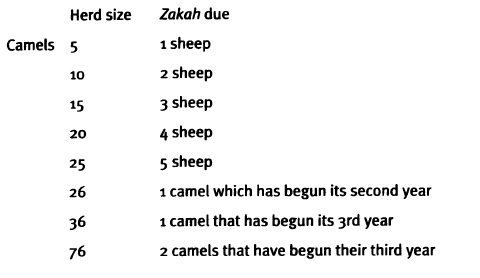
All the taxable limits in this hadith, i.e. 5, 10, 15......76, are unequivocal and no other interpretation may be countenanced. The same applies to the amount of zakah due.
Another example is the fixed share stipulated in the Qur'an to be due to heirs, e.g. 'Half is due to the only daughter.' The text here is unequivocal – nass – and no other interpretation can be considered.
Similarly, the Qur'anic text, 'Unlawful to you are dead carcasses and blood' (Qur'an 5:30) is nass regarding the prohibition for humans to consume those things.
3. That Which Is 'Ambivalent' – Mujmal
Mujmal denotes a word or text that is inherently unclear because there is no clue in the text that specifies what it is meant to convey. A word may be homonymous - with more than one meaning - and require an indication as to which meaning should apply. It may be a constructed word that no one is familiar with, or be a word to which the Law Giver has applied a specific meaning that differs from its literal one.
Certainly, the literal meaning of words such as salah, riba, Hajj and siyam are no longer conveyed, as all now refer specifically to the matters that the Law Giver applied to them. Everything mujmal that has been explained by the Law Giver becomes mufassar.
Allah tells us in the Qur'an, 'Allah permits trade but prohibits riba', (Qur'an 2:275). The last word of this sentence literally means 'increase', however, as not every increase or profit is unlawful the text is ambivalent - mujmal - as to the type of increase that is forbidden. Clarification by the Prophet (S) and error-free Imams (‘a) has served to remove that ambivalence.
When one has no access to water, ablution without water - tayamum - needs to be performed. 'If you have entered a woman and do not find water, use clean earth ...' (Qur'an 5:6). The word sa’id used is ambivalent for it could refer to a plateau, to high ground or to clean soil. However, the usage of this word is clarified in the hadith.
4. That Which Is Equivocal – Mutashabih
Allah tells us there are two types of ayat - muhkam and mutashabih. Regarding the latter we read:
'Perverse hearts seek out mutashabih ayat in order to mislead others by their own interpretations. Only Allah and those with authentic knowledge comprehend their real meaning' (Qur'an 3:7).
An essential guideline for charitable acts is that good deeds have a tenfold reward and evil acts a single-fold penalty (Qur'an 6:160)3.
An example of misinterpretation of this ayah is the claim that, 'Stealing an apple to give away as an act of charity yields a nine-fold reward' (the giving bringing a ten-fold reward, minus the single-fold penalty for stealing, leaving the nine-fold benefit).
Another example is the justification for frequenting nightclubs - environments that abound with things that are not permitted - by claiming that doing this affords opportunities to advise people to keep to the good and to eschew the bad.
According to the Imamiyah School of law, valid interpretation of mutashabih ayat is the sole province of the error-free Imams (‘a) appointed by the Prophet (S) (see Thaqalain hadith), to guide us in conjunction with the Qur'an.
Conclusion
From the above classifications we conclude that Zahir, ambivalent and equivocal words in the Qur'an and ahadith, are open to interpretation, but that those that are unequivocal – nass - are not. Thus, the ijtihad of companions or jurists that oppose these rules are regarded as invalid and not open to consideration. Historians have nonetheless recorded numerous breaches.
The noted scholar Sayyid Abd al-Husayn Sharaf al-Din (the author of ‘The Right Path’ - Al-Murajat), in his work on this subject Al Nass wal Ijtihad, records 15 interpretations by the first Caliph, 55 by the second, 2 by the third, 13 by Ayesha, two by Khalid Ibn Walid and 13 by Muawiyah, that flout things that are unequivocal - nass - in the Qur'an and ahadith.
An example in contemporary times is found in the suggestion to permit interest on loans for investment and start-up funding - but to maintain the prohibition on interest for loans to those in desperate need. Such an interpretation is not acceptable as it is in flagrant breach of the ayah prohibiting interest that all fuqaha have understood to constitute a definitive ruling with no possibility of interpretation.
- 1. The full Verse reads:
"And the divorced women should wait (not wedding anyone else) concerning themselves for three (monthly) courses; and it is not lawful for them to conceal what Allah has created in their wombs, if they believe in Allah and (in) the Last Day. And their husbands have a greater right (than others) to take them back in the meanwhile, if they wish for reconciliation (indeed). And they (women) have rights similar to those against them in a fair manner, but men have precedence above them; and Allah is the Mighty, the Wise." (Surah Al-Baqarah, 2:228). - 2. Muhammad Abu Zuhra, Usul al-Fiqh, p. 93.
- 3. The full Verse reads:
"Whoever brings a good (deed), he shall have ten times its like, and whoever brings vice, he shall not be recompensed but with its like, and they shall not be dealt with unjustly." (Surah Al-‘An’am, 6:160).
