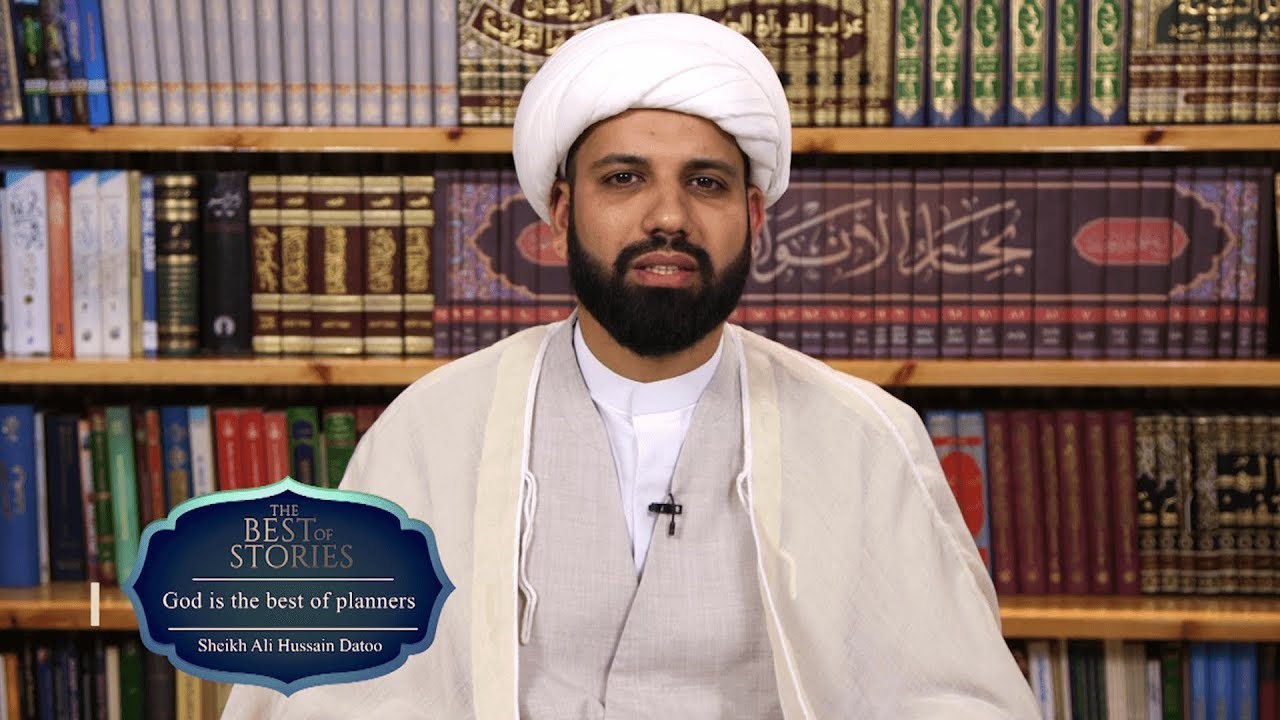
Surah Yusuf (12) - The Best of Stories 1/15

"Nahnu naqussu 'alayka ahsan al-qasasi bimaaa awhainaaa ilayka haadha al-Qur'an"(12:3) "We do relate unto thee [Muhammad] the most beautiful of stories, in that We reveal to thee this (portion of the) Qur'an".
A'udhu billahi, as-samee', al 'aleem, min al-shaytan al-la'een al-rajim. Bismillah, al-Rahman, al-Rahim. Al-hamdulillahi rabb il-'alameen, Al-hamdu lillahi al-ladhee hadana li-hadha wa maa kunna linahtadiya lawla an hadana Allah (7:43). Thumma as-salaat wa as-salaam 'ala sayyiddina Muhammad wa 'ala ahli baytihi at-tayyibeen at-tahireen. Allahumma salli 'ala Muhammadin wa aali Muhammad. Dear viewers, salamun 'alaykum jamee'an wa rahmatullahi wa barakatuh.
It is with great pleasure that we accept this invitation from Allah, Subhana wa Ta'ala, to be His guest in this most holiest of months. The Holy Prophet, peace be upon him, just before the advent of the month of Ramadan mentions in a famous sermon that Allah, Subhana wa Ta'ala, has invited you to His banquet. It is of great importance to understand that Allah has found you and I worthy of inviting us to His banquet. There are people who were with us last year who have passed away by this advent of Ramadan, and there are people who may not be able to accept this month of Ramadan. Maybe they are travelling. Maybe circumstances are such that they will not be able to fast in the holy month of Ramadan.
So we should be extremely grateful to Allah, Subhana wa Ta'ala, that He has given us this life, He has given us health and most importantly, He has given us this understanding of this most beautiful religion that He has given to the majority of us on a plate. Many of us have not had to strive hard and exert great effort in arriving on the path of the Ahlul Bayt, 'alayhimu as-salaam, on this path of Tawhid, on this path of God. Many of us were born into this religion. Others have had to struggle, strive hard in order to arrive at it. We must thank Allah, Subhana wa Ta'ala, for this most beautiful gift that He has given us.
And when it comes to the holy month of Ramadan, we should know that He has selected it above all other months. All the months obviously have their benefits. But the holy month of Ramadan stands out from the rest of the month. It is the month that Allah has chosen for Himself. It is the greatest of months and Allah, Subhana wa Ta'ala, has chosen the greatest of actions to be performed in it. After the Salah which is there as obligatory, He makes it obligatory upon you and I to fast.
Fasting, as you know, is one of those actions where it is not possible to have pride in. Many actions, when you and I perform them, for example, when we pray, it is possible that we pray slowly when people are around us. It is possible that we pray in a beautiful tune. We recite in a beautiful tune so people can hear us. It is possible that we wake up in the middle of the night so that other people are aware of our actions. This obviously brings down the value of that action. However, when it comes to fasting, it is not possible for you to know that I am fasting or for me to know that you are fasting.
It is an act that is done in absolute secrecy between a servant and his most beloved lord. It is an act that you will only find out about if somebody actually says something about it. It is only if I come out and tell you that I am fasting will you know. For that reason, it is an act of secrecy. And between two lovers, the most intimate actions are those actions which are secret and nobody else is aware of that.
Hence Allah, Subhana wa Ta'ala, says about fasting, that fasting is for me and I am its reward. There are some actions where Allah says that the reward of this action will be, for example, to increase your lifespan. If you do this action, your sins will be forgiven. Another action, it is equivalent to Hajj and Umrah. But when it comes to fasting, Allah says I am its reward. It is as if the reward cannot be mentioned in words. It is as if this reward is so great that it is only Allah, Subhana wa Ta'ala, can present this. He is the only one who can present this reward to you and I.
Allah has chosen the greatest of months, the month of Ramadan. He has chosen within the greatest of months, the greatest night, the Laylat ul-Qadr. Within the greatest night He chose the greatest of Prophets, Muhammad peace be upon him. For Muhammad, he chose the greatest of books, the Qur'an. And He chose to reveal it to the greatest place within the body of the Holy Prophet, as is mentioned in the Qur'an, "'ala qalbika litakuna min al-mundhireen" (26:194). That Allah, Subhana wa Ta'ala, has revealed this Qur'an onto the heart of the Prophet so that he can warn us.
On the day of judgment, the Qur'an will come to our shafa'ah, will intercede for us the more we acquaint ourselves with it. It is interesting to note that in ahadith we are told that recitation of the Qur'an is one thing. That, yes, we are to recite the holy Qur'an. However a step further than the recitation of the Qur'an is that you and I should study this holy book, that we should become familiar with it, friends with the Holy Qur'an. The Holy Prophet, peace be upon him, mentions in a tradition that the superiority of the Qur'an over any other speech is like the superiority of Allah, Subhana wa Ta'ala, over His creation. That shows you and I that there is something great in this book.
Other ahadith from the A'immah tell us that it never becomes old, even though it falls on the same ears continuously. This Qur'an never becomes old. You and I are witness to this. We hear the same verse continuously, other verses continuously. It is a book that has no more than some six and a half odd thousand verses within it. But the more you read it, every time you come towards this book, you realise that there is something new you and I can extrapolate from it. There is a new lesson that we can learn from it.
And it is a book that is applicable in every era and every time. It has principles within it, principles of universal, universal principles of morality that continue throughout time. If it talks about justice, it is that justice that must be implemented throughout all periods of time. If it talks about the rights of one's spouse, these are rights that should be upheld throughout time. If it talks about how one should communicate with their children, if it talks about charity, these are not actions that are to be implemented at one time and not another. These are actions which will continue, principles of morality, which will make an individual a true human being. These are actions that will continue for the rest of time.
Allah, Subhana wa Ta'ala, within this Holy Qur'an has given you and I stories. Why? Because when we listen to stories, when we listen to anecdotes, they stick in our minds. Compared to listening to theoretical concepts when we hear an anecdote or a story, especially if it is a true life story. When you watch a documentary, for example, it sticks in your mind more than somebody simply speaking about theoretical concepts that are taught in this documentary. If someone teaches you science, it is different to you watching a documentary and seeing this science unfold in front of your eyes. In the same way, Allah presents many a story within the Holy Qur'an and many an example.
For example, there are times in the Qur'an where Allah says, 'have you not seen how the camel has been created' (88:17), or 'has the incident of Musa not come to you'? (79:15) However, in all of these incidents, Allah, Subhana wa Ta'ala, uses a third party narrator. He says, 'Have you not seen how the incident of Musa came to you? (79:15) Have you not heard about it?' He never makes himself the narrator of a story, except for this one particular story that we wish to discuss in this Holy month of Ramadan.
That is the most blessed story of the most handsome Prophet after Muhammad, none other than Prophet Yusuf peace be upon him. It is the twelfth chapter in this most glorious book, the Qur'an. It comprises of one hundred and eleven verses, but it is an extremely unique story. Why? It is the only lengthy chapter in the Qur'an, which is a story from the first sentence to the last. There are smaller chapters which are stories, but in terms of the most lengthy surahs, in the most lengthy surahs, it is this surah of Yusuf, which is a story in chronological fashion from the first verse to the final verse, where Allah tells us about this story of Yusuf. Not simply so that we can become acquainted with history, so that you and I can understand the lessons that this Prophet went through, learn from his life.
Whenever Allah tells us about a story of a Prophet, it is not simply so that we can become acquainted with the Prophet. It is so that you and I can understand what trials and difficulties this Prophet went through. It is so that you and I can understand the ma'rifah and understanding this Prophet had of Allah, how he looked at Allah, how he spoke to Allah, how he understood Allah. When Allah talks about Maryam in the Qur'an, when He talks about the wife of the Pharaoh in the Qur'an, it is not so that you and I should become ecstatic that these are individuals who believed in God. It is so that you and I can learn from them and then implement and act upon their actions too.
The beginning of this Surah, Allah, Subhana wa Ta'ala, starts with what is known as the disjointed letters, where Allah, Subhana wa Ta'ala, says Bismillah al-rahman al-rahim, "Alif lam raa' tilka aayatul kitabil mubeen"(12:1). These are the verses of the clear book.' And this clear book, it is said that it is a book which is not with us, not this physical Qur'an, but a clear book which is with Allah, Subhana wa Ta'ala,. When this book is revealed to the heart of the Prophet, it comes in the form and the fashion that we have today.
It comes in an Arabic form. It is very clear that Allah has chosen the language of Arabic above all other languages. If there is any gift we can give to the next generation, it is that you and I can teach them this beautiful language of Allah, Subhana wa Ta'ala. How beautiful it would be that we open the Qur'an and we are able to understand it as we are reading it. How beautiful it would be that we would be able to read the ahadith of the Holy Prophet and his family and understand it directly from their mouths, understand the wording that they said, the nuances within the Arabic language. It is a difficult language to understand, but it is a gift we can part to the next generation.
For many of us who may be first generation Muslims born here in the West, our parents did a great sacrifice for us by migrating from one part of the world to another. They did something great for us. It is now time that we do something great for our next generation as well. And there is nothing better than to be able to give them this language which will open up an ocean to them not only of the Qur'an, but also of ahadith of the Ahlul Bayt, 'alayhim as-salaam.
Here is where Allah, Subhana wa Ta'ala, says that: "we have revealed this Qur'an in an Arabic form so that you may understand it" (12:2). And then He says a sentence which He does not say about any other Surah in the Qur'an. He says: "Nahnu naqussu 'alayka ahsan al-qasasi bimaaa awhainaaa ilayka haadha al-Qur'an"(12:3). "[Oh Prophet of God], We are going to narrate to you the best of stories". Do you see how beautiful this is? That Allah says the best of stories requires the best of narrators. I am not going to simply make it come to you oh Prophet from another narrator, from a third party narrator. The best of stories in the Qur'an requires the best of narrators and the best of the narrator is none other than Allah, Subhana wa Ta'ala, Himself. So He tells the Prophet, We shall reveal this to you directly, not from a third party, not from a third narrator.
And then He tells the Prophet, before this revelation, prior to this revelation, you were unaware of this story. It is possible the Prophet knew generally about the story, about the prophets named Yusuf and Ya'qub. But he did not know the intricacies that are going to be mentioned. The Jews came to the Holy Prophet, it is said, and they tried to corner him. They questioned him about Ya'qub's family. They asked the Holy Prophet, 'tell us, how is it that they moved from Palestine to Egypt?' Thinking that the Prophet would not know about it because it was mentioned in their books, but not in the Qur'an thus far.
However, the Holy Prophet, when this revelation comes to him, he does not simply give a straightforward answer and say that the 'Aal of Ya'qub migrated from Palestine to Egypt because Yusuf became a king. Rather, it says everything else apart from a straightforward answer. It tells them about the intricacies of a servant of Allah, Subhana wa Ta'ala, who relied on Allah and trusted on Allah through every difficulty that he fell into, such that Allah took so great care of him that he started off at the bottom of a pit in a well, and he ended up as one of the greatest kings and advisors to the greatest king in Egypt.
It shows how Allah, Subhana wa Ta'ala, when He wants to debase someone, when He wants to annihilate somebody, He can take them from the tops and bring them to the bottom but when Allah, Subhana wa Ta'ala, loves a servant, He will take them from the pits of a well and make them the greatest of kings.
Insha'Allah in the coming episodes, we hope to discuss this most beautiful chapter of the Qur'an, this most beautiful story, particularly taking and extrapolating ethical principles that we can look at. We shall look at how Ya'qub speaks and communicates with Yusuf and the brothers. We will look at what happened between the brothers. We will look at what happened to Yusuf and how he relied on God and how God took great care of him. We will look at how he went into the prison and what happened in the prison and what we can learn from this great Prophet, not so that we can become ecstatic that this is one of our Prophets, no. So that we can understand how we can implement the advice and the actions of this holy Prophet so that we can walk on his path and become like him and gain closer proximity to Allah, Subhana wa Ta'ala.
Wa sall-Allahu 'ala Muhammad wa 'ala ahli baytihi, at-tayyibeen, at-tahireen.