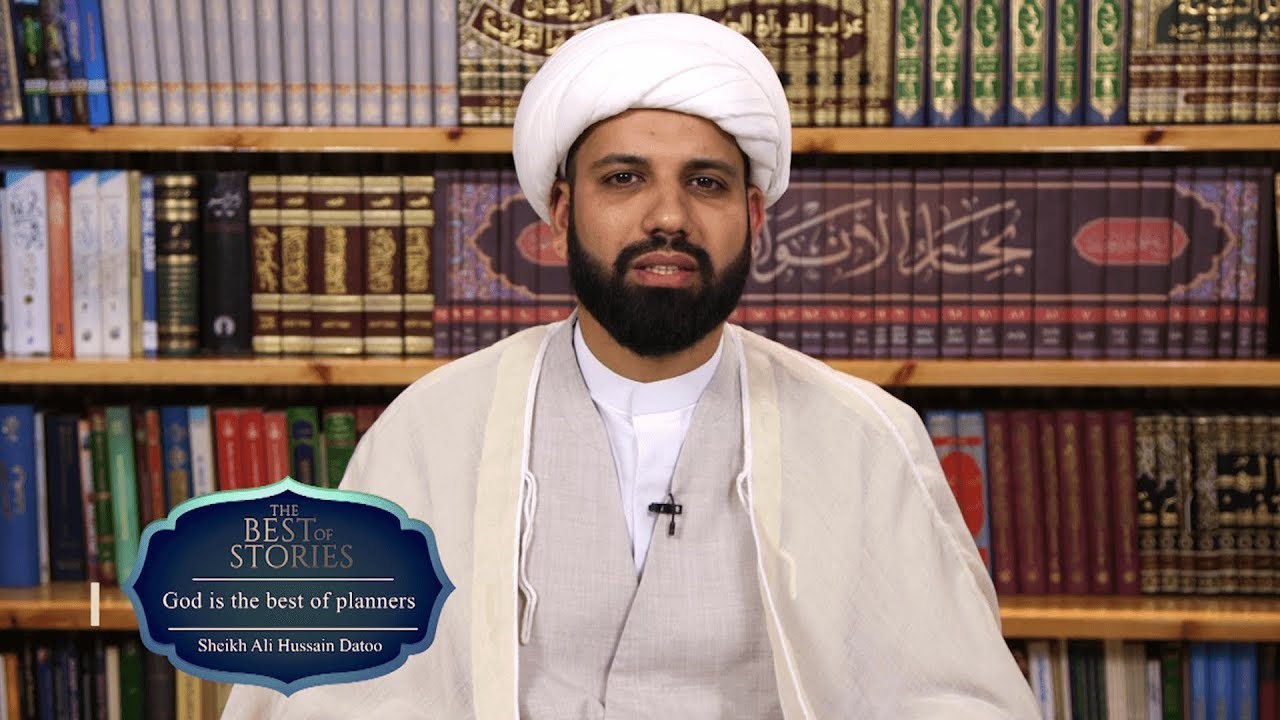
Surah Yusuf (12) - The Best Of Stories 5/15

"Nahnu naqussu 'alayka ahsan al-qasasi bimaaa awhainaaa ilayka haadha al-Qur'an"(12:3) "We do relate unto thee [Muhammad] the most beautiful of stories, in that We reveal to thee this (portion of the) Qur'an".
A'udhu billahi, as-samee', al 'aleem, min al-shaytan al-la'een al-rajim. Bismillah, al-Rahman, al-Rahim. Al-hamdulillahi rabb il-'alameen, wa as-sallal-Lahu 'ala Muhammad wa 'ala ahli baytihi at-tayyibeen at-tahireen. Allahumma salli 'ala Muhammad, wa aali Muhammad. Dear viewers, salamun 'alaykum jamee'an wa rahmatullahi wa barakatuh.
In this series of talks, we have been looking at ethical principles from the best of stories in the Holy Qur'an, the story of the great Prophet Yusuf, alayhi as-salaam. As mentioned previously, this is the most unique chapter in the Holy Qur'an in terms of a story, there is no other chapter that is as long as this chapter and has a chronological story from its beginning until its very end.
Allah Subhana wa Ta'ala, has placed within this story many a sign for those who reflect, from between the relationship of Ya'qub and his sons Yusuf and Binyamin and the rest of the brothers, to the way in which the brothers themselves treat Yusuf and treat one another. The story, of course, unfolds and there is a lot more that comes to light with regards to how Yusuf is then sold as a slave, how he ends up in the prison, and finally, how Allah plans it such that he becomes the head of the Treasury.
Before we continue where we have left off in this story, I want to remind us about a few different ahadith with regards to the greatness of the Holy Qur'an. This book that Allah has blessed us with, the book which was revealed in this very month on the most blessed night the book that is a guidance, a form of healing for the hearts, for those who believe in it.
In the first hadith, the Holy Prophet, peace be upon him, says that "If you yearn for Allah, Subhana wa Ta'ala, then listen to the Qur'an for those are His words." If you love Allah, Subhana wa Ta'ala, you naturally yearn for Him. When you yearn for someone, you yearn for anything from that individual or that person. That which we can capture from Allah, Subhana wa Ta'ala, are His words. And so for one who loves Allah, listening to the Holy Qur'an, reading the Holy Qur'an is like conversing with Allah, Subhanahu wa Ra'ala.
In a second tradition from Imam al-Sadiq,'alayhi as-salaam, he mentions that when Zuraara was with him, he was paying attention and listening to the Qur'an, and he questioned the Imam. He says, "He who hears the Qur'an being recited, does he have to listen to it?" The sixth holy Imam replies, and he says, "Yes, if the Qur'an is being recited in your presence, it is obligatory upon you to listen to it and pay attention."
You and I know that sometimes we have the Qur'an playing in the car, sometimes in our houses. The greatness of this book is such that it should not simply be background sound, it is guidance, it is the speech of the Almighty directly coming to our ears and our hearts. And for that reason, if it is being recited, it is obligatory upon us to ensure that we do not speak at the same time, that we not only listen to it, but pay attention to what is being said as well.
In the story of Yusuf that we have concluded thus far, we have understood that there were vices within these brothers at the beginning of the Surah, at the beginning of the story unfolding within them, manifesting themselves. Vices that would lead them to do something extremely atrocious to their young brother.
We then looked at how the relationship between this father Ya'qub and his sons were, as well as the relationship that Yusuf had with his father. We then extrapolated from that, the rights that a child has over his father, over his parent and the right that a parent has over their children as well.
We come to one of the most astonishing verses in this Surah. It is a very eloquent verse and a cliffhanger that Allah Subhana wa Ta'ala, leaves the reader at. Allah continues to say in verse number 15 of Surah Yusuf: "Fa lamma dhahabu bihi"(12:15), when the brothers took Yusuf and went with him, "wa ajma'u", and they gathered and they came together, "an yaj'aluhu fi ghayaabat al jubb"(12:15), they came together and they had plotted this plan, they were ready to put him into the pits of the well. The verse then stops there.
It is as if Allah has left the reader with his imagination to now contemplate how a seven, eight or nine year old child is going to go into the depths of the well. Is it that they take off his shirt and they throw him inside? Is it that they pretend and they are trying to play a game with him and they lure him to go down? Is it that they pick him up in a very aggressive manner and throw him into the pits of this well?
Allah in the most eloquent fashion takes the reader right until the well and then stops the sentence there. The verse continues, but it is not related to Yusuf being thrown inside the well. Allah says: "wa awhayna ilayhi la tunabbi'annahum bi amrihim hadha wa hum la yash'urun"(12:15), and you will, oh Yusuf, He reveals to Yusuf. Yusuf is now in the pits of the well, and Allah says:"Oh Yusuf, We are revealing to you that you shall inform them of this event at a time when they are unaware."
So from this ilhaam or from this wahy that Allah has given to Yusuf, this revelation to his heart, it is very clear that Yusuf will survive this trial, Yusuf will survive this calamity being in the pits of the well not only will he survive, but there shall be a time when he shall inform his brothers of what they did and they will be unaware that he is, of course, Yusuf.
How is it possible that somebody can come to this stage where they are willing to throw a young child into the pits of the well? Interestingly enough, in the verse prior to this, we find that these brothers, or at least some of them, still had a conscious within them. One of them at least gave the advice or the opinion that they should kill Yusuf. Another one said why do not we banish him from the land? (12:9)
But you find in here the reason why they wanted to do it in verse number nine is that "our father may now pay attention to us." And after that, they still wanted good, they say: "wa takunu min ba'dihi qawman saliheen"(12:9), after we commit this action, then we can be of the good individuals, of a good people'. They wanted to be good individuals, they had a conscience which was telling them that this action that you are about to do is wrong. Not all of them had killed their hearts and their consciences maybe some of them, maybe the majority of them. But there were at least some of them that knew that what they were doing was wrong and that after they have done it, they then want to become of a good people, they want to be righteous individuals.
From this, we can extrapolate a very important principle, and that is that the ends does not justify the means. You and I cannot have a good goal and then go about it in a manner which is against the law of the land or against the Shari'ah. We know that the Shari'ah dictates to us that we have to obey and uphold the law of the land as well of course, so long as it does not contradict our human rights and our Shari'ah.
For that reason, if somebody has a lofty goal, if somebody wants to give charity, it is not possible that that individual then goes about doing fraud in their dealings in their businesses, goes about earning in a 'haraam' fashion, in an unlawful manner, and then goes and gives that charity. These are two contradictory end goals that are coming together, he wants to do good but the means to do this good deed, the means to do this charity is obviously one that is outside of the Shari'ah.
We find that it is possible that an individual can kill off their desires for Allah Subhana wa Ta'ala, kill off this desire to want to do good, kill off this desire to go back to Him, kill off this desire to love Him. If they do not listen to this conscience, if they begin to work against this conscience, when the conscience bites them, and this is a blessing from Allah, that He has given us a conscience that innately tells us what is right and wrong.
In a hadith from the Ahlul Bayt, 'alayhum as-salaam, in a beautiful tradition, they say that when you are at a crossroads and you are not aware of what path to choose, then ask your heart for they do not take 'rishwah', they do not take bribes your heart will speak the truth, your conscience will tell you what is right.
But if you continuously, day after day, begin to numb this conscience, begin to suffocate this conscience within us, then the time will come when this conscience will not speak anymore, where it has been killed off and doing evil is like doing good.
Sometimes when a youngster, especially a youth, when they commit an action, when they lie, when they steal, for example, or they do a heinous crime, it bites them, it affects them, and they want to go and repent, they want to repay the individual who they have wronged.
But sometimes an adult who continues to do these wrong actions, they come to a stage in their life where lying now becomes habitual, where backbiting becomes the norm, where accusing one another is accepted in society, where not observing physical and social hijab, both for the men and the women is accepted.
Have you noticed in our society how there are some vices which are unacceptable but some vices are not? For example, in a Muslim community, would it be acceptable for somebody to bring in alcohol and drink within the mosque, in the vicinity of the mosque? It would be unacceptable, unheard of, not something that would cross anyone's mind. But lying, lying is accepted, lying takes place, we accept that people lie.
In an interesting hadith we are told that the master key to every sin is drinking alcohol, and then the hadith continues and the Imam says, "Wal kidhbu asharru minal sharaab", that lying is even worse off than drinking alcohol. It shows you that in the eyes of Allah, an individual who lies has now opened the doors for every possible sin, they are willing to commit and able to commit now every sin. But on our scale, sometimes lying is much more lighter, is acceptable.
These individuals who kill off their conscience, who are now able to do every action without their conscience biting them, without thinking that they are doing wrong, Allah makes mention of them in the Qur'an in their state. He says, Bismillah, al-rahman, al-rahim "Afa ra'ayta man ittakhadha ilaahahu hawaah"(25:43) , have you not seen an individual who has taken his base desires as his Lord? Where his desire, his greed, his desire for the opposite gender, his desire of anger, his desire of wealth and greed has overcome this individual, that has become his lord. That is the reason this individual gets up in the morning,that is the reason this individual goes to work.
Have you ever thought when we go to our graves, we are asked sometimes the most simplest of questions. Are we not told that when we go into our graves we will be asked, "who is your Lord?", "what is your book?", "who is your Prophet?", "who is your Imam?" Simple questions that the youngest of children can answer today.
Why is it that Allah asks these simple questions? And why is it that it is difficult for many to answer these questions? Because Allah is not asking the mind. Allah will not ask that which we have crammed and memorised, that information will be forgotten. What will remain is what is in our hearts, that Lord that we worked for, that Lord that we woke up for, that Lord that we spent every moment chasing. If you were chasing the dunya, then that would be our Lord and that is the answer we shall give in the grave. If we were chasing wealth, then that is the answer we shall give in the grave as well.
Allah says that He has placed a covering on these individuals' hearts, on their eyes and their ears. They can not hear anymore, they are not able to take any more guidance.
I would like to remind myself and yourself, that these brothers, at least at the beginning of this Surah, were running after the dunya, they wanted something from the world that they did not have and they were willing to go to any lengths in order to achieve it, including killing their brother or at least contemplating killing their brother.
There is a beautiful tradition in which Allah, Subhana wa Ta'ala, mentions through the words of the Prophet that "Allah has revealed unto the world that -'Run away and tire the one who chases you and serve the one who runs away from you'." You will realise that when you run after the world, when you try and obtain only the world, when your goal is simply wealth and luxury, then it always seems like a mirage, the closer you get to where your goal was, the further the goalpost begins to move. But when you begin to run away from this world, meaning when you start to work in this world only for the sake of God, when you work only for the sake of God to bring in a halaal income for your family, when you have children for the sake of God, when you get married for the sake of God, to get closer to God, to have a companion on this path, to up bring children onto the path of the Ahlul Bayt. When we work in this manner in the world, then Allah, Subhana wa Ta'ala, commands the world "Come and serve my servant, give him from the fruits of the world."
We have to remember, though, that the world that Allah will give us is not the world necessarily that we want. What we want might be different from the world that Allah will give us, Allah will give us that world which is good for us, and will take us closer to Him, not the world that will distract us from Him and make us deviated from His path.
These are the nights of Ramadan, the nights that are passing by us. Every night we recite du'as and ad'iyyah, we ask Allah, Subhana wa Ta'ala, to accept our a'maal, to make us of individuals who are not distracted from this world, individuals who will pay attention and will fix their gazes upon Him.
It is in these nights of the Holy Month of Ramadan where Amir Al-Mu'mineen, 'alayhi as-salaam, would lean on pillars within the mosque of Kufa and whisper in an intimate conversation with his beloved Lord, reminding himself of how much of a slave and a servant he is, how lowly he is, how humble is, how he is nothing, how poor he is in the eyes of Allah, Subhana wa Ta'ala.
If we can contemplate for a few moments every night on the wordings of this great man, the other prayers that we have been prescribed to recite during this holy month, we shall realise that we are poverty in the eyes of Allah. "Antum al fuqaraa' illa Allah"(35:15) , as He says in the Qur'an. You are nothing and you depend totally upon Allah. He is the one who is rich, He gives you. As much as you run after the world, He has allotted what there is for you to eat, He has allotted your sustenance, do not take from somebody else's sustenance, only take what has been allotted for you.
Stay within the boundaries of the Shari'ah and then begin to do something greater in this world. What is the main goal of you and I in this world? Why do we live? Do we live to eat and drink and have relations and have children? Or is there something greater that Allah has created us for?
InshaAllah in these nights we can contemplate on these questions, arrive at greater understandings so that when the day of Eid comes, we truly return back to Allah, Subhana wa Ta'ala, with cleansed and purified hearts so that He can place true knowledge within it.
With that I end and I greet you. Wa as-salaamu 'alaykum jamee'an, wa rahmat Ullahi, wa barakaatuh.