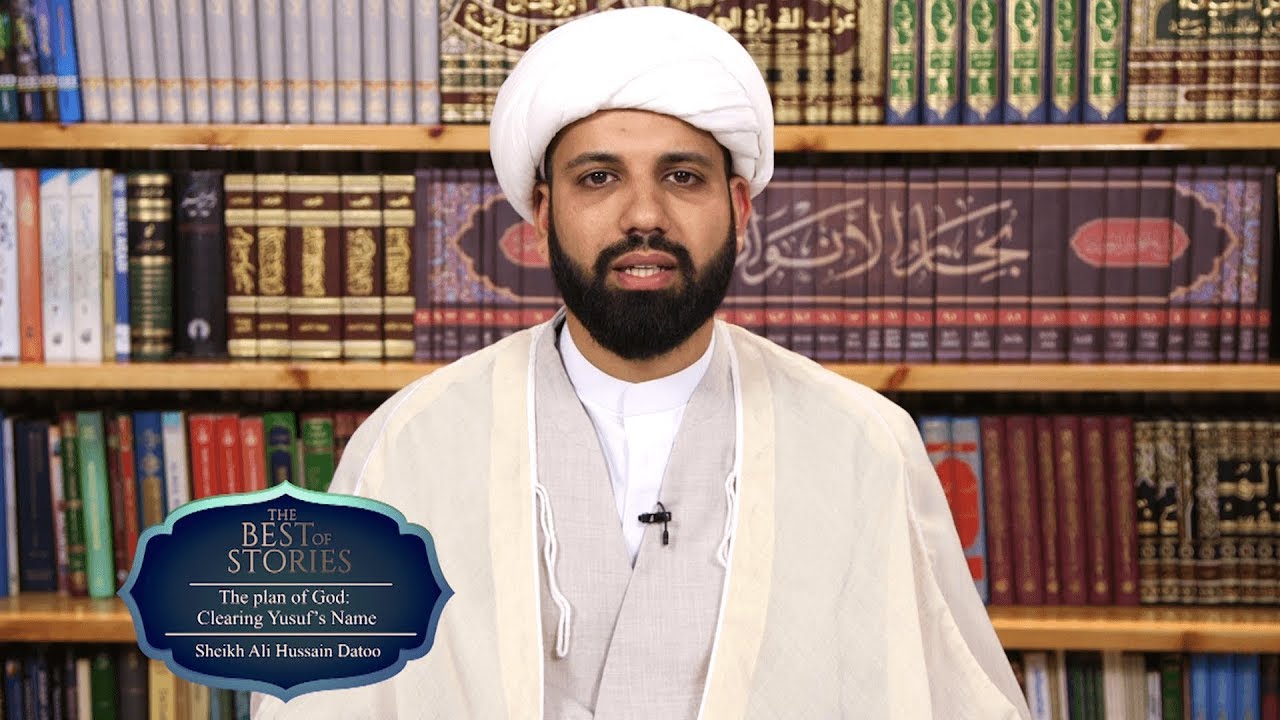
Surah Yusuf (12) - The Best Of Stories 15/15

"Nahnu naqussu 'alayka ahsan al-qasasi bimaaa awhainaaa ilayka haadha al-Qur'an"(12:3) "We do relate unto thee [Muhammad] the most beautiful of stories, in that We reveal to thee this (portion of the) Qur'an".
A'udhu billahi, as-samee', al 'aleem, min al-shaytan al-la'een al-rajim. Bismillah, al-Rahman, al-Rahim. Al-hamdulillahi rabb il-'alameen, thumma as-salaat wa as-salaam 'ala sayyiddina wa Habibi qulubina wa tabiba nufusina, Muhammad ibn 'Abdallah wa 'ala ahli baytihi at-tayyibeen at-tahireen. Allahumma salli 'ala Muhammadin wa aali Muhammad. Dear viewers, salaamun 'alaykum jamee'an wa rahmat Ullahi wa barakaatuh.
And welcome to the final episode in the series in the holy month of Ramadan, in which we have been discussing the most beautiful story in the Holy Qur'an, the story of Yusuf peace be upon in.
Throughout the series, we have been looking at different moral principles, which we have been able to extrapolate from this story, from this chapter and look at how we can implement it in a practical manner.
We looked at how the brothers of Yusuf had certain vices within them. We looked at how these vices eat away one's faith and how we must remain away from them. We also began to understand the relationship between parent and child, and child and parent, the duties of a parent to the child, and some of the requirements that a child has to their parents as well. We looked at tests and tribulations and we looked at how Allah Subhana wa Ta'ala tests those whom He loves, not because He wants to put them through difficulty, but because He wants to increase their capacity and their vessel and this can only be done through a difficult nurturing.
Whenever you want to expand something, you need to heat it. If your ring is too small that it needs to be expanded, you need to heat it in order to push it out, in order to expand it that much more. That is exactly what Allah Subhana wa Ta'ala does with us, in order to increase our capacity, He has to put us through certain difficulties, trials and tests not because He does not love us rather the complete opposite, because He loves us, He puts us through these test, gives us the tools to pass them so that He can give us even more after we come through them.
We also looked at how there are certain desires that man has, desires which are good, the desire of anger, the desire of the opposite gender, the desire for wealth- these are all good desires, the desires of imagination. However they all have to be controlled and only used when they need to be used. If these desires control man, then naturally man becomes worse off than the animals.
As the famous Hadith says that angels have been created with an intellect and no desire, animals have been created with desire and no intellect, but man has been created with both. So if man's desires govern his intellect, he becomes worse off than the animals and if his intellect governs his desires, then he becomes even greater than the angels.
We looked at how the first sin committed by Satan was the same sin that the brothers of Yusuf committed and although its pleasure was short lived, that Satan did not do 'sajdah' [prostration] and he felt great in that. The actual effect and the negative effect that came from that sin is everlasting.
Which then looked at how when Yusuf was in the prison, how he preferred and prioritized God over everything else. This is a principle that you and I need to inculcate on a regular basis, to make it part and parcel of us that, God will be my priority above everything else, even when it comes to one's parents. (29:8) Is it not true that when one's parents tell them to disobey God, then they should disobey their parents and listen to God and other times to obey one's parents? But there comes a time when if a parent tries to put themselves on the same level and pedestal as God, then obviously God needs to be given precedence.
In everything that we do in our relationship with our children, with our spouse. When we go to work, when we play, whatever we may be doing, God has to be the priority and we can implement this in small methods. For example, praying Salaah on time. This will prove to us and prove to God that we prioritize Him over everything else, the Ahlul Bayt 'alayhum as-salaam used to say, 'ma khuliqna li-l-la'ib' -'we have not been created to play in this world.'
This world is short-lived 70, 80, 90 years, that is not a long time. Ask somebody who is in their fifties whether or not life has passed and they will tell you that it has just gone by then. Yes, those children who are young look forward to growing up. Ask the elders, they will not want the days to pass because they know they are coming to the end of their time. So we remind ourselves that our time is coming to an end we do not know when death will come about and so every moment that we have been blessed with, we need to take advantage of it and we need to make sure we use it in the best fashion.
We came to the section where (12:50) Yusuf was in prison and Yusuf did not accept to come out of the prison when the king summoned him, except that the king would now ask the ladies as to what happened regarding that incident when they cut their fingers off. (12:51)This is where Zulaykha also was called, and she made it clear that it is Yusuf that has been truthful and it is I who tried to seduce him.
(12:52)Verse number fifty two. Many 'mufassirin' [exegetes] say that these verse is mentioned by Yusuf however chronologically it does not sit well because Yusuf is still in prison so he is not able to say this to the public. This would have been Zulaykha talking as well as the next verse.
Zulaykha therefore mentions - 'dhaalika li ya'lama anni lam akhunhu bil ghayb' (12:52) - 'I am making mention that he is the one who is truthful.' Why? Zulaykha says, 'so that he, Yusuf should know that I did not betray him during his absence', that just because he is in prison and he can not speak for himself, that I am not going to betray him and say that he attacked me, No, I am going to say the truth. It is clear here that something has changed in Zulaykha now she wants to say the truth. Now she is willing to stand up and say the truth as to what happened in order to clear Yusuf's reputation as well.
She says, I am saying this so that he should know that I did not betray him during his absence, 'wa ann-Allaha la yahdi kayda-l-khaa'inin'(12:53) -'and she bears witness that Allah Subhana wa Ta'ala will not guide and bring about the plans of those who are deceiving.'
Then the most profound statement comes about and she says , 'wa maa ubarri'u nafsi'(12:53) -'I do not say that I am free from my lower self', 'inna-n-nafsa la ammaaratu-m bi-s-su illa maa rahima Rabbi' (12:53) - 'this lower self that everybody has, this 'nafs al-ammaarah'-It is calling towards evil.' It is attracted towards evil, it wants play, it wants relaxation, it wants to be lazy, it does not want to work for the sake of God, It does not want to do about it, does not want to obey God and worship Him. It wants to do everything that 'it' wants which is evil and ill.
(12:53) She says, I am not free from this soul, this soul that is calling towards evil. 'illa maa rahima Rabbi'-'Except if my Lord has mercy on me', 'Inna Rabbi Ghafurun Rahim'- And she bears witness that 'the Lord, Allah Subhana wa Ta'ala is all Forgiving and all Merciful.'
(12:54)Now the King calls upon Yusuf and asks for him to be released, to be brought to him. And he says, this is the king meaning this is not the Aziz. This is not the husband of Zulaykha, this is a king above the Aziz, somebody who has the greatest authority in the palace. He calls out Yusuf after understanding what has happened now that Yusuf 's reputation is pure and clean, and he did not wrong anyone rather, it was the ladies who wronged him. (12:54) He says, 'I will keep him for myself, I will use him for myself in the palace because I found in him to be an honorable individual and an individual who is very faithful.'
It is here now that the plan of Allah unfolds and Allah Subhana wa Ta'ala looks after Yusuf in a manner in which He has taken him from the pits of the well and is now going to make him the head of the Treasury. Of course, as you know, the interpretation of the dream of the king is that seven years will come where they will flourish in the harvest and seven years of difficulty will come. (12:55) And this is where 'Yusuf says, Make me the head of the Treasury, I will be able to distribute accordingly and in a just fashion.'
I would like us to move to verse number ninety seven (12:97). Now, the brothers of Yusuf come to their father after having come to Egypt, now being sent back to the father and now coming again (12:94) 'Ya'qub says it is as if I can perceive Yusuf is here', Yaq'ub is blind by this time out of crying because of the separation that he has had with Yusuf,his old age as well. He wants Yusuf and now he perceives Yusuf, he tells the brothers, paraphrasing, (12:94) that it is as if I can sense Yusuf is here or do you think that this is my ill judgment? (12:95) And they say, you know, you are in error, you are an old man. (12:96)And as soon as the shirt of Yusuf is brought and he wipes it on his eyes, he is given eyesight again and he tells them that, is this not my clear judgment?
Now they understand that this is Yusuf, and so now the brothers understand that the truth has come to surface. This is what Allah revealed to Yusuf in the well. (12:15) When Allah says that We revealed unto Yusuf that you will inform them of this action of theirs one day whilst they are unaware, they were unaware that this was Yusuf. When Yusuf placed the goblet into the sack of Binyamin, they were unaware.
But now they have become aware that this was Yusuf so what did they do? They do 'tawassul [intercession],they do tawassul with their own father, (12:97) They tell Ya'qub, Please ask Allah Subhana wa Ta'ala for our forgiveness, turn to Allah ask Him to forgive us. (12:98) And Ya'qub says, I shall turn to my Lord, I shall ask Him for forgiveness 'innahu huwa-l-Ghafuru Rahim'-Why? 'Because 'He is all Forgiving and all Merciful.
Before we continue here, did you notice how, despite everything they have done to Ya'qub. Ya'qub does not turn around and say I am not going to ask for your forgiveness, Ya' qub does not say you are at fault, Ya'qub does not say, How dare you speak to me, I want to banish you, I want to cut you off none of this is mentioned.
You see how the Hadith of the Ahlul Bayt mentions,' takhallaqu bi akhlaaqi-Llah'-'Personify the characteristics and the names and attributes of Allah Subhana wa Ta'ala.' Allah is al-Ghaffaar- Allah is all Forgiving. You and I should also be forgiving, this father forgives the children straight away he actually asks Allah and does tawassul for them that Allah should forgive him, that Allah should forgive all of the children.
The children clearly have opened their eyes. Now, the brothers, they want to return back to Allah they have understood their error. 'Fa lamma dakhalu 'alaa Yusufa' (12:99-100) -'now the brothers and the mother and the father enter into the presence of Yusuf, Yusuf embraces them, Yusuf greets them and elevates them and puts them on a high stool, he gives the father and the mother a great station, a great place to sit in the Majlis, It is a respectful position.'
Many have mentioned this misconception again, that the 'nubuwwah' [prophethood] was removed from Yusuf because when he met his father, he was on a horse and his father was walking and he did not come down. This is again not acceptable of such a prophet who has been so pure throughout this entire chapter, throughout this entire incident, who loves his father, who respects his father and clearly in the Qur'an, when they meet, he gives them the highest of respect.
'wa rafa'a abawayhi 'ala-l-arsh'(12:100) -' and he gives them high thrones and high seats', 'Wa kharru lahu sujjada'-'and this is when they all prostrate'. Prostrate, not doing sajdah, It seems to be the method of bowing down or greeting one another that they have done now to Yusuf. ' wa qaala ya abati'. How beautiful. Now Yusuf turns to his father and he says, 'Oh my father', 'haadha ta'wilu ru'yaya'(12:100) -'This is the interpretation of that dream,'; that dream that happened when I was seven or nine years of age now this is the interpretation of that dream. 'Qad ja'alaha Rabbi haqqa' (12:100) - 'my Lord has made it truthful.' ' wa qad ahsana bih'- 'and my Lord has been so kind to me.' Would we say this about Allah when if we had gone through all these difficulties, trials and tribulations?
Yusuf said,' wa qad ahsana bihi idh akhrajani mina-s-sijna'(12:100) - 'Allah was kind to me when he removed me from prison.' Notice he does not say when Allah, he does not talk about when Allah put him in prison. He does not talk about when Allah put him in the well. No, no, he does not talk about that he talks about the blessings of Allah. That went Allah took me out of prison, how kind He was to me.
'Wa jaa'a bikum mina-l-badwi'(12:100)-'And Allah has brought you from the desert to me', 'min ba'di an nazaga-sh-shaytaanu bayni wa bayna ikhwati' (12:100). How beautiful. 'Yusuf says that after shaytaan caused this disturbance between me and my brothers, he does not blame the brothers, he does not say because of my brothers and what they did. No, no, he does not talk about the negative aspects, he looks at the positives and he looks at how Allah has been so kind to him. After Shaytan planted seeds of dissension between him and his brothers, how Allah has brought them all forth and brought them together. 'Inna Rabbi Latifun bi maa yashaa'- 'my Lord, is so kind to those whom He wishes', 'innahu huwa-l-'Alimun Hakeem'(12:100)- 'He is the all Knowing, and He is the Wise.'
Yusuf ends with a prayer. He says, 'Rabbi qad aataytani min-al-mulk'(12:101) - 'Oh my Lord, You have given me the kingdom', 'wa 'allamtani min ta'wil al-ahaadith' (12:101)- 'You have taught me the interpretation of events and of dreams', Faatir-as-samaawati wa-l-ard'- 'You are the Originator of the heavens and of the earth,' 'anta Waliyyi fi-d-dunya wa-l-aakhirah'(12:101)- 'You are my guardian...'
Who else can I rely on? Everything that happened, You are the only door that was open to me, You are the only Hand that was stretched and You never let me down. You looked after me in the pits, You looked after me when I was being sold in the marketplace, in the palace, in the room, in the prison and now You have brought all my family together and now we have forgiven one another. They have sought forgiveness and once again, I am reunited with my beloved parents.
This brings our series for this Shahr Ramadan to an end. I thank you for bearing patience and for listening, listening attentively to the discourse that we have had on this most beautiful chapter in the Qur'an of Surat Yusuf.
We ask Allah Subhana wa Ta'ala to accept our a'maal and our actions in this holy month that is coming to an end now. And we ask Allah Subhana wa Ta'ala to give us the Tawfiq, to give us the blessings and the barakah that we should continue to learn from the Holy Qur'an and inshAllah, meet one another again in the future to discuss other suwar and other chapters of the Holy Qur'an, understand different verses, different anecdotes and different stories from this most beautiful Book, and most importantly, that He gives us the ability to implement it in our daily lives.
I thank you for paying attention and for listening through the series and with that I greet you. Wa as-salaamu 'alaykum jami'an, wa Rahmat Ullaahi, Wa barakatuh.