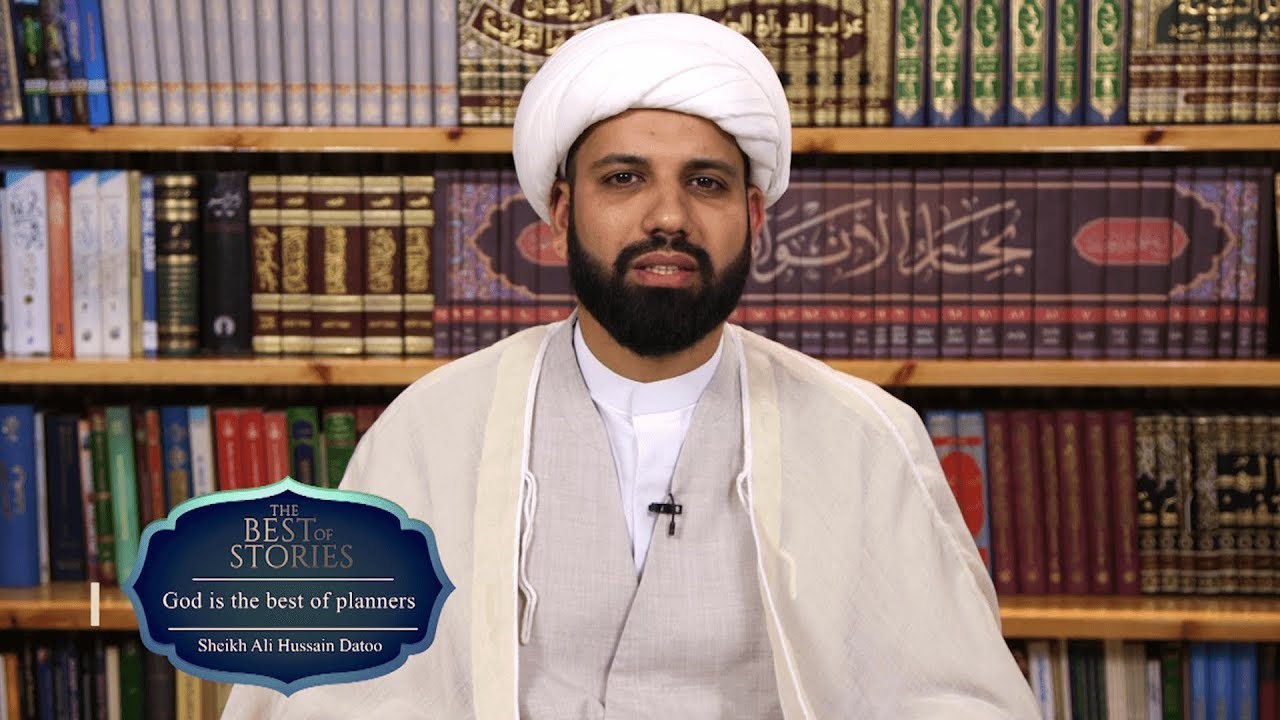
Surah Yusuf (12) - The Best Of Stories 7/15

"Nahnu naqussu 'alayka ahsan al-qasasi bimaaa awhainaaa ilayka haadha al-Qur'an"(12:3) "We do relate unto thee [Muhammad] the most beautiful of stories, in that We reveal to thee this (portion of the) Qur'an".
A'udhu billahi, as-samee', al 'aleem, min al-shaytan al-la'een al-rajim. Bismillah, al-Rahman, al-Rahim. Al-hamdulillahi rabb il-'alameen, wa as-sallal-Lahu 'ala Muhammad wa 'ala ahli baytihi at-tayyibeen at-tahireen. Allahumma salli 'ala Muhammad, wa aali Muhammad. Dear viewers, salamun 'alaykum jamee'an wa rahmatullahi wa barakatuh.
Welcome to another episode where we are discussing the most beautiful story in the Holy Qur'an, the best of stories with the best of narrators, Allah narrates the story directly to the Holy Prophet. It is the story of the Prophet Yusuf peace be upon him.
Before we continue where we had left off, I would like to remind us that in this holy month of Ramadan, God has gifted us with the gift of fasting. There are people who are not healthy enough to fast, there are youngsters who are not able to fast. For those of us who are healthy and are able to undertake the fast, let us remind ourselves how blessed we are.
When the holy Prophet went to Me'raj and he spoke directly to Allah, Subhanah wa Ta'ala, Allah asks him and He says, "Oh Ahmad, do you know when a servant is most close to Me? And what time, during what action is a servant most closest to Me?" The Prophet says- 'No'. So Allah replies and He says "Oh Ahmad at two times, the first is when he is in Sajdah, that is a time when there is hardly any 'hujub'- any veils between a servant and his beloved master Allah and the second time is when a servant is hungry when a servant is hungry, he has not satiated his desires, Allah says he is closest to Me at that time."
And that is why when we fast, we become more conscious of Allah, Subhanah wa Ta'ala, we think about Him more, we do not commit the same sins we would do outside of fasting as we do whilst we are fasting. It is one of the blessings of fasting that as we refrain ourselves from that which is halaal, not even that which is haraam. When we refrain ourselves from that which is halaal, Allah gives us that much more ability and tawfiq to gain that much more proximity to Him.
Of course, there is a famous tradition from the great lady Fatimah, 'alayha as- salaam, in which she says "How many a people who are fasting do not have anything but hunger and thirst?". This should remind us that this fast is not only for us to abstain from food and water, but this fast is there in order for us to abstain from all ills that we commit, we should refrain and hold and take the reins of our eyes so that we are in control of them and where they fall, of our ears and what they lean to, over our tongue and when it moves, of our feet and where it takes us, of our hands and what it touches this is when somebody is truly fasting.
A level above this is now when an individual takes control of their own thoughts and begins to ensure that they take the reins in control of their thoughts such that they not allow their thoughts to move and wander from here to there, thinking about and contemplating about wrong and evil or things that have no benefit to them. You know very well how merciful this Lord is that when we think about wrong, He does not punish us for it, neither is it written down but when we even contemplate good and intend it, then Allah, Subhanah wa Ta'ala, writes it down for us as if we have completed that action.
On the Day of Judgment, we are told that a time will come when the servant will stand in front of Allah, Subhanah wa Ta'ala, and his book of good deeds will be given in his right hand, and the book of evil deeds will be given in the left.
And then another book will be revealed to him and come to him, and in that book, when he opens it, he shall see actions which he knows he never did. For example, it is written inside that he has built a mosque or has alleviated poverty from the whole world. He knows he was not able to do these things, so he turns around to Allah and he says to Allah, "I swear by Your might and Your glory, that You know very well that I did not do these actions." So Allah turns to him and says "Nawwaytumuha fa katabnaaha"- 'you simply intended these actions, so We have written them down for you.' That is how merciful this Lord is for us.
And in this holy month of Ramadan, when we perform these actions which He loves the most, we should remind ourselves of the merciful Lord that He is, not of the wrathful Lord, not of the punishments of Allah, that is one aspect that should be recounted, and we should remind ourselves of but the greater characteristic of Allah is not one who punishes. He starts this holy Book by saying "Bismillah al-Rahmaan al-Rahim", in the name of Allah, the most Beneficient and the most Merciful. He uses His names of Al-Rahmaan and Al-Rahim.
Throughout the story of Yusuf, you and I find how merciful Allah, Subhanah wa Ta'ala, is to His beloved servant, that He never lets go of a servant. If a servant thinks that all doors are shut, then he has misunderstood God, because there is one door that never shuts- that is the door of Allah, Subhanah wa Ta'ala.
There is a female mystic who says, 'How long will you knock at the door that is already open?' You do not knock at the door of Allah, you just enter. You want from Allah, you raise your hands and you ask, and you should be 100 percent certain that He is going to answer. Never think for a moment that Allah, Subhanah wa Ta'ala, lets go of an individual, never think for a moment that Allah does not pay attention to you and I, never lose hope in Allah, Subhanah wa Ta'ala.
Look at how he looked after Yusuf even after what happened to him in the world. Look at how His plan unfolds and He takes gentle care of Yusuf. We are at that part in the chapter where the brothers of Yusuf have now thrown him into a well.
"Wa jaa'at sayyaaratun"(12:10), and then a group of people come by, a caravan of people come by, an individual goes forth and throws down the bucket in order to fetch water. As he picks up the water bucket, expecting just water to be filled within, he finds that Yusuf comes up. "Qaala ya bushraa haadha ghulaam"(12:19), so he turns around and 'he says, good news, we have a young child over here, we have a servant, we can go and sell him for some money.'
Just think about what this individual has said. When you and I come across a young child who has lost his father, lost his way, the first thing that comes to our mind is how can we assist this young child to get back home?
It again reminds you and I, "fa ra'ayta man ittakhadha illaahahu hawaah" (25:43). 'Have you not seen an individual whose base desires have overtaken him?' Everything he looks at, he looks at how to make benefit and profit from it, he wants to see how I can take from it, not how I can give back. When he sees people in need, he does not think, how can I give? He thinks, how can I exploit? When a war happens in Iraq, for example, a war happens in Afghanistan, people like that, they do not think, how can we help the people of Iraq or Afghanistan, of Yemen? Instead, they think, how can we benefit? How can we exploit, how can we increase the prices of medicine? How can we increase the prices of construction so that we can benefit and reap more from these people and their governments?
These are individuals who have been taken by their desires, all they see is the dunya which they are running after, and Allah, Subhanah wa Ta'ala, has promised that the dunya will never be given to these people.
I want to give you an example, we see it in the story of Yusuf, and I mentioned it previously in another episode, that they wanted the love of the father, they were already given his love, but they wanted his undivided attention, but they did not get that because they went about it in the wrong way. They went about it by separating Yusuf and Ya'qub in a manner in which God was not pleased. They could have asked their father to give them more attention, their father could have explained why he was doing what he was doing, but instead of that, they decided to take this path against Allah so Allah deceived them in their own plan.
I want to give you an example of people in our society today who are extremely wealthy. If you have ever read the biography of an individual who has become very wealthy, there are a few things that you see are quite common between this clique of people in this strata of individuals.
The first is that their goal from the onset is to become the wealthiest of people. They want wealth, that is their aim, that is their goal and they will not stop at anything for that. A time comes when they have to make a decision between family and wealth, many of them have had problems in their marriages, many of them have cut off relations with their children and their children do not speak to them because they come to a crossroads some of them do not even get a relation, do not even have a relationship, do not even get married, do not even have a companion, because they are too engrossed in this dunya and trying to make and match their goal.
You find a time comes when they have to make a decision at a crossroads between their work, the dunya, their goal, and their children and their family and their spouse. Many of them, many of them choose their work life and when they do that, they forego everything else that God has blessed them with. And this individual works hard and works very hard and because of the time and effort they put in, they accumulate and amass a great deal of wealth.
But think to yourself, the most wealthiest individuals, what is the common factor between them? What do they always do when they become extremely wealthy? They all do one particular thing, they give away the wealth that they ran after. Can you imagine running after something for 50, 60 years only to finally achieve it and obtain it and then only to think to yourself that there is no satisfaction in it. Satisfaction is now in giving away that thing which I was running after, that thing that I gave my family up for, that thing that I gave my health up for now I am going to give it away in order to find satisfaction.
You find some of the most wealthiest people have even made it public knowledge that they are not going to give their wealth to their children, instead, they are only going to give, leave behind a very short, small amount of money but the rest of it is going to charity. Why? Because they do not want to spoil their children and they do not want their children to become like them, they do not want their children to have a masses of wealth, only to find out that there is no satisfaction and no life in running after this dunya.
As the caravan comes to this well, they bring out Yusuf. They do not have any level of humanity left within them, they see this child and they ask themselves, how can we profit? Let us go ahead and sell him.
But this is the plan of Allah, Subhanah wa Ta'ala, unfolding. As they take him to the marketplace, the king, an adviser, comes by and as he comes by with his wife, he tells his wife, it seems that they did not have children, the Aziz and his wife Zulaykha. They come by, they see Yusuf, this young child, extremely handsome, they say, let us take him either as a child or we will take him as a servant.
And Allah, Subhana wa Ta'ala, mentions here "wa kadhaalika makkanna li Yusufa fil ardh" (12:21). Allah, Subhana wa Ta'ala, says 'This was Our plan, this is how We are going to establish Yusuf in the earth, this is how We are going to make him a king of the head of the Treasury in the lands.'
Yes, you saw from your naked eyes that he was in difficulty in the well, but We looked after him and We revealed to him such that he was calm and collective. You thought that he was being kidnapped and what was happening to him was evil, externally, it was evil and wrong, but internally it was good for him and there was a plan that was unfolding.
And now when he is bought as a slave and he is taken to the king's palace, you think he is going to be just a slave, you think that he is going to be mistreated but We have a plan that is unfolding behind the scenes. Why? Because at the end of the day, the best of planners is Allah, Subhanah wa Ta'ala. Whatever He desires, His plan will come to fruition. Whatever He desires to be executed shall be executed.
I want to remind ourselves here that Allah, Subhanah wa Ta'ala, is in control of absolutely everything. If you have ever tried to plant seeds in the ground, you will see that some grow and some do not. Everything happens by His permission, the seed that grows only grows by His permission, the seed that does not grow does not grow by His permission.
And that is why, especially in Muharram, when we recount this verse, when we recount this statement of Sayyada Zaynab, 'alayha as-salaam, it begins to make sense when we realise that everything is in the hands of Allah. When Yazid asks her, "How have you found what Allah has done to your brother?" What does she remark and she says in that famous oft repeated line, she says, "Wa maa ra'aytu illa jameela"- 'I have not seen anything but beauty.'
Do you think that everything that happened in Karbala happened without the permission of Allah? It happened with His permission, it was under His eyesight, it was under His vision, He was watching over Husayn, and everything that happened to Husayn only happened because Allah wanted it to happen to Husayn. Why? Because every arrow that hit his chest, he was going to a station that nobody else would have been able to achieve, he had to endure that difficulty and hardship. Externally it was difficulty and hardship but internally, Husayn was ecstatic because he was achieving a position that nobody else could have achieved.
In the same way Allah, Subhanah wa Ta'ala, says in the Qur'an, with regards to something we see on a daily life but something that goes past our eyesight because it is so evident. Allah questions and He says, 'Have you not seen the birds in the sky who expand their wings and contract?' "Ma yumsiku hunna"(67:19) What is holding them up? He just says in the verse, He says that they are expanding and contracting their wings and then He asks the question, what is holding them up? Do you think it is the expansion of their wings and then contracting their wings that is holding them up? But Allah, Subhanah wa Ta'ala, says, "Ma yumsiku hunna illa al-Rahman"(67:19), nothing is holding them up apart from the all Merciful.
If you and I want to stand up sometimes, do not you find that you have a dead leg and you can not stand up? It is a reminder that however strong you think you are, without the permission of Allah, Subhanah wa Ta'ala, you are not able to even stand up. And that is why we say in the Salah continuously when we pray "Bi hawlil Allahi wa quwwatihi aqumu wa aq'ud"- 'it is only through His power and permission that I stand up and I sit down.'
As these nights of Ramadan are ending and they are coming to a close, we must remember that we should use our time to the best way possible in a most beneficial manner possible, so we ask Allah, Subhanah wa Ta'ala, that these nights of Shahr Ramadan, do not let them end but that You have forgiven us for our sins. Allah, if we have wronged an individual who we cannot find, an individual who may not forgive us, inspire them to forgive us. Allah, if we have wronged You, if we have done wrong against You, if we have missed our prayers, if we have not paid our dues, if we have not fasted a fast that we should have done, if we have not gone for Hajj when we should have gone for Hajj, Allah forgive us our sins and give us the ability and tawfiq to repay You in the manner in which You deserve.
With that I end and I greet you. Wa as-salaamu 'alaykum jamee'an, wa rahmat Ullahi wa barakaatuh.
"Nahnu naqussu 'alayka ahsan al-qasasi bimaaa awhainaaa ilayka haadha al-Qur'an"(12:3) "Wir erzählen dir [Muhammad] die schönste aller Geschichten, indem Wir dir diesen (Teil des) Qur'an offenbaren".
A'udhu billahi, as-samee', al 'aleem, min al-shaytan al-la'een al-rajim. Bismillah, al-Rahman, al-Rahim. Al-hamdulillahi rabb il-'alameen, wa as-sallal-Lahu 'ala Muhammad wa 'ala ahli baytihi at-tayyibeen at-tahireen. Allahumma salli 'ala Muhammad, wa aali Muhammad. Liebe Betrachter, salamun 'alaykum jamee'an wa rahmatullahi wa barakatuh.
Willkommen zu einer weiteren Folge, in der wir die schönste Geschichte im Heiligen Qur'an besprechen, die beste aller Geschichten mit dem besten aller Erzähler, Allah erzählt die Geschichte direkt dem Heiligen Propheten. Es ist die Geschichte des Propheten Yusuf, Friede sei mit ihm.
Bevor wir dort weitermachen, wo wir aufgehört hatten, möchte ich uns daran erinnern, dass Gott uns in diesem heiligen Monat Ramadan mit der Gabe des Fastens beschenkt hat. Es gibt Menschen, die nicht gesund genug sind, um zu fasten, es gibt junge Menschen, die nicht in der Lage sind zu fasten. Für diejenigen unter uns, die gesund sind und das Fasten durchführen können, sollten wir uns daran erinnern, wie gesegnet wir sind.
Als der heilige Prophet nach Me'raj ging und er direkt zu Allah, Subhana wa Ta'ala, sprach, fragte ihn Allah und sagte: "Oh Ahmad, weißt du, wann ein Diener Mir am nächsten ist? Und zu welcher Zeit, während welcher Handlung ist ein Diener Mir am nächsten?" Der Prophet sagt: "Nein". Also antwortet Allah und sagt: "Oh Ahmad, zu zwei Zeiten, die erste ist, wenn er in Sajdah ist, das ist eine Zeit, in der es kaum 'hujub' - irgendwelche Schleier zwischen einem Diener und seinem geliebten Herrn Allah gibt und die zweite Zeit ist, wenn ein Diener hungrig ist, wenn er seine Begierden nicht gesättigt hat, sagt Allah, dass er Mir zu dieser Zeit am nächsten ist."
Und das ist der Grund, warum wir, wenn wir fasten, uns Allahs, Subhana wa Ta'ala, bewusster werden, wir denken mehr an Ihn, wir begehen nicht die gleichen Sünden, die wir außerhalb des Fastens tun würden, wie wir es während des Fastens tun. Es ist eine der Segnungen des Fastens, dass wir uns von dem, was halaal ist, fernhalten, auch nicht von dem, was haraam ist. Wenn wir uns von dem, was halaal ist, fernhalten, gibt uns Allah viel mehr Fähigkeit und Tawfiq, um viel mehr Nähe zu Ihm zu erlangen.
Natürlich gibt es eine berühmte Überlieferung von der großen Dame Fatimah, 'alayha as- salaam, in der sie sagt: "Wie viele Leute, die fasten, haben nichts als Hunger und Durst?". Dies soll uns daran erinnern, dass dieses Fasten nicht nur dazu da ist, dass wir uns von Essen und Wasser enthalten, sondern dieses Fasten ist dazu da, dass wir uns von allen Übeln, die wir begehen, enthalten, wir sollen uns zurückhalten und die Zügel unserer Augen in die Hand nehmen, so dass wir die Kontrolle über sie haben und wohin sie fallen, über unsere Ohren und wozu sie sich neigen, über unsere Zunge und wann sie sich bewegt, über unsere Füße und wohin sie uns führt, über unsere Hände und was sie berührt - das ist es, wenn jemand wirklich fastet.
Eine Stufe darüber ist nun, wenn ein Individuum die Kontrolle über seine eigenen Gedanken übernimmt und beginnt, dafür zu sorgen, dass es die Zügel bei der Kontrolle seiner Gedanken in die Hand nimmt, so dass es seinen Gedanken nicht erlaubt, sich zu bewegen und von hier nach dort zu wandern, indem es über Falsches und Böses oder Dinge nachdenkt, die keinen Nutzen für es haben. Ihr wisst sehr gut, wie barmherzig dieser Herr ist, dass, wenn wir über Falsches nachdenken, Er uns nicht dafür bestraft, noch wird es aufgeschrieben, aber wenn wir sogar über Gutes nachdenken und es beabsichtigen, dann schreibt Allah, Subhana wa Ta'ala, es für uns auf, als ob wir diese Handlung vollendet hätten.
Am Tag der Auferstehung wird uns gesagt, dass eine Zeit kommen wird, in der der Diener vor Allah, Subhana wa Ta'ala, stehen wird, und sein Buch der guten Taten wird ihm in die rechte Hand gegeben werden, und das Buch der schlechten Taten wird ihm in die linke Hand gegeben werden.
Und dann wird ihm ein anderes Buch offenbart werden und zu ihm kommen, und in diesem Buch, wenn er es öffnet, wird er Taten sehen, von denen er weiß, dass er sie nie getan hat. Zum Beispiel steht darin geschrieben, dass er eine Moschee gebaut hat oder die Armut auf der ganzen Welt gelindert hat. Er weiß, dass er nicht in der Lage war, diese Dinge zu tun, also dreht er sich zu Allah um und sagt zu Allah: "Ich schwöre bei Deiner Macht und Deiner Herrlichkeit, dass Du sehr wohl weißt, dass ich diese Taten nicht getan habe.
" Da wendet sich Allah zu ihm und sagt: "Nawwaytumuha fa katabnaaha" - "Du hast diese Handlungen nur beabsichtigt, also haben Wir sie für dich aufgeschrieben. Das ist, wie barmherzig dieser Herr für uns ist.
Und in diesem heiligen Monat Ramadan, wenn wir diese Handlungen ausführen, die Er am meisten liebt, sollten wir uns an den barmherzigen Herrn erinnern, der Er ist, nicht an den zornigen Herrn, nicht an die Strafen Allahs, das ist ein Aspekt, der erzählt werden sollte, und wir sollten uns daran erinnern, aber die größere Eigenschaft Allahs ist nicht einer, der bestraft. Er beginnt dieses heilige Buch mit den Worten "Bismillah al-Rahmaan al-Rahim", im Namen Allahs, des Allerbarmers und des Barmherzigen.
Er benutzt Seine Namen Al-Rahmaan und Al-Rahim.
In der Geschichte von Yusuf sehen Sie und ich, wie barmherzig Allah, Subhana wa Ta'ala, zu Seinem geliebten Diener ist, dass Er einen Diener niemals loslässt. Wenn ein Diener denkt, dass alle Türen verschlossen sind, dann hat er Gott missverstanden, denn es gibt eine Tür, die niemals geschlossen wird - das ist die Tür Allahs, Subhana wa Ta'ala.
Es gibt eine weibliche Mystikerin, die sagt: 'Wie lange willst du an die Tür klopfen, die schon offen ist?' Man klopft nicht an die Tür Allahs, man tritt einfach ein. Du willst von Allah, du hebst deine Hände und du fragst, und du solltest 100 Prozent sicher sein, dass Er antworten wird. Denke niemals für einen Moment, dass Allah, Subhana wa Ta'ala, einen Menschen loslässt, denke niemals für einen Moment, dass Allah dir und mir keine Aufmerksamkeit schenkt, verliere niemals die Hoffnung auf Allah, Subhana wa Ta'ala.
Schauen Sie sich an, wie er sich um Yusuf gekümmert hat, sogar nachdem ihm in der Welt etwas zugestoßen ist. Schauen Sie sich an, wie sich sein Plan entfaltet und er sich sanft um Yusuf kümmert. Wir sind an der Stelle im Kapitel, wo die Brüder von Yusuf ihn nun in einen Brunnen geworfen haben.
"Wa jaa'at sayyaaratun" (12:10), und dann kommt eine Gruppe von Menschen vorbei, eine Karawane von Menschen kommt vorbei, ein Einzelner geht hinaus und wirft den Eimer hin, um Wasser zu holen. Als er den Wassereimer aufhebt, in der Erwartung, dass sich darin nur Wasser befindet, stellt er fest, dass Yusuf auftaucht. "Qaala ya bushraa haadha ghulaam" (12:19), also dreht er sich um und sagt: "Gute Nachrichten, wir haben hier ein kleines Kind, wir haben einen Diener, wir können ihn für etwas Geld verkaufen.
Denken Sie einfach darüber nach, was diese Person gesagt hat. Wenn Sie und ich einem kleinen Kind begegnen, das seinen Vater verloren hat, das seinen Weg verloren hat, dann ist das erste, was uns in den Sinn kommt, wie können wir diesem kleinen Kind helfen, nach Hause zu kommen?
Es erinnert Sie und mich erneut daran: "fa ra'ayta man ittakhadha illaahahu hawaah" (25:43). 'Hast du nicht einen Menschen gesehen, dessen niedere Begierden ihn übermannt haben? Alles, was er anschaut, schaut er an, wie er Nutzen und Gewinn daraus ziehen kann, er will sehen, wie ich davon nehmen kann, nicht wie ich zurückgeben kann. Wenn er Menschen in Not sieht, denkt er nicht, wie kann ich geben? Er denkt, wie kann ich ausbeuten?
Wenn zum Beispiel im Irak ein Krieg stattfindet, wenn in Afghanistan ein Krieg stattfindet, dann denken solche Leute nicht, wie können wir den Menschen im Irak oder in Afghanistan, im Jemen helfen? Stattdessen denken sie, wie können wir profitieren? Wie können wir ausbeuten, wie können wir die Preise für Medikamente erhöhen? Wie können wir die Preise für Bauarbeiten erhöhen, damit wir von diesen Menschen und ihren Regierungen profitieren und mehr ernten können?
Dies sind Individuen, die von ihren Begierden eingenommen wurden, alles, was sie sehen, ist die dunya, der sie hinterherlaufen, und Allah, Subhana wa Ta'ala, hat versprochen, dass die dunya diesen Menschen niemals gegeben wird.
Ich möchte Ihnen ein Beispiel geben, wir sehen es in der Geschichte von Yusuf, und ich habe es bereits in einer anderen Episode erwähnt, dass sie die Liebe des Vaters wollten, sie hatten bereits seine Liebe bekommen, aber sie wollten seine ungeteilte Aufmerksamkeit, aber sie bekamen sie nicht, weil sie auf die falsche Weise vorgingen. Sie gingen es an, indem sie Yusuf und Ya'qub auf eine Weise trennten, die Gott nicht gefiel. Sie hätten ihren Vater bitten können, ihnen mehr Aufmerksamkeit zu schenken, ihr Vater hätte erklären können, warum er tat, was er tat, aber stattdessen entschieden sie sich, diesen Weg gegen Allah zu gehen, so dass Allah sie in ihrem eigenen Plan täuschte.
Ich möchte Ihnen ein Beispiel von Menschen in unserer heutigen Gesellschaft geben, die extrem wohlhabend sind. Wenn Sie jemals die Biographie einer Person gelesen haben, die sehr wohlhabend geworden ist, dann gibt es ein paar Dinge, die Sie sehen, die zwischen dieser Clique von Menschen in dieser Schicht von Individuen ziemlich gemeinsam sind.
Die erste ist, dass ihr Ziel von Anfang an ist, die reichsten Menschen zu werden. Sie wollen Reichtum, das ist ihr Ziel, das ist ihr Ziel und dafür machen sie vor nichts Halt. Es kommt eine Zeit, in der sie eine Entscheidung zwischen Familie und Reichtum treffen müssen, viele von ihnen haben Probleme in ihren Ehen, viele von ihnen haben die Beziehungen zu ihren Kindern abgebrochen und ihre Kinder sprechen nicht mit ihnen, weil sie an einen Scheideweg kommen, einige von ihnen bekommen nicht einmal eine Beziehung, haben nicht einmal eine Beziehung, heiraten nicht einmal, haben nicht einmal einen Gefährten, weil sie zu sehr in diese Dunya vertieft sind und versuchen, ihr Ziel zu erreichen und zu erfüllen.
Sie finden, dass eine Zeit kommt, in der sie an einem Scheideweg eine Entscheidung treffen müssen zwischen ihrer Arbeit, der dunya, ihrem Ziel und ihren Kindern und ihrer Familie und ihrem Ehepartner. Viele von ihnen, viele von ihnen wählen ihr Arbeitsleben und wenn sie das tun, verzichten sie auf alles andere, mit dem Gott sie gesegnet hat. Und dieses Individuum arbeitet hart und arbeitet sehr hart, und aufgrund der Zeit und der Mühe, die sie investieren, häufen sie einen großen Reichtum an und häufen ihn an.
Aber denken Sie an sich selbst, die reichsten Personen, was ist der gemeinsame Faktor zwischen ihnen? Was tun sie immer, wenn sie extrem wohlhabend werden? Sie alle tun eine bestimmte Sache, sie verschenken den Reichtum, dem sie nachgelaufen sind. Können Sie sich vorstellen, dass Sie 50, 60 Jahre lang hinter etwas hergelaufen sind, nur um es schließlich zu erreichen und es zu erhalten und dann nur zu denken, dass es keine Befriedigung gibt. Die Befriedigung liegt jetzt darin, das wegzugeben, dem ich hinterhergerannt bin, das, wofür ich meine Familie aufgegeben habe, das, wofür ich meine Gesundheit aufgegeben habe, jetzt werde ich es weggeben, um Befriedigung zu finden.
Sie werden feststellen, dass einige der reichsten Menschen sogar öffentlich bekannt gemacht haben, dass sie ihr Vermögen nicht an ihre Kinder vererben werden, stattdessen werden sie nur eine sehr kurze, kleine Menge Geld hinterlassen, aber der Rest geht an wohltätige Zwecke. Und warum? Weil sie ihre Kinder nicht verwöhnen wollen und sie wollen nicht, dass ihre Kinder so werden wie sie, sie wollen nicht, dass ihre Kinder eine Masse an Reichtum haben, nur um herauszufinden, dass es keine Befriedigung und kein Leben gibt, wenn man dieser Dunya hinterherläuft.
Als die Karawane zu diesem Brunnen kommt, bringen sie Yusuf heraus. Sie haben kein Maß an Menschlichkeit mehr in sich, sie sehen dieses Kind und fragen sich, wie können wir davon profitieren? Lasst uns weitermachen und ihn verkaufen.
Aber dies ist der Plan von Allah, Subhana wa Ta'ala, der sich entfaltet. Als sie ihn auf den Marktplatz bringen, kommt der König, ein Berater, vorbei und als er mit seiner Frau vorbeikommt, sagt er seiner Frau, es scheint, dass sie keine Kinder hatten, der Aziz und seine Frau Zulaykha. Sie kommen vorbei, sie sehen Yusuf, dieses junge Kind, sehr hübsch, sie sagen, lass uns ihn entweder als Kind nehmen oder wir werden ihn als Diener nehmen.
Und Allah, Subhana wa Ta'ala, erwähnt hier "wa kadhaalika makkanna li Yusufa fil ardh" (12:21). Allah, Subhana wa Ta'ala, sagt: "Dies war Unser Plan, so werden Wir Yusuf auf der Erde etablieren, so werden Wir ihn zu einem König an der Spitze der Schatzkammer in den Ländern machen.
Ja, ihr habt mit euren bloßen Augen gesehen, dass er in dem Brunnen in Schwierigkeiten war, aber Wir haben nach ihm gesehen und Wir haben ihm offenbart, dass er ruhig und gesammelt war. Ihr dachtet, dass er entführt wurde und dass das, was mit ihm geschah, böse war, äußerlich war es böse und falsch, aber innerlich war es gut für ihn und es gab einen Plan, der sich entfaltete.
Und wenn er nun als Sklave gekauft und in den Königspalast gebracht wird, denken Sie, dass er nur ein Sklave sein wird, Sie denken, dass er misshandelt werden wird, aber Wir haben einen Plan, der sich hinter den Kulissen entfaltet. Und warum? Weil am Ende des Tages Allah, Subhana wa Ta'ala, der beste Planer ist. Was auch immer Er wünscht, Sein Plan wird in Erfüllung gehen. Was auch immer Er wünscht, ausgeführt zu werden, wird ausgeführt werden.
Ich möchte uns hier daran erinnern, dass Allah, Subhana wa Ta'ala, die Kontrolle über absolut alles hat. Wenn Sie jemals versucht haben, Samen in den Boden zu pflanzen, werden Sie sehen, dass manche wachsen und manche nicht. Alles geschieht durch Seine Erlaubnis, der Samen, der wächst, wächst nur durch Seine Erlaubnis, der Samen, der nicht wächst, wächst nicht durch Seine Erlaubnis.
Und deshalb, besonders im Muharram, wenn wir diesen Vers nacherzählen, wenn wir diese Aussage von Sayyada Zaynab, 'alayha as-salaam, nacherzählen, beginnt es Sinn zu machen, wenn wir erkennen, dass alles in den Händen Allahs liegt. Als Yazid sie fragt: "Wie findest du, was Allah mit deinem Bruder gemacht hat?" Was sagt sie und sie sagt in dieser berühmten, oft wiederholten Zeile: "Wa maa ra'aytu illa jameela" - "Ich habe nichts als Schönheit gesehen.
Glaubst du, dass alles, was in Karbala geschah, ohne die Erlaubnis Allahs geschah? Es geschah mit Seiner Erlaubnis, es war unter Seinen Augen, es war unter Seinem Blick, Er wachte über Husayn, und alles, was Husayn widerfuhr, geschah nur, weil Allah wollte, dass es Husayn widerfuhr. Und warum? Weil jeder Pfeil, der seine Brust traf, ihn zu einer Station führte, die niemand sonst hätte erreichen können, er musste diese Schwierigkeit und Härte ertragen.
Äußerlich waren es Schwierigkeiten und Entbehrungen, aber innerlich war Husayn ekstatisch, weil er eine Position erreichte, die niemand sonst hätte erreichen können.
Auf die gleiche Weise sagt Allah, Subhana wa Ta'ala, im Qur'an, in Bezug auf etwas, das wir im täglichen Leben sehen, das aber an unserem Augenlicht vorbeigeht, weil es so offensichtlich ist. Allah fragt und sagt: "Habt ihr nicht die Vögel am Himmel gesehen, die ihre Flügel ausbreiten und zusammenziehen?" "Ma yumsiku hunna" (67:19) Was hält sie auf? Er sagt einfach in dem Vers, Er sagt, dass sie ihre Flügel ausbreiten und zusammenziehen und dann stellt Er die Frage, was sie aufrecht hält?
Glaubst du, es ist das Ausbreiten ihrer Flügel und dann das Zusammenziehen ihrer Flügel, das sie aufrecht hält? Aber Allah, Subhana wa Ta'ala, sagt: "Ma yumsiku hunna illa al-Rahman" (67:19), nichts hält sie aufrecht, außer dem Allbarmherzigen.
Wenn Sie und ich manchmal aufstehen wollen, stellen Sie dann nicht fest, dass Sie ein totes Bein haben und nicht aufstehen können? Es ist eine Erinnerung daran, dass, egal wie stark man denkt, dass man ist, ohne die Erlaubnis von Allah, Subhana wa Ta'ala, ist man nicht einmal in der Lage, aufzustehen. Und deshalb sagen wir in der Salah ständig, wenn wir beten "Bi hawlil Allahi wa quwwatihi aqumu wa aq'ud" - 'es ist nur durch Seine Macht und Erlaubnis, dass ich aufstehe und mich setze.
'
Da diese Nächte des Ramadan zu Ende gehen und sie sich dem Ende nähern, müssen wir uns daran erinnern, dass wir unsere Zeit auf die bestmögliche Art und Weise nutzen sollten, also bitten wir Allah, Subhana wa Ta'ala, dass diese Nächte des Shahr Ramadan nicht enden, sondern dass Du uns unsere Sünden vergibst. Allah, wenn wir einer Person Unrecht getan haben, die wir nicht finden können, einer Person, die uns vielleicht nicht verzeihen kann, inspiriere sie, uns zu verzeihen.
Allah, wenn wir Dir Unrecht getan haben, wenn wir Dir Unrecht getan haben, wenn wir unsere Gebete versäumt haben, wenn wir unsere Abgaben nicht bezahlt haben, wenn wir nicht gefastet haben, was wir hätten tun sollen, wenn wir nicht zur Hadsch gegangen sind, als wir zur Hadsch hätten gehen sollen, Allah vergib uns unsere Sünden und gib uns die Fähigkeit und Tawfiq, Dir so zu vergelten, wie Du es verdienst.
Damit schließe ich und grüße Sie. Wa as-salaamu 'alaykum jamee'an, wa rahmat Ullahi wa barakaatuh.